追蹤綜述論文的細節
選讀・DLCV 07・物件追蹤:從單一物件到多物件 的論文導讀(第 1/1 篇)。引用編號對應本頁底部的參考文獻。
導覽:本頁與本系列: 導覽:本頁與本系列
本頁內容
- Luo 等人〈Multiple object tracking: A literature review〉[3]
- Ciaparrone 等人〈Deep learning in video multi-object tracking: A survey〉[2]
- Adžemović〈Deep learning-based multi-object tracking: A comprehensive survey from foundations to state-of-the-art〉[4]
- Marvasti-Zadeh 等人〈Deep learning for visual tracking: A comprehensive survey〉[5]
- Thangavel(Kugarajeevan)等人〈Transformers in single object tracking: An experimental survey〉[6]
- Ye 等人〈Deep learning for person re-identification: A survey and outlook〉[7]
- Luiten 等人〈HOTA〉[8]
- 如何判讀這些論文的證據
- 參考文獻
電腦視覺深度學習
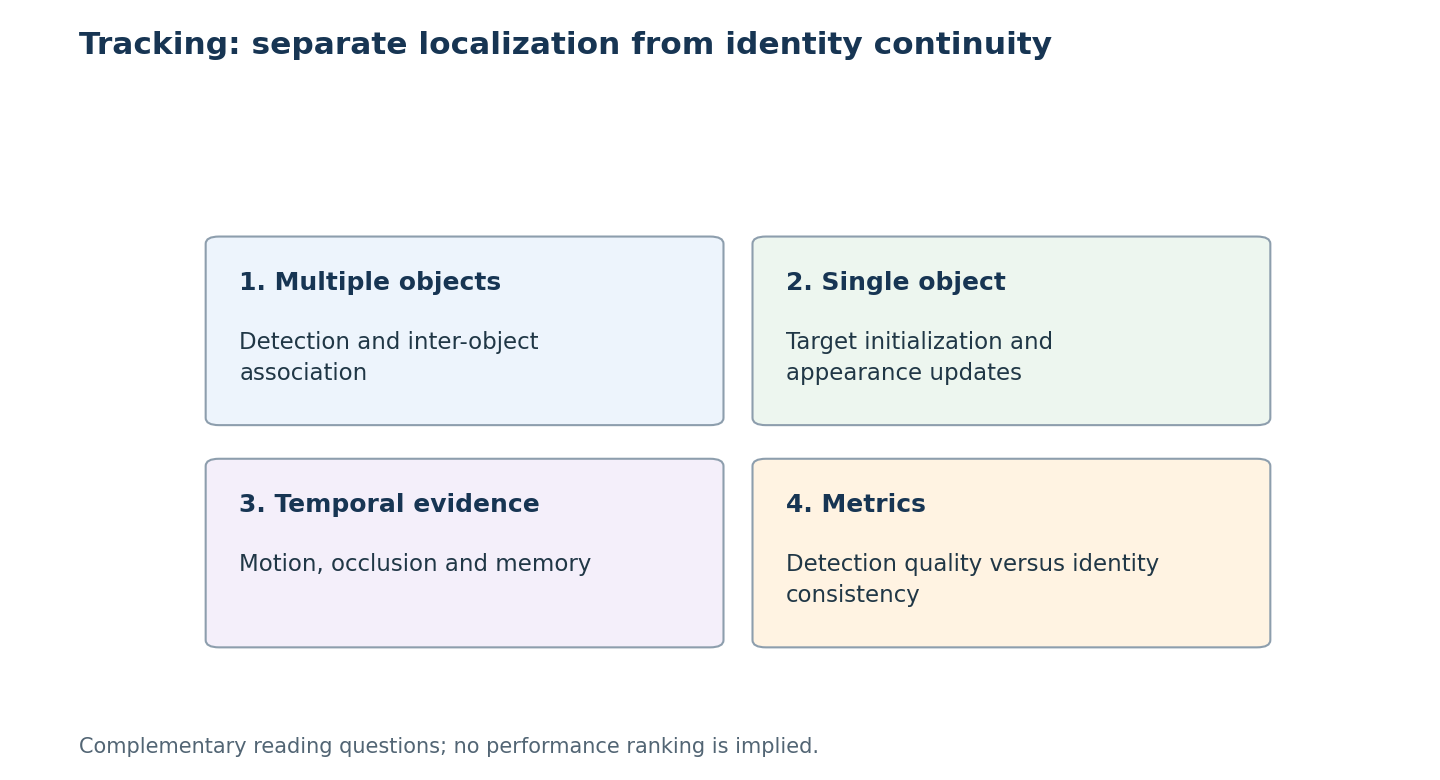
先確認是多物件或單物件追蹤,再分開檢查定位、身分連續性與時間記憶。
這則補充把「現代觀點」裡簡短的綜述清單展開:每篇綜述涵蓋什麼、如何整理這個領域,以及它的結論。
Luo 等人〈Multiple object tracking: A literature review〉[3]
(Artificial Intelligence,2021;2014 年首次公開)。經典參考文獻。它形式化定義 MOT 問題,依初始化方式(以偵測為基礎或不需偵測)、處理模式(線上或離線)與輸出型態(確定性或機率性)分類方法,並分析外觀模型、運動模型、互動模型、互斥限制與遮擋處理等元件,以及各種推論方法。想不依賴任何網路去理解問題本身,就讀這篇。
Ciaparrone 等人〈Deep learning in video multi-object tracking: A survey〉[2]
(Neurocomputing,2020)。把深度 MOT 整理成四個階段——偵測、特徵擷取/運動預測、親和度計算與關聯——並回顧深度學習如何進入每個階段。從 MOTChallenge 上的比較得到的主要結論是:大部分進步來自偵測品質與學習式外觀特徵。
Adžemović〈Deep learning-based multi-object tracking: A comprehensive survey from foundations to state-of-the-art〉[4]
(arXiv,2025)。把先偵測再追蹤分成聯合偵測與嵌入、啟發式、以運動為主、親和度學習與離線方法五類,並與端到端追蹤器比較。它指出 2022 年(ByteTrack 與 MOTR)是加速的轉捩點,並總結:啟發式追蹤器在擁擠、運動大致線性的場景領先,學習式關聯則在複雜運動上勝出。
Marvasti-Zadeh 等人〈Deep learning for visual tracking: A comprehensive survey〉[5]
(IEEE T-ITS,2022)。針對 SOT。從九個面向(網路架構、網路運用、訓練方式、目標函數、輸出、與相關濾波器的結合、空拍視角、長時追蹤與線上追蹤)分析深度追蹤器,並在 OTB、VOT、LaSOT 與空拍基準上比較。
Thangavel(Kugarajeevan)等人〈Transformers in single object tracking: An experimental survey〉[6]
(IEEE Access,2023)。把 Transformer 追蹤器分成 CNN-Transformer 混合、雙流兩階段,以及單流單階段全 Transformer 三類,並實驗評估其穩健性與效率;單流設計(OSTrack 類)成為主流模式。
Ye 等人〈Deep learning for person re-identification: A survey and outlook〉[7]
(IEEE TPAMI,2022)。把封閉世界 Re-ID(特徵學習、度量學習、排序最佳化)與開放世界 Re-ID(異質資料、原始影像、雜訊標籤、非監督與開放集合設定)分開討論,提出 AGW 基線與 mINP 指標,後者衡量找到所有正確匹配所需的代價。
Luiten 等人〈HOTA〉[8]
(IJCV,2020)。不是綜述,但它重新檢視了整個領域的評估方式,以實例與使用者研究說明 MOTA 與 IDF1 的偏差,也是目前排行榜以 HOTA 排名的原因。
如何判讀這些論文的證據
多物件追蹤 MOT 與單物件追蹤 SOT 的初始化、決策問題不同。MOT 依偵測或聯合學習維持多個身分;SOT 已給目標,須避免漂移到相似物。運動、外觀、記憶皆可有用,但關聯進步不能與更強偵測器、不同初始化混為一談。
逐項記錄公開或私有偵測、外部資料、線上或離線處理,以及消失物件如何處理。身分切換、漏偵測與定位對指標影響不同;較強偵測可提高總分,卻未隔離關聯演算法。應一起讀身分敏感、偵測敏感指標,檢查遮蔽序列,再依框遺失、身分混淆或外觀更新失敗選下一篇。
參考文獻
- Shyandram,〈物件追蹤Object Tracking 簡介〉,Medium 文章,2023;2026 年更新。連結
- G. Ciaparrone, F. Luque Sánchez, S. Tabik, L. Troiano, R. Tagliaferri and F. Herrera, “Deep learning in video multi-object tracking: A survey,” Neurocomputing, 2020. arXiv:1907.12740
- W. Luo, J. Xing, A. Milan, X. Zhang, W. Liu and T.-K. Kim, “Multiple object tracking: A literature review,” Artificial Intelligence, vol. 293, 2021 (arXiv 2014). arXiv:1409.7618
- M. Adžemović, “Deep learning-based multi-object tracking: A comprehensive survey from foundations to state-of-the-art,” arXiv:2506.13457, 2025. arXiv
- S. M. Marvasti-Zadeh, L. Cheng, H. Ghanei-Yakhdan and S. Kasaei, “Deep learning for visual tracking: A comprehensive survey,” IEEE Transactions on Intelligent Transportation Systems, vol. 23, 2022. arXiv:1912.00535
- J. Thangavel (Kugarajeevan), T. Kokul, A. Ramanan and S. Fernando, “Transformers in single object tracking: An experimental survey,” IEEE Access, vol. 11, 2023. arXiv:2302.11867
- M. Ye, J. Shen, G. Lin, T. Xiang, L. Shao and S. C. H. Hoi, “Deep learning for person re-identification: A survey and outlook,” IEEE TPAMI, vol. 44, 2022. arXiv:2001.04193
- J. Luiten, A. Ošep, P. Dendorfer, P. Torr, A. Geiger, L. Leal-Taixé and B. Leibe, “HOTA: A higher order metric for evaluating multi-object tracking,” International Journal of Computer Vision, 2020. arXiv:2009.07736
- K. Bernardin and R. Stiefelhagen, “Evaluating multiple object tracking performance: The CLEAR MOT metrics,” EURASIP Journal on Image and Video Processing, 2008. doi
- E. Ristani, F. Solera, R. S. Zou, R. Cucchiara and C. Tomasi, “Performance measures and a data set for multi-target, multi-camera tracking,” ECCV Workshop on Benchmarking Multi-Target Tracking, 2016. arXiv:1609.01775
- K. Peng, A. Mathur and A. Narayanan, “Mitigating dataset harms requires stewardship: Lessons from 1000 papers,” arXiv:2108.02922, 2021. arXiv
- L. Zheng, L. Shen, L. Tian, S. Wang, J. Wang and Q. Tian, “Scalable person re-identification: A benchmark,” ICCV, 2015. doi
- L. Wei, S. Zhang, W. Gao and Q. Tian, “Person transfer GAN to bridge domain gap for person re-identification,” CVPR, 2018. arXiv:1711.08565
- H. Luo, Y. Gu, X. Liao, S. Lai and W. Jiang, “Bag of tricks and a strong baseline for deep person re-identification,” CVPR Workshops, 2019. arXiv:1903.07071
- M. Wieczorek, B. Rychalska and J. Dąbrowski, “On the unreasonable effectiveness of centroids in image retrieval,” arXiv:2104.13643, 2021. arXiv
- S. Li, L. Sun and Q. Li, “CLIP-ReID: Exploiting vision-language model for image re-identification without concrete text labels,” AAAI, 2023. arXiv:2211.13977
- D. S. Bolme, J. R. Beveridge, B. A. Draper and Y. M. Lui, “Visual object tracking using adaptive correlation filters,” CVPR, 2010. doi
- J. F. Henriques, R. Caseiro, P. Martins and J. Batista, “High-speed tracking with kernelized correlation filters,” IEEE TPAMI, vol. 37, 2015. arXiv:1404.7584
- L. Bertinetto, J. Valmadre, J. F. Henriques, A. Vedaldi and P. H. S. Torr, “Fully-convolutional Siamese networks for object tracking,” arXiv:1606.09549, 2016 (ECCV 2016 workshops). arXiv
- B. Li, J. Yan, W. Wu, Z. Zhu and X. Hu, “High performance visual tracking with Siamese region proposal network,” CVPR, 2018. doi
- B. Ye, H. Chang, B. Ma, S. Shan and X. Chen, “Joint feature learning and relation modeling for tracking: A one-stream framework” (OSTrack), ECCV, 2022. arXiv:2203.11991
- X. Chen, H. Peng, D. Wang, H. Lu and H. Hu, “SeqTrack: Sequence to sequence learning for visual object tracking,” CVPR, 2023 (the arXiv entry was later extended as SeqTrackv2). arXiv:2304.14394
- N. Ravi, V. Gabeur, Y.-T. Hu, R. Hu, C. Ryali, T. Ma et al., “SAM 2: Segment anything in images and videos,” ICLR, 2025. arXiv:2408.00714
- C.-Y. Yang, H.-W. Huang, W. Chai, Z. Jiang and J.-N. Hwang, “SAMURAI: Adapting segment anything model for zero-shot visual tracking with motion-aware memory,” arXiv:2411.11922, 2024. arXiv
- N. Carion, L. Gustafson, Y.-T. Hu et al., “SAM 3: Segment anything with concepts,” ICLR, 2026. arXiv:2511.16719
- Y. Wu, J. Lim and M.-H. Yang, “Object tracking benchmark,” IEEE TPAMI, vol. 37, 2015. doi
- H. Fan, L. Lin, F. Yang, P. Chu, G. Deng, S. Yu et al., “LaSOT: A high-quality benchmark for large-scale single object tracking,” CVPR, 2019. arXiv:1809.07845
- L. Huang, X. Zhao and K. Huang, “GOT-10k: A large high-diversity benchmark for generic object tracking in the wild,” IEEE TPAMI, vol. 43, 2021. arXiv:1810.11981
- M. Müller, A. Bibi, S. Giancola, S. Al-Subaihi and B. Ghanem, “TrackingNet: A large-scale dataset and benchmark for object tracking in the wild,” arXiv:1803.10794, 2018 (ECCV 2018). arXiv
- R. E. Kalman, “A new approach to linear filtering and prediction problems,” Journal of Basic Engineering, vol. 82, no. 1, pp. 35–45, 1960. doi
- H. W. Kuhn, “The Hungarian method for the assignment problem,” Naval Research Logistics Quarterly, vol. 2, pp. 83–97, 1955. doi
- A. Bewley, Z. Ge, L. Ott, F. Ramos and B. Upcroft, “Simple online and realtime tracking,” ICIP, 2016. arXiv:1602.00763
- N. Wojke, A. Bewley and D. Paulus, “Simple online and realtime tracking with a deep association metric,” ICIP, 2017. doi
- Y. Zhang, P. Sun, Y. Jiang, D. Yu, F. Weng, Z. Yuan, P. Luo, W. Liu and X. Wang, “ByteTrack: Multi-object tracking by associating every detection box,” ECCV, 2022. arXiv:2110.06864
- J. Cao, J. Pang, X. Weng, R. Khirodkar and K. Kitani, “Observation-centric SORT: Rethinking SORT for robust multi-object tracking,” CVPR, 2023. arXiv:2203.14360
- N. Aharon, R. Orfaig and B.-Z. Bobrovsky, “BoT-SORT: Robust associations multi-pedestrian tracking,” arXiv:2206.14651, 2022. arXiv
- Z. Wang, L. Zheng, Y. Liu, Y. Li and S. Wang, “Towards real-time multi-object tracking” (JDE), ECCV, 2020. arXiv:1909.12605
- Y. Zhang, C. Wang, X. Wang, W. Zeng and W. Liu, “FairMOT: On the fairness of detection and re-identification in multiple object tracking,” IJCV, 2021. arXiv:2004.01888
- P. Bergmann, T. Meinhardt and L. Leal-Taixé, “Tracking without bells and whistles” (Tracktor), ICCV, 2019. arXiv:1903.05625
- F. Zeng, B. Dong, Y. Zhang, T. Wang, X. Zhang and Y. Wei, “MOTR: End-to-end multiple-object tracking with transformer,” ECCV, 2022. arXiv:2105.03247
- Y. Zhang, T. Wang and X. Zhang, “MOTRv2: Bootstrapping end-to-end multi-object tracking by pretrained object detectors,” CVPR, 2023. arXiv:2211.09791
- R. Gao, J. Qi and L. Wang, “Multiple object tracking as ID prediction” (MOTIP), CVPR, 2025. arXiv:2403.16848
- S. Li, T. Fischer, L. Ke, H. Ding, M. Danelljan and F. Yu, “OVTrack: Open-vocabulary multiple object tracking,” CVPR, 2023. arXiv:2304.08408
- A. Milan, L. Leal-Taixé, I. Reid, S. Roth and K. Schindler, “MOT16: A benchmark for multi-object tracking,” arXiv:1603.00831, 2016 (MOT16/MOT17). arXiv
- P. Dendorfer, H. Rezatofighi, A. Milan, J. Shi, D. Cremers, I. Reid, S. Roth, K. Schindler and L. Leal-Taixé, “MOT20: A benchmark for multi object tracking in crowded scenes,” arXiv:2003.09003, 2020. arXiv
- P. Sun, J. Cao, Y. Jiang, Z. Yuan, S. Bai, K. Kitani and P. Luo, “DanceTrack: Multi-object tracking in uniform appearance and diverse motion,” CVPR, 2022. arXiv:2111.14690
- Y. Cui, C. Zeng, X. Zhao, Y. Yang, G. Wu and L. Wang, “SportsMOT: A large multi-object tracking dataset in multiple sports scenes,” ICCV, 2023. arXiv:2304.05170
- F. Yu, H. Chen, X. Wang, W. Xian, Y. Chen, F. Liu, V. Madhavan and T. Darrell, “BDD100K: A diverse driving dataset for heterogeneous multitask learning,” CVPR, 2020. arXiv:1805.04687
- C. Doersch, Y. Yang, M. Vecerik, D. Gokay, A. Gupta, Y. Aytar et al., “TAPIR: Tracking any point with per-frame initialization and temporal refinement,” ICCV, 2023. arXiv:2306.08637
- N. Karaev, I. Rocco, B. Graham, N. Neverova, A. Vedaldi and C. Rupprecht, “CoTracker: It is better to track together,” ECCV, 2024. arXiv:2307.07635
- N. Karaev, I. Makarov, J. Wang, N. Neverova, A. Vedaldi and C. Rupprecht, “CoTracker3: Simpler and better point tracking by pseudo-labelling real videos,” arXiv:2410.11831, 2024. arXiv
- Z. Tang, S. Wang, D. C. Anastasiu et al., “The 9th AI City Challenge,” ICCV Workshops, 2025. arXiv:2508.13564
- VOT Challenge organizers, “The Visual Object Tracking (VOT) challenge series,” website, 2013–present. votchallenge.net
- R. Jonker and A. Volgenant, “A shortest augmenting path algorithm for dense and sparse linear assignment problems,” Computing, vol. 38, no. 4, pp. 325–340, 1987. doi
- D. F. Crouse, “On implementing 2D rectangular assignment algorithms,” IEEE Transactions on Aerospace and Electronic Systems, vol. 52, no. 4, pp. 1679–1696, 2016. doi