CPGA-Net+:注意力、BDSF 與較強版本
選讀・DLCV 09C・低光影像增強 的論文導讀(第 11/13 篇)。引用編號對應本頁底部的參考文獻。
導覽:本頁與本系列: 導覽:本頁與本系列
本頁內容
- KinD:修復反射率,另外控制照明
- Retinex-Net:分解、調光、去雜訊
- EnlightenGAN:未配對外觀與內容約束
- Zero-DCE/Zero-DCE++:沒有參考影像的曲線學習
- RUAS:搜尋展開模型中的先驗
- SCI:訓練校準,部署一個照明區塊
- Retinexformer:以照明引導復原
- IAT:局部仿射圖與全域相機式轉換
- Multinex:以解析先驗融合出 Retinex 殘差
- CPGA-Net:通道先驗、gamma 估計與學習式融合
- CPGA-Net+:注意力、BDSF 與較強版本
- HDRNet:Deep bilateral learning for real-time image enhancement
- 影像自適應 3D LUT(Zeng 等人,TPAMI 2022)
電腦視覺深度學習
挑戰
CPGA-Net+ [40] 研究局部與全域路徑如何互相引導,再探索推論時移除運算。核對的來源為 arXiv v4,2025 年修訂題名為「Rethinking Theoretical Illumination for Efficient Low-Light Image Enhancement」。其中包含基礎版、BDSF、CPGA-Net++,這些名稱代表不同配置。
方法
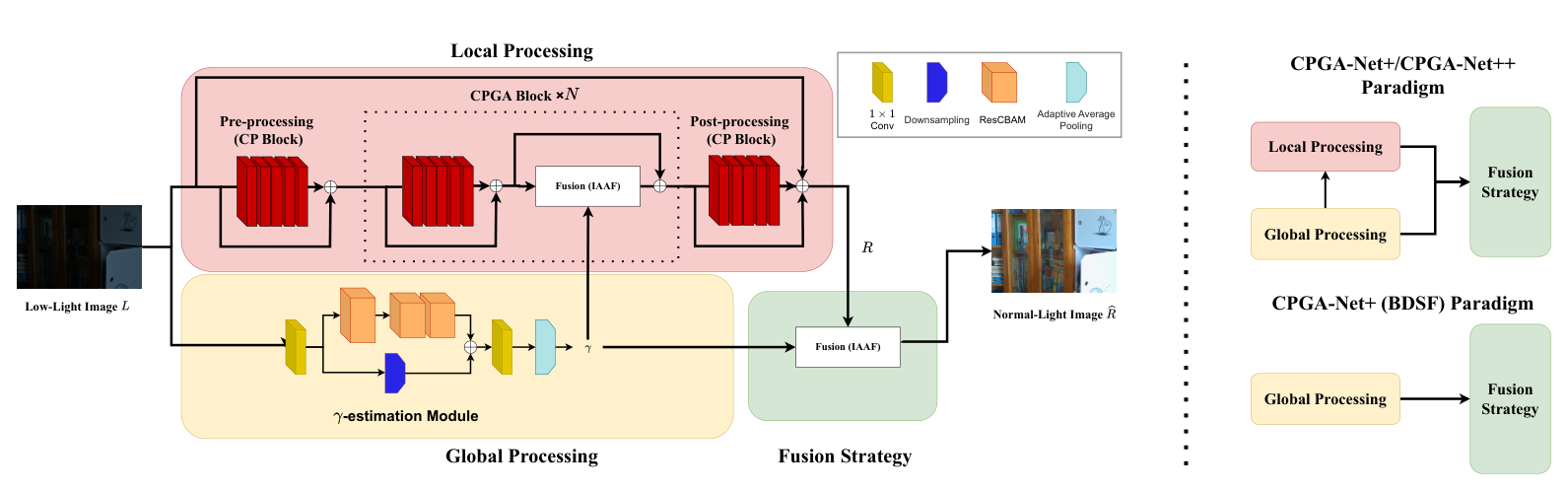
圖片來源: [40], PDF 第 4 頁. 原始 PDF.
把重建形式變成特徵調變。 動機中的代數重排為
的角色同前一則 CPGA-Net 導讀。係數和為一,但不一定是凸組合:若物理透射率滿足 ,則 ,另一係數非正。因此,可學習的特徵係數應視為模型參數,不是經校準的影像可信機率。
CP 區塊估計依通道先驗而定的調變與互補特徵場,再於特徵空間套用重建式組合。殘差連接保留先前表示,基礎版使用兩個 CP 區塊。全域分支預測 gamma,插入式 gamma/融合模組把全域處理帶入局部路徑,不必等到最後輸出才互動。
最後的融合使用 gamma 轉換候選、局部候選與可學習的交集修正。公開基礎版明確計算指數與修正,再限制輸出範圍。與 CPGA-Net 相同,此交集是可訓練的影像狀張量,而非數學上的集合交集。
BDSF 移除已訓練路徑。 區塊設計簡化(Block Design Simplification)利用觀察到的局部路徑近恆等行為,以繼承權重執行全域路徑。其有效性是由指定權重比較支持的經驗近似;光靠殘差架構,不能保證每一條已訓練局部路徑都可無誤差刪除。
較強配置改變融合。 CPGA-Net++ 加入 ConvNeXt 式區塊與空間評分融合,包含異質局部/全域輸入。這會改變中間映射,使相同的直接移除策略無法維持行為;原文的較強版高效率變體需要微調。
監督訓練結合像素 L1、VGG 感知、SSIM 與色調映射後的 HDR L1。色調映射強調不同動態範圍的差異,但將它用在 sRGB 上,不會讓訓練目標變成量測到的 HDR 輻射值。原文也研究無參考訓練,那是另一種監督制度。
讀圖與選用判斷。 分開閱讀擴充架構與權重選擇、微調程序。架構決定可執行哪些轉換,訓練與權重繼承則決定實際評估哪個實例。同樣地,係數總和為一不代表係數皆非負,因此這個條件本身不構成凸組合。比較基礎版、加強版與進一步微調版本時,須記錄權重來源及額外訓練;否則可能把品質差異歸因於模組圖,卻忽略評估同時改變了學得的參數與訓練歷程。
結果
原表 I/IV 的基礎 CPGA-Net+ 在 LOL-v1 為 22.53 dB/0.812 SSIM/0.205 LPIPS。完整基礎版有 0.060M 參數、9.356G 運算;BDSF 為 0.020M、2.141G,顯示的影像品質數值相同。
表 V 的 CPGA-Net++ 為 22.24/0.835/0.136,相對基礎版 22.53/0.812/0.205,改善結構/感知指標卻降低 PSNR。不同偏好不應被壓縮成普遍的「更好」標籤。
消融實驗
表 IV 比較只有局部、只有全域、平行分支與插入式互動。只訓練全域路徑為 22.08 dB,完整互動為 22.53。BDSF 列繼承完整模型權重,不能和獨立訓練縮減路徑混為一談。
表 VI 的零、二、四個 CP 區塊,分別得到 20.56、22.53、21.93 dB;增加區塊並未單調改善。表 VII 分開加入各損失,再組合四者得到 22.53 dB,測試的是最佳化配方與架構。
表 V 中,經微調的高效率 CPGA-Net++ 降至 21.28/0.800/0.220。這不同於基礎版 BDSF 所呈現的近似無損移除結果。
結論
貢獻同時包含結構化互動機制,以及哪些已訓練運算可以移除的研究。比較品質與成本時,應區分基礎版、BDSF、較強融合與較強版壓縮。
限制與問題
近恆等剪枝可能在不同訓練配方或部署領域失效。逆透射率、學習式注意力與混合權重,不是可以交換使用的物理量。原文顯示極暗影像仍有顆粒狀偽影;全域 gamma 與融合結構,都無法恢復已被截斷或雜訊破壞的證據。應驗證實際版本、旗標、權重與裝置。
參考文獻
- Shyandram, “簡介Deep Learning Low-Light Image Enhancement (LLIE)” (Introduction to deep-learning low-light image enhancement, in Chinese), Medium post, 2024; updated 2026. link
- A. Foi, M. Trimeche, V. Katkovnik and K. Egiazarian, “Practical Poissonian-Gaussian noise modeling and fitting for single-image raw-data,” IEEE Transactions on Image Processing, vol. 17, no. 10, pp. 1737–1754, 2008. doi
- K. He, J. Sun and X. Tang, “Single image haze removal using dark channel prior,” IEEE Transactions on Pattern Analysis and Machine Intelligence, vol. 33, no. 12, pp. 2341–2353, 2011. doi
- X. Guo, Y. Li and H. Ling, “LIME: Low-light image enhancement via illumination map estimation,” IEEE Transactions on Image Processing, vol. 26, no. 2, pp. 982–993, 2017. doi
- ITU-R, “Recommendation BT.601-7: Studio encoding parameters of digital television for standard 4:3 and wide-screen 16:9 aspect ratios,” 2011. ITU
- Q. Yan, Y. Feng, C. Zhang, et al., “HVI: A new color space for low-light image enhancement,” in Proc. IEEE/CVF CVPR, 2025. arXiv
- S. M. Pizer, E. P. Amburn, J. D. Austin, et al., “Adaptive histogram equalization and its variations,” Computer Vision, Graphics, and Image Processing, vol. 39, no. 3, pp. 355–368, 1987. doi
- K. Zuiderveld, “Contrast limited adaptive histogram equalization,” in Graphics Gems IV, Academic Press, 1994, pp. 474–485. doi
- E. H. Land, “The retinex theory of color vision,” Scientific American, vol. 237, no. 6, pp. 108–128, 1977. doi
- D. J. Jobson, Z. Rahman and G. A. Woodell, “Properties and performance of a center/surround retinex,” IEEE Transactions on Image Processing, vol. 6, pp. 451–462, 1997. doi
- D. J. Jobson, Z. Rahman and G. A. Woodell, “A multiscale retinex for bridging the gap between color images and the human observation of scenes,” IEEE Transactions on Image Processing, vol. 6, no. 7, pp. 965–976, 1997. doi
- X. Dong, Y. Pang and J. Wen, “Fast efficient algorithm for enhancement of low lighting video,” ACM SIGGRAPH 2010 Posters, 2010. SIGGRAPH history doi
- S. Wang, J. Zheng, H.-M. Hu and B. Li, “Naturalness preserved enhancement algorithm for non-uniform illumination images,” IEEE Transactions on Image Processing, vol. 22, no. 9, pp. 3538–3548, 2013. doi
- C. Lee, C. Lee and C.-S. Kim, “Contrast enhancement based on layered difference representation of 2D histograms,” IEEE Transactions on Image Processing, vol. 22, no. 12, pp. 5372–5384, 2013. doi
- C. Li, C. Guo, L. Han, J. Jiang, M.-M. Cheng, J. Gu and C. C. Loy, “Low-light image and video enhancement using deep learning: A survey,” IEEE Transactions on Pattern Analysis and Machine Intelligence, vol. 44, no. 12, pp. 9396–9416, 2022. arXiv
- C. Wei, W. Wang, W. Yang and J. Liu, “Deep retinex decomposition for low-light enhancement,” in Proc. British Machine Vision Conference (BMVC), 2018. arXiv project
- Y. Jiang, X. Gong, D. Liu, et al., “EnlightenGAN: Deep light enhancement without paired supervision,” IEEE Transactions on Image Processing, vol. 30, pp. 2340–2349, 2021. arXiv
- C. Guo, C. Li, J. Guo, et al., “Zero-reference deep curve estimation for low-light image enhancement,” in Proc. IEEE/CVF CVPR, 2020, pp. 1777–1786. arXiv
- C. Li, C. Guo and C. C. Loy, “Learning to enhance low-light image via zero-reference deep curve estimation,” IEEE Transactions on Pattern Analysis and Machine Intelligence, vol. 44, no. 8, 2022. arXiv
- R. Liu, L. Ma, J. Zhang, X. Fan and Z. Luo, “Retinex-inspired unrolling with cooperative prior architecture search for low-light image enhancement,” in Proc. IEEE/CVF CVPR, 2021, pp. 10556–10565. arXiv
- L. Ma, T. Ma, R. Liu, X. Fan and Z. Luo, “Toward fast, flexible, and robust low-light image enhancement,” in Proc. IEEE/CVF CVPR, 2022, pp. 5627–5636. arXiv
- Y. Cai, H. Bian, J. Lin, H. Wang, R. Timofte and Y. Zhang, “Retinexformer: One-stage Retinex-based transformer for low-light image enhancement,” in Proc. IEEE/CVF ICCV, 2023. arXiv code
- Y. Wang, R. Wan, W. Yang, H. Li, L.-P. Chau and A. C. Kot, “Low-light image enhancement with normalizing flow,” in Proc. AAAI Conference on Artificial Intelligence, vol. 36, no. 3, pp. 2604–2612, 2022. arXiv
- X. Yi, H. Xu, H. Zhang, L. Tang and J. Ma, “Diff-Retinex: Rethinking low-light image enhancement with a generative diffusion model,” in Proc. IEEE/CVF ICCV, 2023. arXiv
- J. Hou, Z. Zhu, J. Hou, H. Liu, H. Zeng and H. Yuan, “Global structure-aware diffusion process for low-light image enhancement,” in Advances in Neural Information Processing Systems (NeurIPS), 2023. arXiv
- H. Jiang, A. Luo, X. Liu, S. Han and S. Liu, “LightenDiffusion: Unsupervised low-light image enhancement with latent-Retinex diffusion models,” in Proc. European Conference on Computer Vision (ECCV), 2024. arXiv
- C. He, C. Fang, Y. Zhang, et al., “Reti-Diff: Illumination degradation image restoration with Retinex-based latent diffusion model,” in Proc. International Conference on Learning Representations (ICLR), 2025. proceedings
- M. Gharbi, J. Chen, J. T. Barron, S. W. Hasinoff and F. Durand, “Deep bilateral learning for real-time image enhancement,” ACM Transactions on Graphics (Proc. SIGGRAPH), vol. 36, no. 4, art. 118, 2017. doi arXiv
- H. Zeng, J. Cai, L. Li, Z. Cao and L. Zhang, “Learning image-adaptive 3D lookup tables for high performance photo enhancement in real-time,” IEEE Transactions on Pattern Analysis and Machine Intelligence, vol. 44, no. 4, 2022. doi arXiv
- K. G. Lore, A. Akintayo and S. Sarkar, “LLNet: A deep autoencoder approach to natural low-light image enhancement,” Pattern Recognition, vol. 61, pp. 650–662, 2017. doi
- L. Tao, C. Zhu, J. Song, T. Lu, H. Jia and X. Xie, “Low-light image enhancement using CNN and bright channel prior,” in Proc. IEEE International Conference on Image Processing (ICIP), 2017, pp. 3215–3219. doi
- S. W. Zamir, A. Arora, S. Khan, et al., “Learning enriched features for real image restoration and enhancement,” in Proc. European Conference on Computer Vision (ECCV), 2020, pp. 492–511. arXiv
- X. Xu, R. Wang, C.-W. Fu and J. Jia, “SNR-aware low-light image enhancement,” in Proc. IEEE/CVF CVPR, 2022, pp. 17693–17703. doi
- Z. Cui, K. Li, L. Gu, S. Su, P. Gao, Z. Jiang, Y. Qiao and T. Harada, “You only need 90K parameters to adapt light: A light weight transformer for image enhancement and exposure correction,” in Proc. British Machine Vision Conference (BMVC), 2022. paper arXiv
- X. Ding, X. Zhang, N. Ma, J. Han, G. Ding and J. Sun, “RepVGG: Making VGG-style ConvNets great again,” in Proc. IEEE/CVF CVPR, 2021, pp. 13728–13737. doi arXiv
- Y. Zhang, J. Zhang and X. Guo, “Kindling the darkness: A practical low-light image enhancer,” in Proc. ACM International Conference on Multimedia (ACM MM), 2019, pp. 1632–1640. doi
- Y. Zhang, X. Guo, J. Ma, W. Liu and J. Zhang, “Beyond brightening low-light images,” International Journal of Computer Vision, vol. 129, no. 4, pp. 1013–1037, 2021. doi
- J. Bai, Y. Yin, Q. He, Y. Li and X. Zhang, “RetinexMamba: Retinex-based Mamba for low-light image enhancement,” arXiv:2405.03349, 2024. arXiv
- S.-E. Weng, S.-G. Miaou and R. Christanto, “A lightweight low-light image enhancement network via channel prior and gamma correction,” International Journal of Pattern Recognition and Artificial Intelligence, vol. 39, no. 12, art. 2554013, 2025. doi code manuscript
- S.-E. Weng, C.-Y. Hsiao, L.-W. Lu, et al., “Rethinking theoretical illumination for efficient low-light image enhancement” (CPGA-Net+), arXiv:2409.05274, 2024. arXiv
- W. Wu, J. Weng, P. Zhang, X. Wang, W. Yang and J. Jiang, “URetinex-Net: Retinex-based deep unfolding network for low-light image enhancement,” in Proc. IEEE/CVF CVPR, 2022, pp. 5891–5900. doi
- Z. Liang, C. Li, S. Zhou, R. Feng and C. C. Loy, “Iterative prompt learning for unsupervised backlit image enhancement,” in Proc. IEEE/CVF ICCV, 2023. arXiv
- C. Yang, M. Jin, X. Jia, Y. Xu and Y. Chen, “AdaInt: Learning adaptive intervals for 3D lookup tables on real-time image enhancement,” in Proc. IEEE/CVF CVPR, 2022, pp. 17522–17531. CVF arXiv
- C. Yang, M. Jin, Y. Xu, R. Zhang, Y. Chen and H. Liu, “SepLUT: Separable image-adaptive lookup tables for real-time image enhancement,” in Proc. European Conference on Computer Vision (ECCV), 2022, pp. 201–217. doi arXiv
- T. Wang, Y. Li, J. Peng, Y. Ma, X. Wang, F. Song and Y. Yan, “Real-time image enhancer via learnable spatial-aware 3D lookup tables,” in Proc. IEEE/CVF ICCV, 2021, pp. 2471–2480. CVF arXiv
- C. Liu, H. Yang, J. Fu and X. Qian, “4D LUT: Learnable context-aware 4D lookup table for image enhancement,” IEEE Transactions on Image Processing, vol. 32, pp. 4742–4756, 2023. doi arXiv
- W. Kim and N. I. Cho, “Image-adaptive 3D lookup tables for real-time image enhancement with bilateral grids,” in Proc. European Conference on Computer Vision (ECCV), 2024, pp. 91–108. doi ECCV
- C. Chen, Q. Chen, J. Xu and V. Koltun, “Learning to see in the dark,” in Proc. IEEE/CVF CVPR, 2018, pp. 3291–3300. arXiv
- M. V. Conde, G. Geigle and R. Timofte, “InstructIR: High-quality image restoration following human instructions,” in Proc. European Conference on Computer Vision (ECCV), 2024. arXiv
- Z. Cui, G.-J. Qi, L. Gu, S. You, Z. Zhang and T. Harada, “Multitask AET with orthogonal tangent regularity for dark object detection,” in Proc. IEEE/CVF ICCV, 2021. arXiv
- K. A. Hashmi, G. Kallempudi, D. Stricker and M. Z. Afzal, “FeatEnHancer: Enhancing hierarchical features for object detection and beyond under low-light vision,” in Proc. IEEE/CVF ICCV, 2023. arXiv
- M. Dehghani, A. Arnab, L. Beyer, A. Vaswani and Y. Tay, “The efficiency misnomer,” in Proc. International Conference on Learning Representations (ICLR), 2022. ICLR arXiv
- A. Ignatov, R. Timofte, S. Liu, et al., “Learned smartphone ISP on mobile GPUs with deep learning, Mobile AI & AIM 2022 challenge: Report,” in Proc. European Conference on Computer Vision (ECCV) Workshops, 2023, pp. 44–70. doi arXiv
- Z. Wang, A. C. Bovik, H. R. Sheikh and E. P. Simoncelli, “Image quality assessment: From error visibility to structural similarity,” IEEE Transactions on Image Processing, vol. 13, no. 4, pp. 600–612, 2004. doi
- R. Zhang, P. Isola, A. A. Efros, E. Shechtman and O. Wang, “The unreasonable effectiveness of deep features as a perceptual metric,” in Proc. IEEE/CVF CVPR, 2018. arXiv
- K. Ma, K. Zeng and Z. Wang, “Perceptual quality assessment for multi-exposure image fusion,” IEEE Transactions on Image Processing, vol. 24, no. 11, pp. 3345–3356, 2015. doi
- V. Vonikakis, “Datasets” (source of the VV test images), personal web page. link
- A. Mittal, R. Soundararajan and A. C. Bovik, “Making a ‘completely blind’ image quality analyzer,” IEEE Signal Processing Letters, vol. 20, no. 3, pp. 209–212, 2013. doi
- A. Mittal, A. K. Moorthy and A. C. Bovik, “No-reference image quality assessment in the spatial domain,” IEEE Transactions on Image Processing, vol. 21, no. 12, pp. 4695–4708, 2012. doi
- Y. Blau, R. Mechrez, R. Timofte, T. Michaeli and L. Zelnik-Manor, “The 2018 PIRM challenge on perceptual image super-resolution,” in Proc. European Conference on Computer Vision (ECCV) Workshops, 2018. arXiv
- C. Ma, C.-Y. Yang, X. Yang and M.-H. Yang, “Learning a no-reference quality metric for single-image super-resolution,” Computer Vision and Image Understanding, vol. 158, pp. 1–16, 2017. doi arXiv
- D. Hasler and S. E. Süsstrunk, “Measuring colorfulness in natural images,” in Proc. SPIE 5007, Human Vision and Electronic Imaging VIII, 2003. doi
- J. Immerkær, “Fast noise variance estimation,” Computer Vision and Image Understanding, vol. 64, no. 2, pp. 300–302, 1996. doi
- J. Liao, S. Hao, R. Hong and M. Wang, “GT-Mean loss: A simple yet effective solution for brightness mismatch in low-light image enhancement,” in Proc. IEEE/CVF ICCV, 2025. arXiv
- Y. P. Loh and C. S. Chan, “Getting to know low-light images with the Exclusively Dark dataset,” Computer Vision and Image Understanding, vol. 178, pp. 30–42, 2019. arXiv
- F. Liu and L. Fan, “A review of advancements in low-light image enhancement using deep learning,” Neurocomputing, vol. 652, art. 131052, 2025. arXiv
- J. Liu, D. Xu, W. Yang, M. Fan and H. Huang, “Benchmarking low-light image enhancement and beyond,” International Journal of Computer Vision, vol. 129, no. 4, pp. 1153–1184, 2021. doi project
- W. Yang, W. Wang, H. Huang, S. Wang and J. Liu, “Sparse gradient regularized deep Retinex network for robust low-light image enhancement,” IEEE Transactions on Image Processing, vol. 30, pp. 2072–2086, 2021. doi
- J. Hai, Z. Xuan, R. Yang, et al., “R2RNet: Low-light image enhancement via Real-low to Real-normal Network,” Journal of Visual Communication and Image Representation, vol. 90, art. 103712, 2023. arXiv
- R. Wang, X. Xu, C.-W. Fu, et al., “Seeing dynamic scene in the dark: A high-quality video dataset with mechatronic alignment,” in Proc. IEEE/CVF ICCV, 2021, pp. 9680–9689. doi code
- V. Bychkovsky, S. Paris, E. Chan and F. Durand, “Learning photographic global tonal adjustment with a database of input/output image pairs,” in Proc. IEEE CVPR, 2011, pp. 97–104. dataset
- J. Cai, S. Gu and L. Zhang, “Learning a deep single image contrast enhancer from multi-exposure images,” IEEE Transactions on Image Processing, vol. 27, no. 4, pp. 2049–2062, 2018. doi
- X. Liu, Z. Wu, A. Li, et al., “NTIRE 2024 challenge on low light image enhancement: Methods and results,” in Proc. IEEE/CVF CVPR Workshops, 2024. arXiv
- X. Liu, Z. Wu, F.-A. Vasluianu, et al., “NTIRE 2025 challenge on low light image enhancement: Methods and results,” in Proc. IEEE/CVF CVPR Workshops, 2025. arXiv
- S. Zheng, Y. Ma, J. Pan, C. Lu and G. Gupta, “Low-light image and video enhancement: A comprehensive survey and beyond,” arXiv:2212.10772, 2022. arXiv
- E. Adhikarla, Y. Liu and B. D. Davison, “Diffusion models for low-light image enhancement: A multi-perspective taxonomy and performance analysis,” arXiv:2510.05976, 2025. arXiv
- J. Yan, C. Tu, W. Zhang, Z. Wang, P. Cao, Q. Lin, Y. Fang, X. Liu, Z. Wu, Z. Zhou and R. Timofte, “NTIRE 2026 challenge on efficient low light image enhancement: Methods and results,” NTIRE 2026 workshop report, arXiv:2605.02212, 2026. arXiv
- O. Ronneberger, P. Fischer and T. Brox, “U-Net: Convolutional networks for biomedical image segmentation,” in Proc. Medical Image Computing and Computer-Assisted Intervention (MICCAI), 2015, pp. 234–241. doi arXiv
- J. Chen, A. Adams, N. Wadhwa and S. W. Hasinoff, “Bilateral guided upsampling,” ACM Transactions on Graphics (Proc. SIGGRAPH Asia), vol. 35, no. 6, 2016. doi project
- K. He, J. Sun and X. Tang, “Guided image filtering,” IEEE Transactions on Pattern Analysis and Machine Intelligence, vol. 35, no. 6, pp. 1397–1409, 2013. doi
- C. Chen and J. Mo, “IQA-PyTorch: PyTorch toolbox for image quality assessment,” software (pip package
pyiqa). GitHub - J. Ke, Q. Wang, Y. Wang, P. Milanfar and F. Yang, “MUSIQ: Multi-scale image quality transformer,” in Proc. IEEE/CVF ICCV, 2021. arXiv
- J. Wang, K. C. K. Chan and C. C. Loy, “Exploring CLIP for assessing the look and feel of images,” in Proc. AAAI Conference on Artificial Intelligence, 2023. arXiv
- V. Kannan, S. Malik, N. C. Babu and R. Soundararajan, “Quality assessment of low-light restored images: A subjective study and an unsupervised model,” IEEE Access, vol. 11, pp. 68216–68230, 2023. doi arXiv
- ITU-R, “Recommendation BT.500-15: Methodologies for the subjective assessment of the quality of television images,” 2023. ITU
- R. A. Bradley and M. E. Terry, “Rank analysis of incomplete block designs: The method of paired comparisons,” Biometrika, vol. 39, no. 3–4, pp. 324–345, 1952. doi
- H. Talebi and P. Milanfar, “NIMA: Neural image assessment,” IEEE Transactions on Image Processing, 2018. arXiv
- S. Yang, T. Wu, S. Shi, et al., “MANIQA: Multi-dimension attention network for no-reference image quality assessment,” in Proc. IEEE/CVF CVPR Workshops, 2022, pp. 1190–1199. doi arXiv
- H. Wu, Z. Zhang, W. Zhang, C. Chen, et al., “Q-Align: Teaching LMMs for visual scoring via discrete text-defined levels,” in Proc. International Conference on Machine Learning (ICML), PMLR 235, 2024. arXiv
- A. G. Howard, M. Zhu, B. Chen, D. Kalenichenko, W. Wang, T. Weyand, M. Andreetto and H. Adam, “MobileNets: Efficient convolutional neural networks for mobile vision applications,” arXiv:1704.04861, 2017. arXiv
- M. Sandler, A. Howard, M. Zhu, A. Zhmoginov and L.-C. Chen, “MobileNetV2: Inverted residuals and linear bottlenecks,” in Proc. IEEE/CVF CVPR, 2018, pp. 4510–4520. doi arXiv
- W.-S. Lai, J.-B. Huang, O. Wang, E. Shechtman, E. Yumer and M.-H. Yang, “Learning blind video temporal consistency,” in Proc. European Conference on Computer Vision (ECCV), 2018, pp. 179–195. doi arXiv
- S. W. Hasinoff, D. Sharlet, R. Geiss, A. Adams, J. T. Barron, F. Kainz, J. Chen and M. Levoy, “Burst photography for high dynamic range and low-light imaging on mobile cameras,” ACM Transactions on Graphics (Proc. SIGGRAPH Asia), vol. 35, no. 6, 2016. doi
- J. Chen, S. Paris and F. Durand, “Real-time edge-aware image processing with the bilateral grid,” ACM Transactions on Graphics (Proc. SIGGRAPH), vol. 26, no. 3, art. 103, 2007. doi
- C. Tomasi and R. Manduchi, “Bilateral filtering for gray and color images,” in Proc. IEEE International Conference on Computer Vision (ICCV), 1998, pp. 839–846. doi
- S. Paris and F. Durand, “A fast approximation of the bilateral filter using a signal processing approach,” International Journal of Computer Vision, vol. 81, no. 1, pp. 24–52, 2009. doi
- H. Wu, S. Zheng, J. Zhang and K. Huang, “Fast end-to-end trainable guided filter,” in Proc. IEEE/CVF CVPR, 2018, pp. 1838–1847. doi arXiv
- R. Wang, Q. Zhang, C.-W. Fu, X. Shen, W.-S. Zheng and J. Jia, “Underexposed photo enhancement using deep illumination estimation,” in Proc. IEEE/CVF CVPR, 2019, pp. 6842–6850. doi CVF
- Y. Lin, Z. Fu, K. Wen, T. Ye, S. Chen, G. Meng, Y. Wang, et al., “DPLUT: Unsupervised low-light image enhancement with lookup tables and diffusion priors,” in Proc. AAAI Conference on Artificial Intelligence, vol. 39, no. 5, pp. 5316–5324, 2025. doi arXiv
- K. Dabov, A. Foi, V. Katkovnik and K. Egiazarian, “Image denoising by sparse 3-D transform-domain collaborative filtering,” IEEE Transactions on Image Processing, 2007. doi
- K. Simonyan and A. Zisserman, “Very deep convolutional networks for large-scale image recognition,” ICLR, 2015. arXiv
- J. Deng, W. Dong, R. Socher, L.-J. Li, K. Li and L. Fei-Fei, “ImageNet: A large-scale hierarchical image database,” CVPR, 2009. doi
- A. Brateanu, T. Mu, C. O. Ancuti and C. Ancuti, “Multinex: Lightweight Low-light Image Enhancement via Multi-prior Retinex,” in Proc. IEEE/CVF CVPR, 2026. paper supplement