Latent Diffusion:先壓縮感知資訊,再學習影像分布
選讀・DLCV 12・影像生成:從 GAN 到文字生成影像系統 的論文導讀(第 1/3 篇)。引用編號對應本頁底部的參考文獻。
導覽:本頁與本系列: 導覽:本頁與本系列
挑戰
像素空間擴散反覆處理大型網格,即使其中許多細節可以更精簡地表示。Rombach 等人的 CVPR 2022 Latent Diffusion Models 論文 [5],把學習有用的影像表示,與學習此表示上的分布分開。關鍵取捨是:壓縮到什麼程度能省運算,又不先丟掉生成器應產生的細節?
方法
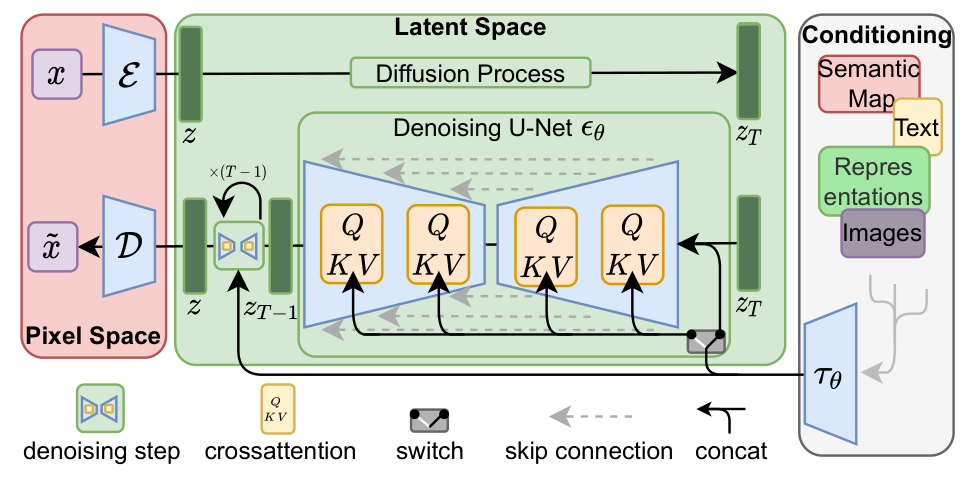
先訓練影像表示。 編碼器 把 RGB 影像 映射為 ,解碼器 重建 。空間壓縮倍率為 , 是潛在通道數。感知重建與區塊對抗訓練鼓勵具影像外觀的重建,而不只追求低像素誤差。
原文研究較弱的 KL 正規化與向量量化正規化。後者將量化器吸收進解碼器,後續擴散仍在空間潛在表示上運作,與自迴歸生成器逐一選擇離散碼本索引不同。
固定表示,再訓練先驗。 帶雜訊潛在與條件去雜訊目標可寫為
是擴散時間步, 是保留的訊號功率比例, 為標準高斯雜訊, 是去雜訊 U-Net, 為條件, 將條件編碼。期望值平均訓練樣本、雜訊與時間步;先驗訓練期間固定自編碼器。
依資訊形式選擇條件機制。 空間對齊的資訊可與帶雜訊潛在串接;交叉注意力則讓特徵網格讀取文字等未對齊序列。影像特徵提供查詢,條件特徵提供鍵與值,再把注意力加權結果放進 U-Net,並不強迫每個詞對應唯一區塊。
推論先對潛在去雜訊,最後解碼一次。自編碼器、文字編碼器雖非每步都執行,仍屬完整系統成本。原始文字生成實驗使用學習式語言條件元件;不能把這篇論文當成所有後續 Stable Diffusion 權重與文字編碼器的統一規格。
讀圖與選用判斷。 先追蹤影像經過自動編碼器,再看較小潛在網格上的擴散。這也提供檢查順序:先確認編碼、解碼能否保留關心的細節,再評估潛在先驗能否生成它。若重建階段就已失敗,不能只把問題歸到去雜訊取樣器。生成時文字作為條件,潛在取樣完成後由解碼器輸出影像;推論時沒有原始目標影像可供比較。若用於修復,還必須明確說明觀測量測如何限制這條生成路徑。
結果
原表 1 的 FFHQ、LDM-4、200 步 DDIM,為 FID 4.98、precision 0.73、recall 0.50。表 2 的 MS-COCO 文字條件生成,未用無分類器引導時 FID 為 23.35,使用尺度 1.5 引導後為 12.61,採 250 步 DDIM。條件強度改變是實驗設定的一部分,不能當成可隨意替換的評估細節。
原文也研究版面條件、超解析度與修補。影像生成基準支持學習影像分布的效益,並未證明生成細節對應未觀測到的真實場景。
消融實驗
第 4.1 節比較壓縮倍率 1、2、4、8、16、32,讓擴散模型參數、訓練步數與單張 A100 計算條件具有可比性。壓縮太少,需把訓練花在昂貴像素細節;壓縮太多,則在擴散開始前就流失資訊。圖 5–6 支持中等壓縮,尤其倍率 4、8 的品質/吞吐量取捨。
第一階段重建與下游生成的比較回答不同問題。自編碼器重建改善可能有幫助,但不保證有限容量先驗也能同樣容易地學好新潛在分布。減少步數則改變取樣器實驗,而非只改變自編碼器。
結論
LDM 建立兩階段設計:先學會感知上有用的空間碼,再於該碼學習條件分布。壓縮、條件、先驗容量與取樣,各有獨立角色。
限制與問題
解碼器無法可靠恢復被壓縮丟棄的精確證據。感知/對抗重建可能偏好合理外觀而非像素忠實度。文字條件不保證拼字、計數或來源歸屬;訓練分布也限制先驗能表示的概念。用於修復時,一般潛在擴散只提供先驗,量測一致性須另有機制。
參考文獻
- T. Karras, S. Laine and T. Aila, “A Style-Based Generator Architecture for Generative Adversarial Networks,” CVPR, 2019. arXiv
- A. Brock, J. Donahue and K. Simonyan, “Large Scale GAN Training for High Fidelity Natural Image Synthesis,” ICLR, 2019. arXiv
- W. Peebles and S. Xie, “Scalable Diffusion Models with Transformers,” ICCV, 2023. CVF
- C. Saharia, W. Chan, S. Saxena et al., “Photorealistic Text-to-Image Diffusion Models with Deep Language Understanding,” NeurIPS, 2022. arXiv · project page
- R. Rombach, A. Blattmann, D. Lorenz, P. Esser and B. Ommer, “High-Resolution Image Synthesis with Latent Diffusion Models,” CVPR, 2022. CVF
- C. Meng, Y. He, Y. Song et al., “SDEdit: Guided Image Synthesis and Editing with Stochastic Differential Equations,” ICLR, 2022. arXiv
- L. Zhang, A. Rao and M. Agrawala, “Adding Conditional Control to Text-to-Image Diffusion Models,” ICCV, 2023. CVF
- A. Hertz, R. Mokady, J. Tenenbaum et al., “Prompt-to-Prompt Image Editing with Cross-Attention Control,” ICLR, 2023. arXiv
- T. Brooks, A. Holynski and A. A. Efros, “InstructPix2Pix: Learning to Follow Image Editing Instructions,” CVPR, 2023. CVF
- A. Lugmayr, M. Danelljan, A. Romero et al., “RePaint: Inpainting using Denoising Diffusion Probabilistic Models,” CVPR, 2022. CVF
- J. Ho and T. Salimans, “Classifier-Free Diffusion Guidance,” NeurIPS 2021 Workshop on Deep Generative Models and Downstream Applications; arXiv:2207.12598, 2022. arXiv
- I. J. Goodfellow, J. Pouget-Abadie, M. Mirza et al., “Generative Adversarial Nets,” NeurIPS, 2014. arXiv
- D. P. Kingma and M. Welling, “Auto-Encoding Variational Bayes,” ICLR, 2014. arXiv
- A. van den Oord, O. Vinyals and K. Kavukcuoglu, “Neural Discrete Representation Learning,” NeurIPS, 2017. arXiv
- P. Esser, R. Rombach and B. Ommer, “Taming Transformers for High-Resolution Image Synthesis,” CVPR, 2021. CVF
- J. Ho, A. Jain and P. Abbeel, “Denoising Diffusion Probabilistic Models,” NeurIPS, 2020. arXiv
- P. Dhariwal and A. Nichol, “Diffusion Models Beat GANs on Image Synthesis,” NeurIPS, 2021. arXiv
- Y. Lipman, R. T. Q. Chen, H. Ben-Hamu, M. Nickel and M. Le, “Flow Matching for Generative Modeling,” ICLR, 2023. arXiv
- X. Liu, C. Gong and Q. Liu, “Flow Straight and Fast: Learning to Generate and Transfer Data with Rectified Flow,” ICLR, 2023. arXiv
- P. Esser, S. Kulal, A. Blattmann et al., “Scaling Rectified Flow Transformers for High-Resolution Image Synthesis,” ICML, PMLR 235, 2024. arXiv
- T. Li, Y. Tian, H. Li, M. Deng and K. He, “Autoregressive Image Generation without Vector Quantization,” NeurIPS, 2024. arXiv
- A. Sauer, D. Lorenz, A. Blattmann and R. Rombach, “Adversarial Diffusion Distillation,” ECCV, LNCS, pp. 87–103, 2024. doi · arXiv
- A. Radford, J. W. Kim, C. Hallacy et al., “Learning Transferable Visual Models From Natural Language Supervision,” ICML, PMLR 139, 2021. arXiv
- C. Raffel, N. Shazeer, A. Roberts et al., “Exploring the Limits of Transfer Learning with a Unified Text-to-Text Transformer,” Journal of Machine Learning Research, vol. 21, 2020. arXiv
- D. Podell, Z. English, K. Lacey et al., “SDXL: Improving Latent Diffusion Models for High-Resolution Image Synthesis,” ICLR, 2024. arXiv
- R. Liu, D. Garrette, C. Saharia et al., “Character-Aware Models Improve Visual Text Rendering,” ACL, 2023. ACL Anthology
- A. Ramesh, P. Dhariwal, A. Nichol, C. Chu and M. Chen, “Hierarchical Text-Conditional Image Generation with CLIP Latents,” arXiv:2204.06125, 2022. arXiv
- H. Chefer, Y. Alaluf, Y. Vinker, L. Wolf and D. Cohen-Or, “Attend-and-Excite: Attention-Based Semantic Guidance for Text-to-Image Diffusion Models,” ACM Transactions on Graphics, vol. 42, no. 4 (SIGGRAPH), 2023. doi · arXiv
- O. Ronneberger, P. Fischer and T. Brox, “U-Net: Convolutional Networks for Biomedical Image Segmentation,” MICCAI, 2015. arXiv
- J. Yu, Y. Xu, J. Y. Koh et al., “Scaling Autoregressive Models for Content-Rich Text-to-Image Generation,” Transactions on Machine Learning Research, 2022. arXiv
- H. Chang, H. Zhang, J. Barber et al., “Muse: Text-To-Image Generation via Masked Generative Transformers,” ICML, PMLR 202, 2023. arXiv
- R. Gal, Y. Alaluf, Y. Atzmon et al., “An Image is Worth One Word: Personalizing Text-to-Image Generation using Textual Inversion,” ICLR, 2023. arXiv
- N. Ruiz, Y. Li, V. Jampani, Y. Pritch, M. Rubinstein and K. Aberman, “DreamBooth: Fine Tuning Text-to-Image Diffusion Models for Subject-Driven Generation,” CVPR, 2023. CVF
- E. J. Hu, Y. Shen, P. Wallis et al., “LoRA: Low-Rank Adaptation of Large Language Models,” ICLR, 2022. arXiv
- Y. Huang, J. Huang, Y. Liu et al., “Diffusion Model-Based Image Editing: A Survey,” IEEE Transactions on Pattern Analysis and Machine Intelligence, 2025. doi · arXiv
- J. Song, C. Meng and S. Ermon, “Denoising Diffusion Implicit Models,” ICLR, 2021. arXiv
- T. Salimans and J. Ho, “Progressive Distillation for Fast Sampling of Diffusion Models,” ICLR, 2022. arXiv
- Y. Song, P. Dhariwal, M. Chen and I. Sutskever, “Consistency Models,” ICML, PMLR 202, 2023. arXiv
- P. Sun, Y. Jiang, S. Chen et al., “Autoregressive Model Beats Diffusion: Llama for Scalable Image Generation,” arXiv:2406.06525, 2024. arXiv
- H. Chang, H. Zhang, L. Jiang, C. Liu and W. T. Freeman, “MaskGIT: Masked Generative Image Transformer,” CVPR, 2022. CVF
- K. Tian, Y. Jiang, Z. Yuan, B. Peng and L. Wang, “Visual Autoregressive Modeling: Scalable Image Generation via Next-Scale Prediction,” NeurIPS, 2024. arXiv
- L. Yu, J. Lezama, N. B. Gundavarapu et al., “Language Model Beats Diffusion — Tokenizer is Key to Visual Generation,” ICLR, 2024. arXiv
- Chameleon Team, “Chameleon: Mixed-Modal Early-Fusion Foundation Models,” arXiv:2405.09818, 2024. arXiv
- X. Wang, Y. Cui, J. Wang et al., “Multimodal learning with next-token prediction for large multimodal models,” Nature, vol. 650, pp. 327–333, 2026 (preprint “Emu3: Next-Token Prediction is All You Need,” 2024). doi · arXiv
- C. Zhou, L. Yu, A. Babu et al., “Transfusion: Predict the Next Token and Diffuse Images with One Multi-Modal Model,” ICLR, 2025. arXiv
- J. Xie, W. Mao, Z. Bai et al., “Show-o: One Single Transformer to Unify Multimodal Understanding and Generation,” ICLR, 2025. arXiv
- C. Wu, X. Chen, Z. Wu et al., “Janus: Decoupling Visual Encoding for Unified Multimodal Understanding and Generation,” CVPR, 2025. CVF
- T.-Y. Lin, M. Maire, S. Belongie et al., “Microsoft COCO: Common Objects in Context,” ECCV, 2014. arXiv
- M. J. Chong and D. Forsyth, “Effectively Unbiased FID and Inception Score and Where to Find Them,” CVPR, 2020. arXiv
- G. Parmar, R. Zhang and J.-Y. Zhu, “On Aliased Resizing and Surprising Subtleties in GAN Evaluation,” CVPR, 2022. CVF
- T. Kynkäänniemi, T. Karras, M. Aittala, T. Aila and J. Lehtinen, “The Role of ImageNet Classes in Fréchet Inception Distance,” ICLR, 2023. arXiv
- G. Stein, J. C. Cresswell, R. Hosseinzadeh et al., “Exposing Flaws of Generative Model Evaluation Metrics and Their Unfair Treatment of Diffusion Models,” NeurIPS, 2023. arXiv
- S. Jayasumana, S. Ramalingam, A. Veit, D. Glasner, A. Chakrabarti and S. Kumar, “Rethinking FID: Towards a Better Evaluation Metric for Image Generation,” CVPR, 2024. CVF
- J. Hessel, A. Holtzman, M. Forbes, R. Le Bras and Y. Choi, “CLIPScore: A Reference-free Evaluation Metric for Image Captioning,” EMNLP, 2021. ACL Anthology
- D. Ghosh, H. Hajishirzi and L. Schmidt, “GenEval: An Object-Focused Framework for Evaluating Text-to-Image Alignment,” NeurIPS Datasets and Benchmarks Track, 2023. arXiv
- K. Huang, K. Sun, E. Xie, Z. Li and X. Liu, “T2I-CompBench: A Comprehensive Benchmark for Open-world Compositional Text-to-image Generation,” NeurIPS Datasets and Benchmarks Track, 2023. proceedings
- J. Xu, X. Liu, Y. Wu et al., “ImageReward: Learning and Evaluating Human Preferences for Text-to-Image Generation,” NeurIPS, 2023. arXiv
- Y. Kirstain, A. Polyak, U. Singer et al., “Pick-a-Pic: An Open Dataset of User Preferences for Text-to-Image Generation,” NeurIPS, 2023. arXiv
- T. Lee, M. Yasunaga, C. Meng et al., “Holistic Evaluation of Text-To-Image Models,” NeurIPS Datasets and Benchmarks Track, 2023. arXiv
- J. Deng, W. Dong, R. Socher, L.-J. Li, K. Li and L. Fei-Fei, “ImageNet: A Large-Scale Hierarchical Image Database,” CVPR, 2009. doi
- C. Schuhmann, R. Beaumont, R. Vencu et al., “LAION-5B: An Open Large-Scale Dataset for Training Next Generation Image-Text Models,” NeurIPS Datasets and Benchmarks Track, 2022. arXiv
- A. Birhane, V. U. Prabhu and E. Kahembwe, “Multimodal datasets: misogyny, pornography, and malignant stereotypes,” arXiv:2110.01963, 2021. arXiv
- N. Carlini, J. Hayes, M. Nasr et al., “Extracting Training Data from Diffusion Models,” USENIX Security Symposium, 2023. USENIX · arXiv
- G. Somepalli, V. Singla, M. Goldblum, J. Geiping and T. Goldstein, “Diffusion Art or Digital Forgery? Investigating Data Replication in Diffusion Models,” CVPR, 2023. CVF
- F. Bianchi, P. Kalluri, E. Durmus et al., “Easily Accessible Text-to-Image Generation Amplifies Demographic Stereotypes at Large Scale,” ACM FAccT, 2023. doi
- A. S. Luccioni, C. Akiki, M. Mitchell and Y. Jernite, “Stable Bias: Analyzing Societal Representations in Diffusion Models,” NeurIPS Datasets and Benchmarks Track, 2023. arXiv
- Coalition for Content Provenance and Authenticity (C2PA), “C2PA Technical Specification,” version 2.1, 2024. specification
- Y. Wen, J. Kirchenbauer, J. Geiping and T. Goldstein, “Tree-Ring Watermarks: Fingerprints for Diffusion Images that are Invisible and Robust,” NeurIPS, 2023. arXiv
- P. Fernandez, G. Couairon, H. Jégou, M. Douze and T. Furon, “The Stable Signature: Rooting Watermarks in Latent Diffusion Models,” ICCV, 2023. CVF
- X. Zhao, K. Zhang, Z. Su et al., “Invisible Image Watermarks Are Provably Removable Using Generative AI,” NeurIPS, 2024. arXiv
- M. Saberi, V. S. Sadasivan, K. Rezaei et al., “Robustness of AI-Image Detectors: Fundamental Limits and Practical Attacks,” ICLR, 2024. arXiv
- W. Lu, Y. Xu, J. Zhang, C. Wang and D. Tao, “HandRefiner: Refining Malformed Hands in Generated Images by Diffusion-based Conditional Inpainting,” ACM Multimedia, 2024, pp. 7085–7093. doi
- C. Zhang, C. Zhang, M. Zhang, I. S. Kweon and J. Kim, “Text-to-image Diffusion Models in Generative AI: A Survey,” arXiv:2303.07909, 2023. arXiv
- F.-A. Croitoru, V. Hondru, R. T. Ionescu and M. Shah, “Diffusion Models in Vision: A Survey,” IEEE Transactions on Pattern Analysis and Machine Intelligence, 2023. doi
- J. Xiong, G. Liu, L. Huang et al., “Autoregressive Models in Vision: A Survey,” Transactions on Machine Learning Research, 2025. arXiv