DenseFuse:學習重建,在特徵空間選擇融合規則
選讀・DLCV 10・影像融合:互補來源與有用輸出 的論文導讀(第 4/11 篇)。引用編號對應本頁底部的參考文獻。
導覽:本頁與本系列: 導覽:本頁與本系列
Li 與 Wu 的 TIP 2019 論文把影像表示學習與來源組合分開 [30]。編碼器、解碼器先學單張影像重建,測試時才在兩者之間插入固定融合規則。
挑戰
傳統融合使用設計好的轉換與活動度。學習式編碼器能提供更豐富表示,但紅外線—可見光配對沒有唯一融合真值。DenseFuse 先解有答案的問題:網路能否保留有用細節,重建自己的輸入?
訓練目標是一般影像,而非正確的跨模態融合。良好重建讓表示可用,卻不能單獨決定最佳融合方式;融合規則仍是明確的設計選擇。
方法
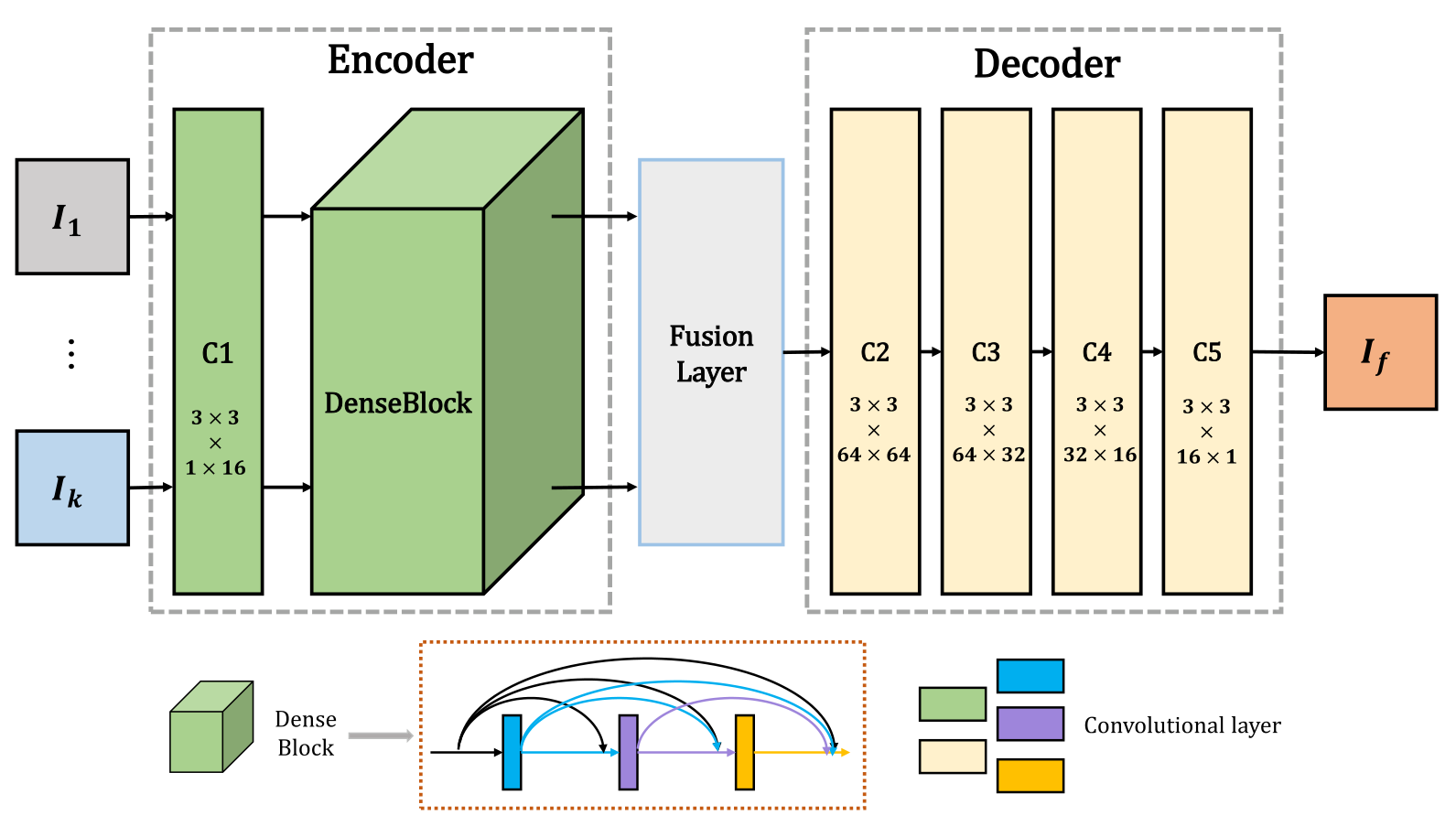
圖片來源: [30], arXiv:1804.08361v9, PDF 第 2 頁. 原始 PDF.
編碼器。 卷積將單通道轉為 16 通道,再由三層密集區塊各增加 16 通道。各層串接先前特徵,輸入依序為 16、32、48 通道,合併輸出為 64 通道 [30]。步幅一與反射填補維持尺寸,因此 影像對應 。
密集連接讓中間特徵持續可用,不必把所有細節擠進最後 16 通道。但這不證明可逆,也不保證每個顯著物件都保留;須用重建與融合實驗檢驗。
解碼器。 四個 卷積把 64 通道依序轉為 64、32、16、1。中間層有整流啟動,最後一層重建影像。單圖訓練與融合特徵推論共用這個解碼器。
重建訓練。 令 為編碼器與解碼器,輸出為 。手稿寫為
是灰階訓練圖, 是重建, 是結構損失權重,SSIM 為結構相似性 [16]。手稿的像素項寫作歐氏範數;移用權重前須核對實作的縮減與尺度。論文測試 [30],大權重反映不同損失尺度,而非四種物理品質定義。
訓練把 COCO 一般影像轉灰階並縮為 ;所述切分約有 79,000 張訓練、1,000 張驗證影像 [30]。學完後,融合時固定編解碼器。
相加規則。 各來源編碼為 , 索引來源, 索引通道, 是位置。最簡單融合為 ,是總和,不是平均,因此幅度可能不同於單圖重建時的特徵分布。
活動度加權。 先算 ,以 鄰域平均得 ,跨來源正規化再融合:
同位置各通道共用 。活動度全零時須定義退回規則,例如等權重。原文雖稱「soft-max」,顯示的公式是除以活動度總和,不是指數 softmax。鄰域平均則鼓勵局部一致權重。
最後解碼 。全卷積影像路徑可接受超過訓練裁切的尺寸,但仍受實作、記憶體限制,且假設來源已配準。
結果
手稿以 20 組紅外線—可見光配對評估,表 II 有七種指標 [30]。相加且 時,、SCD 1.84854、來源平均 SSIM 0.73186。這是小型測試集的各項結果,並非所有指標皆最佳。
表中 DeepFuse 的 、來源平均 SSIM 0.72949,另有方法的熵更高 [30]。因此本章分開看資訊、邊緣與結構量;SSIM 較好不等於偵測或熱保真較好。
消融實驗
表 II 同時改融合策略與結構權重。相加版本的來源平均 SSIM 隨 ,依序為 0.73159、0.73246、0.73186、0.73259 [30];但 從 的 0.44190 降為 1000 的 0.43831。結構權重增加不會改善每個融合分數。
相加與活動度加權的比較,固定表示學習框架而改推論規則,檢查人工合併規則的貢獻。重建損失曲線另顯示權重如何影響訓練,但不是逐個密集連接的完整架構消融。
結論
DenseFuse 是搭配明確融合規則的學習式表示,連接傳統轉換融合與端到端融合:分解、重建由資料學習,活動度與組合仍可直接檢查。
限制與問題
重建不會教跨模態相容性。熱輸入與合併特徵可能偏離訓練灰階自然影像;活動度可能偏好雜訊,相加可能改變尺度,兩者都不知道下游任務重視哪個物件。
小型基準與來源分數也限制泛化宣稱。U2Fusion 直接以來源相依損失訓練輸出,後續注意力則學更豐富互動;它們改變融合決策,而非只加深編碼器。
參考文獻
- Y. Liu, X. Chen, Z. Wang, Z. J. Wang, R. K. Ward and X. Wang, “Deep learning for pixel-level image fusion: Recent advances and future prospects,” Information Fusion, vol. 42, pp. 158–173, 2018. doi
- J. Liu, G. Wu, Z. Liu, D. Wang, Z. Jiang, L. Ma, W. Zhong, X. Fan and R. Liu, “Infrared and visible image fusion: From data compatibility to task adaption,” IEEE Transactions on Pattern Analysis and Machine Intelligence, vol. 47, no. 4, pp. 2349–2369, 2025. doi arXiv
- J. Ma, Y. Ma and C. Li, “Infrared and visible image fusion methods and applications: A survey,” Information Fusion, vol. 45, pp. 153–178, 2019. doi
- P. E. Debevec and J. Malik, “Recovering high dynamic range radiance maps from photographs,” in Proc. SIGGRAPH, 1997, pp. 369–378. doi
- T. Mertens, J. Kautz and F. Van Reeth, “Exposure fusion: A simple and practical alternative to high dynamic range photography,” Computer Graphics Forum, vol. 28, no. 1, pp. 161–171, 2009. doi
- S. Xu, X. Wei, C. Zhang, J. Liu and J. Zhang, “MFFW: A new dataset for multi-focus image fusion,” arXiv:2002.04780, 2020. arXiv
- X. Zhang, “Multi-focus image fusion: A benchmark,” arXiv:2005.01116, 2020. arXiv
- P. J. Burt and E. H. Adelson, “The Laplacian pyramid as a compact image code,” IEEE Transactions on Communications, vol. 31, no. 4, pp. 532–540, 1983. doi
- P. J. Burt and R. J. Kolczynski, “Enhanced image capture through fusion,” in Proc. 4th International Conference on Computer Vision (ICCV), 1993, pp. 173–182. doi
- P. J. Burt and E. H. Adelson, “A multiresolution spline with application to image mosaics,” ACM Transactions on Graphics, vol. 2, no. 4, pp. 217–236, 1983. doi
- H. Li, B. S. Manjunath and S. K. Mitra, “Multisensor image fusion using the wavelet transform,” Graphical Models and Image Processing, vol. 57, no. 3, pp. 235–245, 1995. doi
- S. Li, X. Kang and J. Hu, “Image fusion with guided filtering,” IEEE Transactions on Image Processing, vol. 22, no. 7, pp. 2864–2875, 2013. doi
- K. He, J. Sun and X. Tang, “Guided image filtering,” IEEE Transactions on Pattern Analysis and Machine Intelligence, vol. 35, no. 6, pp. 1397–1409, 2013. doi
- B. Yang and S. Li, “Multifocus image fusion and restoration with sparse representation,” IEEE Transactions on Instrumentation and Measurement, vol. 59, no. 4, pp. 884–892, 2010. doi
- M. Nejati, S. Samavi and S. Shirani, “Multi-focus image fusion using dictionary-based sparse representation,” Information Fusion, vol. 25, pp. 72–84, 2015. doi
- Z. Wang, A. C. Bovik, H. R. Sheikh and E. P. Simoncelli, “Image quality assessment: From error visibility to structural similarity,” IEEE Transactions on Image Processing, vol. 13, no. 4, pp. 600–612, 2004. doi
- X. Zhang, P. Ye and G. Xiao, “VIFB: A visible and infrared image fusion benchmark,” in Proc. IEEE/CVF Conference on Computer Vision and Pattern Recognition (CVPR) Workshops, 2020. CVF arXiv
- X. Zhang, “Benchmarking and comparing multi-exposure image fusion algorithms,” Information Fusion, vol. 74, pp. 111–131, 2021. doi arXiv
- A. M. Eskicioglu and P. S. Fisher, “Image quality measures and their performance,” IEEE Transactions on Communications, vol. 43, no. 12, pp. 2959–2965, 1995. doi
- G. Qu, D. Zhang and P. Yan, “Information measure for performance of image fusion,” Electronics Letters, vol. 38, no. 7, pp. 313–315, 2002. doi
- M. Hossny, S. Nahavandi and D. Creighton, “Comments on ‘Information measure for performance of image fusion’,” Electronics Letters, vol. 44, no. 18, pp. 1066–1067, 2008. doi
- C. S. Xydeas and V. Petrović, “Objective image fusion performance measure,” Electronics Letters, vol. 36, no. 4, pp. 308–309, 2000. doi
- G. Piella and H. Heijmans, “A new quality metric for image fusion,” in Proc. IEEE International Conference on Image Processing (ICIP), 2003, vol. 3, pp. III-173–176. doi
- Y. Han, Y. Cai, Y. Cao and X. Xu, “A new image fusion performance metric based on visual information fidelity,” Information Fusion, vol. 14, no. 2, pp. 127–135, 2013. doi
- K. Ma, K. Zeng and Z. Wang, “Perceptual quality assessment for multi-exposure image fusion,” IEEE Transactions on Image Processing, vol. 24, no. 11, pp. 3345–3356, 2015. doi
- Z. Liu, E. Blasch, Z. Xue, J. Zhao, R. Laganiere and W. Wu, “Objective assessment of multiresolution image fusion algorithms for context enhancement in night vision: A comparative study,” IEEE Transactions on Pattern Analysis and Machine Intelligence, vol. 34, no. 1, pp. 94–109, 2012. doi
- J. Liu, X. Fan, Z. Huang, G. Wu, R. Liu, W. Zhong and Z. Luo, “Target-aware dual adversarial learning and a multi-scenario multi-modality benchmark to fuse infrared and visible for object detection,” in Proc. IEEE/CVF Conference on Computer Vision and Pattern Recognition (CVPR), 2022, pp. 5802–5811. CVF arXiv M3FD
- J. Liu, Z. Liu, G. Wu, L. Ma, R. Liu, W. Zhong, Z. Luo and X. Fan, “Multi-interactive feature learning and a full-time multi-modality benchmark for image fusion and segmentation,” in Proc. IEEE/CVF International Conference on Computer Vision (ICCV), 2023, pp. 8115–8124. CVF arXiv
- Y. Zhang, Y. Liu, P. Sun, H. Yan, X. Zhao and L. Zhang, “IFCNN: A general image fusion framework based on convolutional neural network,” Information Fusion, vol. 54, pp. 99–118, 2020. doi
- H. Li and X.-J. Wu, “DenseFuse: A fusion approach to infrared and visible images,” IEEE Transactions on Image Processing, vol. 28, no. 5, pp. 2614–2623, 2019. doi arXiv
- K. R. Prabhakar, V. S. Srikar and R. V. Babu, “DeepFuse: A deep unsupervised approach for exposure fusion with extreme exposure image pairs,” in Proc. IEEE International Conference on Computer Vision (ICCV), 2017, pp. 4724–4732. doi CVF
- H. Xu, J. Ma, J. Jiang, X. Guo and H. Ling, “U2Fusion: A unified unsupervised image fusion network,” IEEE Transactions on Pattern Analysis and Machine Intelligence, vol. 44, no. 1, pp. 502–518, 2022. doi RoadScene
- L. Tang, J. Yuan and J. Ma, “Image fusion in the loop of high-level vision tasks: A semantic-aware real-time infrared and visible image fusion network,” Information Fusion, vol. 82, pp. 28–42, 2022. doi
- J. Ma, L. Tang, F. Fan, J. Huang, X. Mei and Y. Ma, “SwinFusion: Cross-domain long-range learning for general image fusion via Swin Transformer,” IEEE/CAA Journal of Automatica Sinica, vol. 9, no. 7, pp. 1200–1217, 2022. doi
- X. Zhang and Y. Demiris, “Visible and infrared image fusion using deep learning,” IEEE Transactions on Pattern Analysis and Machine Intelligence, vol. 45, no. 8, pp. 10535–10554, 2023. doi
- Y. Liu, X. Chen, H. Peng and Z. Wang, “Multi-focus image fusion with a deep convolutional neural network,” Information Fusion, vol. 36, pp. 191–207, 2017. doi
- K. Ma, Z. Duanmu, H. Zhu, Y. Fang and Z. Wang, “Deep guided learning for fast multi-exposure image fusion,” IEEE Transactions on Image Processing, vol. 29, pp. 2808–2819, 2020. doi
- Z. Zhao, H. Bai, J. Zhang, Y. Zhang, S. Xu, Z. Lin, R. Timofte and L. Van Gool, “CDDFuse: Correlation-driven dual-branch feature decomposition for multi-modality image fusion,” in Proc. IEEE/CVF Conference on Computer Vision and Pattern Recognition (CVPR), 2023, pp. 5906–5916. CVF arXiv
- J. Ma, W. Yu, P. Liang, C. Li and J. Jiang, “FusionGAN: A generative adversarial network for infrared and visible image fusion,” Information Fusion, vol. 48, pp. 11–26, 2019. doi · public article transcription
- H. Bai, J. Zhang, Z. Zhao, Y. Wu, L. Deng, Y. Cui, T. Feng and S. Xu, “Task-driven image fusion with learnable fusion loss,” in Proc. IEEE/CVF Conference on Computer Vision and Pattern Recognition (CVPR), 2025, pp. 7457–7468. CVF arXiv
- Z. Zhao, H. Bai, Y. Zhu, J. Zhang, S. Xu, Y. Zhang, K. Zhang, D. Meng, R. Timofte and L. Van Gool, “DDFM: Denoising diffusion model for multi-modality image fusion,” in Proc. IEEE/CVF International Conference on Computer Vision (ICCV), 2023, pp. 8082–8093. CVF arXiv
- X. Yi, H. Xu, H. Zhang, L. Tang and J. Ma, “Text-IF: Leveraging semantic text guidance for degradation-aware and interactive image fusion,” in Proc. IEEE/CVF Conference on Computer Vision and Pattern Recognition (CVPR), 2024, pp. 27026–27035. CVF arXiv
- D. Wang, J. Liu, X. Fan and R. Liu, “Unsupervised misaligned infrared and visible image fusion via cross-modality image generation and registration,” in Proc. International Joint Conference on Artificial Intelligence (IJCAI), 2022, pp. 3508–3515. doi arXiv
- L. Tang, Y. Deng, Y. Ma, J. Huang and J. Ma, “SuperFusion: A versatile image registration and fusion network with semantic awareness,” IEEE/CAA Journal of Automatica Sinica, vol. 9, no. 12, pp. 2121–2137, 2022. doi
- A. Toet, “The TNO multiband image data collection,” Data in Brief, vol. 15, pp. 249–251, 2017. doi
- L. Tang, J. Yuan, H. Zhang, X. Jiang and J. Ma, “PIAFusion: A progressive infrared and visible image fusion network based on illumination aware,” Information Fusion, vol. 83–84, pp. 79–92, 2022. doi MSRS
- Q. Ha, K. Watanabe, T. Karasawa, Y. Ushiku and T. Harada, “MFNet: Towards real-time semantic segmentation for autonomous vehicles with multi-spectral scenes,” in Proc. IEEE/RSJ International Conference on Intelligent Robots and Systems (IROS), 2017, pp. 5108–5115. doi
- X. Jia, C. Zhu, M. Li, W. Tang and W. Zhou, “LLVIP: A visible-infrared paired dataset for low-light vision,” in Proc. IEEE/CVF International Conference on Computer Vision (ICCV) Workshops, 2021, pp. 3496–3504. CVF arXiv
- J. Cai, S. Gu and L. Zhang, “Learning a deep single image contrast enhancer from multi-exposure images,” IEEE Transactions on Image Processing, vol. 27, no. 4, pp. 2049–2062, 2018. doi
- X. Zhang, “Deep learning-based multi-focus image fusion: A survey and a comparative study,” IEEE Transactions on Pattern Analysis and Machine Intelligence, vol. 44, no. 9, 2022. doi
- F. Xu, J. Liu, Y. Song, H. Sun and X. Wang, “Multi-exposure image fusion techniques: A comprehensive review,” Remote Sensing, vol. 14, no. 3, art. 771, 2022. doi
- Z. Zhao, H. Bai, J. Zhang, Y. Zhang, K. Zhang, S. Xu, D. Chen, R. Timofte and L. Van Gool, “Equivariant multi-modality image fusion,” in Proc. IEEE/CVF Conference on Computer Vision and Pattern Recognition (CVPR), 2024, pp. 25912–25921. CVF arXiv
- L. Tang, Y. Wang, M. Gong, Z. Li, Y. Deng, X. Yi, C. Li, H. Xu, H. Zhang and J. Ma, “VideoFusion: A spatio-temporal collaborative network for multi-modal video fusion,” in Proc. IEEE/CVF Conference on Computer Vision and Pattern Recognition (CVPR), 2026, pp. 19559–19569. CVF
- N. Yokoya, C. Grohnfeldt and J. Chanussot, “Hyperspectral and multispectral data fusion: A comparative review of the recent literature,” IEEE Geoscience and Remote Sensing Magazine, 2017. doi
- H. R. Sheikh and A. C. Bovik, “Image information and visual quality,” IEEE Transactions on Image Processing, 2006. doi
- H. Xu et al., “U2Fusion,” official implementation accompanying the TPAMI paper, 2022. code
- K. Simonyan and A. Zisserman, “Very deep convolutional networks for large-scale image recognition,” ICLR, 2015. arXiv
- J. Kirkpatrick et al., “Overcoming catastrophic forgetting in neural networks,” Proceedings of the National Academy of Sciences, 2017. doi
- Y. Zhang et al., “IFCNN,” official implementation and errata accompanying the Information Fusion paper, 2020. code
- K. He, X. Zhang, S. Ren and J. Sun, “Deep residual learning for image recognition,” CVPR, 2016. CVF
- J. Deng, W. Dong, R. Socher, L.-J. Li, K. Li and L. Fei-Fei, “ImageNet: A large-scale hierarchical image database,” CVPR, 2009. doi
- N. Silberman, D. Hoiem, P. Kohli and R. Fergus, “Indoor segmentation and support inference from RGBD images,” ECCV, 2012. project
- P. Dhariwal and A. Nichol, “Diffusion models beat GANs on image synthesis,” NeurIPS, 2021. arXiv
- J. Liu et al., “TarDAL,” official implementation accompanying the CVPR paper, 2022. code
- G. Jocher et al., “YOLOv5,” Ultralytics object-detection software, 2020 onward. code
- J. Ma et al., “FusionGAN,” official implementation accompanying the Information Fusion paper, 2019. code
- L. Tang, J. Yuan and J. Ma, “SeAFusion,” official implementation accompanying the Information Fusion paper, 2022. code
- T. Mertens, J. Kautz and F. Van Reeth, “Exposure Fusion,” in Proc. Pacific Graphics, 2007. paper · author project