Blau 與 Michaeli:The Perception-Distortion Tradeoff(CVPR 2018)
選讀・DLCV 09B・生成式影像復原:取樣出一個合理的答案 的論文導讀(第 1/5 篇)。引用編號對應本頁底部的參考文獻。
導覽:本頁與本系列: 導覽:本頁與本系列
挑戰
到了 2017 年,用對抗損失訓練的超解析度方法產生的影像,人們比較喜歡,但它們的 PSNR 與 SSIM 分數卻比 MSE 訓練的網路差。這是指標的缺陷,還是無法避免的事?
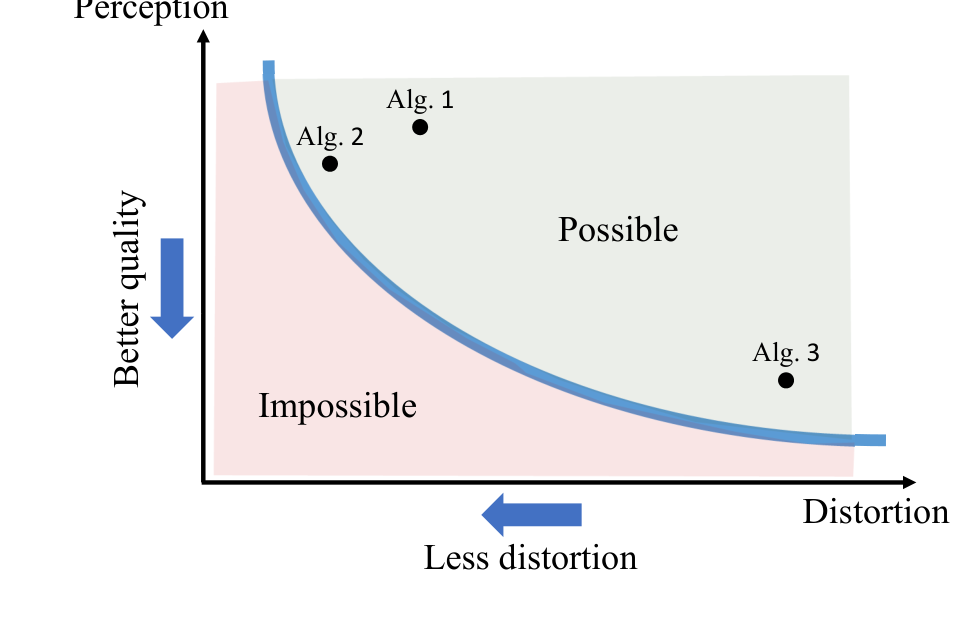
圖片來源: [1], arXiv:1711.06077v4, PDF 第 1 頁. 原始 PDF.
方法
把感知品質定義為輸出分布的性質,也就是復原影像分布與真實影像分布之間的散度(完美的判別器能偵測到它),然後針對每個感知品質水準,在所有可能的估計量中,研究可能達到的最佳失真 [1]。
結果
感知–失真函數是單調的,對凸散度也是凸的,所以這個權衡是問題本身的數學性質,而不是某個特定指標或網路的性質,而且對每一種失真度量都成立。對平方誤差,完美的感知品質最多讓最小 MSE 變成兩倍,由後驗取樣達到(在 arXiv 延伸版中)。結合失真項與對抗項的 GAN 訓練,是逼近這個界的有原則的方法。論文接著把當時許多超解析度方法畫在這個平面上,用無參考指標作為感知品質的代理。
判讀證據
先讀定義和定理 2(權衡),再讀兩倍的結果及其在附錄中的證明,那就是我們補充資料中的論證。讀實驗圖時,請檢查:(a) 那裡的「感知品質」軸是無參考指標(一個代理),而不是理論中的散度;(b) 界是以示意方式畫出的,因為它對真實影像無法計算;(c) PSNR 用了哪個色彩通道與評估流程。
限制與問題
理論談的是分布與期望;它沒有說估計量會捏造哪些特定的細節,所以它不量測幻覺。這個界對自然影像無法計算,而兩倍是上界,不是預測。
結論
它是本篇每一節背後的理論:為什麼 MSE 網路會模糊、為什麼生成式方法會損失 PSNR,以及為什麼一個方法應該用平面上的一個點來描述,而不是單一分數。
參考文獻
- Y. Blau and T. Michaeli, “The Perception-Distortion Tradeoff,” in Proc. IEEE/CVF CVPR, 2018, pp. 6228–6237 (extended version on arXiv). doi · arXiv
- C. Ledig, L. Theis, F. Huszár, J. Caballero, A. Cunningham, A. Acosta, A. Aitken, A. Tejani, J. Totz, Z. Wang and W. Shi, “Photo-Realistic Single Image Super-Resolution Using a Generative Adversarial Network,” in Proc. IEEE CVPR, 2017, pp. 105–114. doi · arXiv
- J. Johnson, A. Alahi and L. Fei-Fei, “Perceptual Losses for Real-Time Style Transfer and Super-Resolution,” in Proc. ECCV, 2016, pp. 694–711. doi · arXiv
- X. Wang, K. Yu, S. Wu, J. Gu, Y. Liu, C. Dong, Y. Qiao and C. C. Loy, “ESRGAN: Enhanced Super-Resolution Generative Adversarial Networks,” in Proc. ECCV Workshops, 2018 (LNCS, 2019), pp. 63–79. doi · arXiv
- X. Wang, L. Xie, C. Dong and Y. Shan, “Real-ESRGAN: Training Real-World Blind Super-Resolution with Pure Synthetic Data,” in Proc. IEEE/CVF ICCV Workshops, 2021, pp. 1905–1914. doi · arXiv
- T. Karras, S. Laine and T. Aila, “A Style-Based Generator Architecture for Generative Adversarial Networks,” in Proc. IEEE/CVF CVPR, 2019, pp. 4396–4405. doi · arXiv
- S. Menon, A. Damian, S. Hu, N. Ravi and C. Rudin, “PULSE: Self-Supervised Photo Upsampling via Latent Space Exploration of Generative Models,” in Proc. IEEE/CVF CVPR, 2020, pp. 2434–2442. doi · arXiv
- K. C. K. Chan, X. Wang, X. Xu, J. Gu and C. C. Loy, “GLEAN: Generative Latent Bank for Large-Factor Image Super-Resolution,” in Proc. IEEE/CVF CVPR, 2021, pp. 14240–14249. doi · arXiv
- X. Wang, Y. Li, H. Zhang and Y. Shan, “Towards Real-World Blind Face Restoration with Generative Facial Prior,” in Proc. IEEE/CVF CVPR, 2021, pp. 9164–9174. doi · arXiv
- S. Zhou, K. C. K. Chan, C. Li and C. C. Loy, “Towards Robust Blind Face Restoration with Codebook Lookup Transformer,” in Proc. NeurIPS, vol. 35, 2022, pp. 30599–30611. doi · arXiv
- J. Ho, A. Jain and P. Abbeel, “Denoising Diffusion Probabilistic Models,” in Proc. NeurIPS, 2020. proceedings · arXiv
- Y. Song, J. Sohl-Dickstein, D. P. Kingma, A. Kumar, S. Ermon and B. Poole, “Score-Based Generative Modeling through Stochastic Differential Equations,” in Proc. ICLR, 2021. arXiv
- B. Efron, “Tweedie’s Formula and Selection Bias,” Journal of the American Statistical Association, vol. 106, no. 496, pp. 1602–1614, 2011. doi
- C. Saharia, J. Ho, W. Chan, T. Salimans, D. J. Fleet and M. Norouzi, “Image Super-Resolution via Iterative Refinement,” IEEE TPAMI, 2022 (early access). doi · arXiv
- C. Saharia, W. Chan, H. Chang, C. Lee, J. Ho, T. Salimans, D. Fleet and M. Norouzi, “Palette: Image-to-Image Diffusion Models,” in Proc. ACM SIGGRAPH Conference, 2022, pp. 1–10. doi · arXiv
- Z. Yue, J. Wang and C. C. Loy, “ResShift: Efficient Diffusion Model for Image Super-resolution by Residual Shifting,” in Proc. NeurIPS, vol. 36, 2023, pp. 13294–13307. doi · arXiv
- H. Chung, J. Kim, M. T. McCann, M. L. Klasky and J. C. Ye, “Diffusion Posterior Sampling for General Noisy Inverse Problems,” in Proc. ICLR, 2023. arXiv
- B. Kawar, M. Elad, S. Ermon and J. Song, “Denoising Diffusion Restoration Models,” in Proc. NeurIPS, vol. 35, 2022, pp. 23593–23606. doi · arXiv
- Y. Wang, J. Yu and J. Zhang, “Zero-Shot Image Restoration Using Denoising Diffusion Null-Space Model,” in Proc. ICLR, 2023. arXiv
- J. Song, A. Vahdat, M. Mardani and J. Kautz, “Pseudoinverse-Guided Diffusion Models for Inverse Problems,” in Proc. ICLR, 2023. ICLR page
- Y. Zhu, K. Zhang, J. Liang, J. Cao, B. Wen, R. Timofte and L. Van Gool, “Denoising Diffusion Models for Plug-and-Play Image Restoration,” in Proc. IEEE/CVF CVPR Workshops, 2023, pp. 1219–1229. doi · arXiv
- R. Rombach, A. Blattmann, D. Lorenz, P. Esser and B. Ommer, “High-Resolution Image Synthesis with Latent Diffusion Models,” in Proc. IEEE/CVF CVPR, 2022, pp. 10674–10685. doi · arXiv
- L. Zhang, A. Rao and M. Agrawala, “Adding Conditional Control to Text-to-Image Diffusion Models,” in Proc. IEEE/CVF ICCV, 2023, pp. 3813–3824. doi · arXiv
- J. Wang, Z. Yue, S. Zhou, K. C. K. Chan and C. C. Loy, “Exploiting Diffusion Prior for Real-World Image Super-Resolution,” International Journal of Computer Vision, vol. 132, no. 12, pp. 5929–5949, 2024. doi · arXiv
- X. Lin, J. He, Z. Chen, Z. Lyu, B. Dai, F. Yu, Y. Qiao, W. Ouyang and C. Dong, “DiffBIR: Toward Blind Image Restoration with Generative Diffusion Prior,” in Proc. ECCV, 2024 (LNCS), pp. 430–448. doi · arXiv
- F. Yu, J. Gu, Z. Li, J. Hu, X. Kong, X. Wang, J. He, Y. Qiao and C. Dong, “Scaling Up to Excellence: Practicing Model Scaling for Photo-Realistic Image Restoration In the Wild,” in Proc. IEEE/CVF CVPR, 2024, pp. 25669–25680. doi · arXiv
- Y. Wang, W. Yang, X. Chen, Y. Wang, L. Guo, L.-P. Chau, Z. Liu, Y. Qiao, A. C. Kot and B. Wen, “SinSR: Diffusion-Based Image Super-Resolution in a Single Step,” in Proc. IEEE/CVF CVPR, 2024, pp. 25796–25805. doi · arXiv
- R. Wu, L. Sun, Z. Ma and L. Zhang, “One-Step Effective Diffusion Network for Real-World Image Super-Resolution,” in Proc. NeurIPS, vol. 37, 2024, pp. 92529–92553. doi · arXiv
- Z. Yue, K. Liao and C. C. Loy, “Arbitrary-steps Image Super-resolution via Diffusion Inversion,” in Proc. IEEE/CVF CVPR, 2025, pp. 23153–23163. doi · arXiv
- L. Dong, Q. Fan, Y. Guo, Z. Wang, Q. Zhang, J. Chen, Y. Luo and C. Zou, “TSD-SR: One-Step Diffusion with Target Score Distillation for Real-World Image Super-Resolution,” in Proc. IEEE/CVF CVPR, 2025, pp. 23174–23184. doi · arXiv
- Y. Lipman, R. T. Q. Chen, H. Ben-Hamu, M. Nickel and M. Le, “Flow Matching for Generative Modeling,” in Proc. ICLR, 2023. arXiv
- X. Liu, C. Gong and Q. Liu, “Flow Straight and Fast: Learning to Generate and Transfer Data with Rectified Flow,” in Proc. ICLR, 2023. arXiv
- G. Ohayon, T. Michaeli and M. Elad, “Posterior-Mean Rectified Flow: Towards Minimum MSE Photo-Realistic Image Restoration,” in Proc. ICLR, 2025. arXiv
- S. Martin, A. Gagneux, P. Hagemann and G. Steidl, “PnP-Flow: Plug-and-Play Image Restoration with Flow Matching,” in Proc. ICLR, 2025. arXiv
- S. Bhadra, V. A. Kelkar, F. J. Brooks and M. A. Anastasio, “On Hallucinations in Tomographic Image Reconstruction,” IEEE Transactions on Medical Imaging, vol. 40, no. 11, pp. 3249–3260, 2021. doi · arXiv
- W. Ren, R. Goyal, Z. Hu, T. T. Aumentado-Armstrong, I. Mohomed and A. Levinshtein, “Hallucination Score: Towards Mitigating Hallucinations in Generative Image Super-Resolution,” arXiv:2507.14367, 2025. arXiv
- A. N. Angelopoulos, A. P. Kohli, S. Bates, M. I. Jordan, J. Malik, T. Alshaabi, S. Upadhyayula and Y. Romano, “Image-to-Image Regression with Distribution-Free Uncertainty Quantification and Applications in Imaging,” in Proc. ICML, PMLR 162, 2022. proceedings · arXiv
- R. Zhang, P. Isola, A. A. Efros, E. Shechtman and O. Wang, “The Unreasonable Effectiveness of Deep Features as a Perceptual Metric,” in Proc. IEEE/CVF CVPR, 2018, pp. 586–595. doi · arXiv
- Z. Wang, A. C. Bovik, H. R. Sheikh and E. P. Simoncelli, “Image Quality Assessment: From Error Visibility to Structural Similarity,” IEEE Transactions on Image Processing, vol. 13, no. 4, pp. 600–612, 2004. doi
- M. Heusel, H. Ramsauer, T. Unterthiner, B. Nessler and S. Hochreiter, “GANs Trained by a Two Time-Scale Update Rule Converge to a Local Nash Equilibrium,” in Proc. NeurIPS (NIPS), 2017. arXiv
- A. Mittal, R. Soundararajan and A. C. Bovik, “Making a ‘Completely Blind’ Image Quality Analyzer,” IEEE Signal Processing Letters, vol. 20, no. 3, pp. 209–212, 2013. doi
- J. Ke, Q. Wang, Y. Wang, P. Milanfar and F. Yang, “MUSIQ: Multi-scale Image Quality Transformer,” in Proc. IEEE/CVF ICCV, 2021, pp. 5128–5137. doi · arXiv
- J. Wang, K. C. K. Chan and C. C. Loy, “Exploring CLIP for Assessing the Look and Feel of Images,” in Proc. AAAI, vol. 37, no. 2, 2023, pp. 2555–2563. doi · arXiv
- X. Li, Y. Ren, X. Jin, C. Lan, X. Wang, W. Zeng, X. Wang and Z. Chen, “Diffusion Models for Image Restoration and Enhancement: A Comprehensive Survey,” International Journal of Computer Vision, vol. 133, no. 11, pp. 8078–8108, 2025. doi · arXiv
- G. Daras, H. Chung, C.-H. Lai, Y. Mitsufuji, J. C. Ye, P. Milanfar, A. G. Dimakis and M. Delbracio, “A Survey on Diffusion Models for Inverse Problems,” arXiv:2410.00083, 2024. arXiv
- B. B. Moser, A. S. Shanbhag, F. Raue, S. Frolov, S. Palacio and A. Dengel, “Diffusion Models, Image Super-Resolution, and Everything: A Survey,” IEEE Transactions on Neural Networks and Learning Systems, vol. 36, no. 7, pp. 11793–11813, 2025. doi · arXiv
- W. Xia, Y. Zhang, Y. Yang, J.-H. Xue, B. Zhou and M.-H. Yang, “GAN Inversion: A Survey,” IEEE TPAMI, vol. 45, no. 3, pp. 3121–3138, 2023. doi · arXiv
- Y. Song and S. Ermon, “Generative Modeling by Estimating Gradients of the Data Distribution,” in Proc. NeurIPS, 2019. arXiv
- H. Chung, J. Kim, S. Kim and J. C. Ye, “Parallel Diffusion Models of Operator and Image for Blind Inverse Problems,” in Proc. IEEE/CVF CVPR, 2023, pp. 6059–6069. paper