現代觀點綜述導讀
選讀・DLCV 01・深度學習的影像處理與電腦視覺 的論文導讀(第 1/1 篇)。引用編號對應本頁底部的參考文獻。
導覽:本頁與本系列: 導覽:本頁與本系列
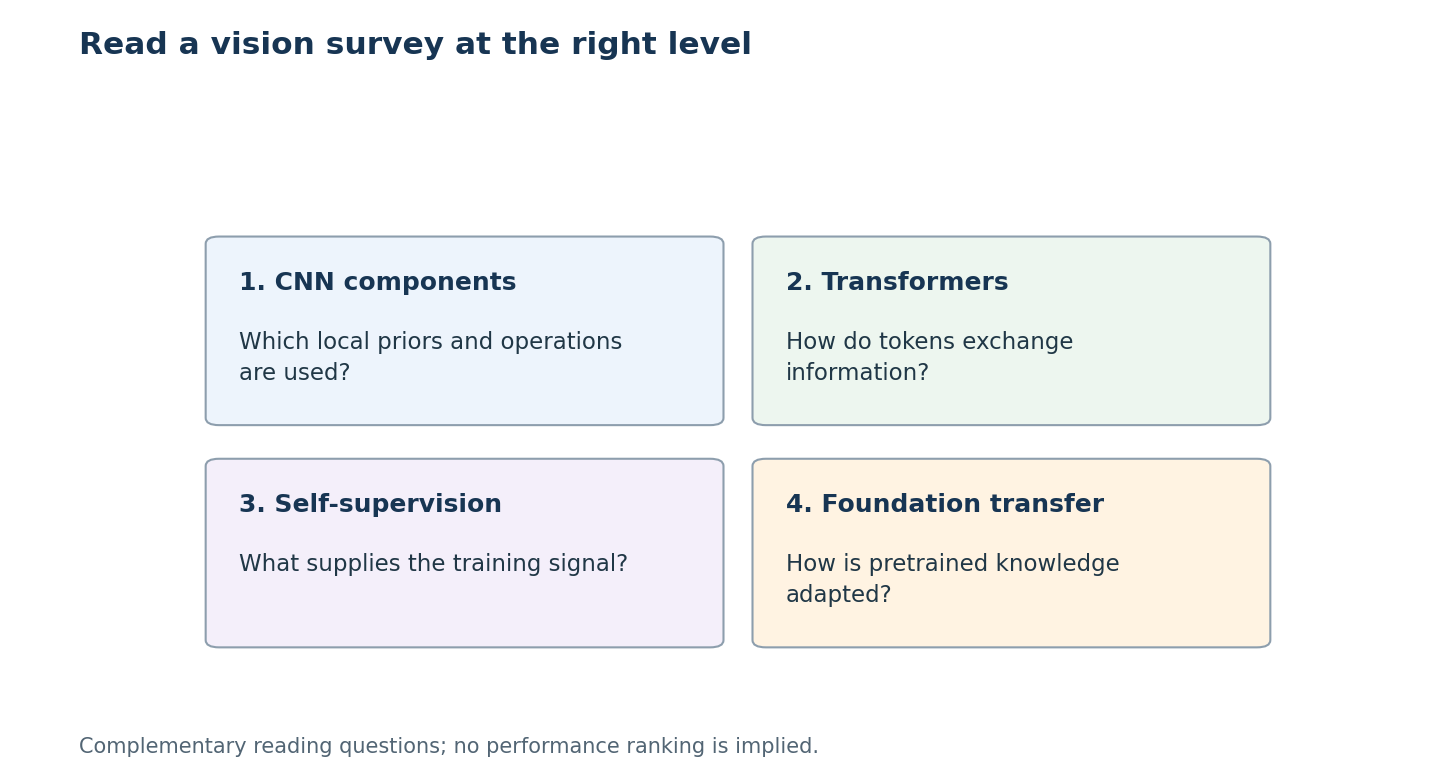
先分清架構、訓練目標與遷移方式,再閱讀 CNN、Transformer、自我監督與視覺基礎模型綜述。
本篇導讀是「現代觀點」中綜述摘要的完整版:逐篇說明每篇綜述涵蓋的範圍、分類方式與結論。
CNN 架構
Li 等人 [30] 回顧了 CNN 的歷史、卷積運算本身、經典與進階架構(LeNet 到 ResNet 一脈,以及輕量化與加入注意力的網路)、一維/二維/多維卷積與各種應用。他們也整理了每個元件的改進(層設計、激活與損失函數、正則化、最佳化、快速計算),透過實驗歸納出挑選函數與超參數的經驗法則,最後討論開放問題與有潛力的方向。若想一次看到 CNN 的設計空間被逐個元件攤開,這是最好的單一參考。
Vision Transformer
Khan 等人 [31](ACM Computing Surveys)依任務整理 Transformer 的研究:先是基礎(自注意力、大規模預訓練、雙向編碼),接著是辨識(分類、偵測、分割、動作辨識)、生成模型、多模態任務(VQA、視覺推理、視覺定位)、影片、低階視覺(超解析度、增強、上色)與三維點雲。他們的核心對比與本篇一致:Transformer 以極少的歸納偏置建模長距離依賴,因此需要大規模預訓練或架構上的先驗(視窗、階層)才能有好的資料效率。
自監督視覺學習
Jing 與 Tian [32](TPAMI)綜述了 2020 年以前那一代的自監督方法,依前置任務(pretext task)分為生成式、上下文式、免費語意標籤式與跨模態式四類,並說明以遷移到下游任務來評估特徵的標準流程。Balestriero 等人 [33] 則以實用的「食譜」形式涵蓋新一代方法,把它們分成四個家族:深度度量學習(對比式)、自蒸餾(DINO 家族)、典型相關分析類方法,以及遮罩影像建模(MAE)。他們強調許多隱藏的「旋鈕」(資料擴增、投影 head、防止塌縮的機制),這也解釋了為什麼自監督結果難以重現。
視覺基礎模型
Awais 等人 [34](TPAMI)依模態組合(視覺搭配文字、音訊、深度)、訓練目標(對比式 vs. 生成式)與提示類型(文字提示;視覺提示,例如 SAM 的點、框、遮罩;以及異質混合提示)為視覺基礎模型分類。他們列出的開放挑戰包括評估與基準測試、真實世界理解與上下文推理、偏差、對抗強健性與可解釋性。Zhang 等人 [35](TPAMI)聚焦於用於視覺辨識的視覺–語言模型:架構與預訓練目標、遷移方法(提示微調、特徵轉接器),以及把知識蒸餾到偵測器與分割器。他們主張網路規模的影像–文字資料降低了對群眾標註的依賴,並讓一個模型服務許多任務。
如何判讀這些論文的證據
這些分類位於不同設計層級:CNN、Transformer 是架構家族,自我監督是訓練訊號來源,基礎模型則強調可重用預訓練能力與調適。Transformer 可以同時採自我監督並作為基礎編碼器,不是互斥競爭類別;混成排名會混淆架構、目標與規模。
遷移結果須追蹤預訓練資料、增強、投影/預測頭、編碼器是否凍結,以及下游標籤。線性探測與完整微調有不同預算。綜述表格未必控制全部變因;先找到設計機制,再讀原論文受控比較。支援多工作仍不能取代資料效率、偏差與穩健性的獨立評估。
參考文獻
- Shyandram, “深度學習的數位影像處理介紹,” Medium post, 2024; updated 2026. link
- R. C. Gonzalez and R. E. Woods, Digital Image Processing, 4th ed., Pearson, 2018. publisher page
- S. Theodoridis and K. Koutroumbas, Pattern Recognition, 4th ed., Academic Press, 2008. publisher page
- Y. LeCun, B. Boser, J. S. Denker, D. Henderson, R. E. Howard, W. Hubbard, and L. D. Jackel, “Backpropagation applied to handwritten zip code recognition,” Neural Computation, vol. 1, no. 4, pp. 541–551, 1989. doi:10.1162/neco.1989.1.4.541
- Y. LeCun, L. Bottou, Y. Bengio, and P. Haffner, “Gradient-based learning applied to document recognition,” Proceedings of the IEEE, vol. 86, no. 11, pp. 2278–2324, 1998. doi:10.1109/5.726791
- O. Russakovsky, J. Deng, H. Su, et al., “ImageNet large scale visual recognition challenge,” International Journal of Computer Vision, vol. 115, no. 3, pp. 211–252, 2015. doi:10.1007/s11263-015-0816-y · arXiv:1409.0575
- A. Krizhevsky, I. Sutskever, and G. E. Hinton, “ImageNet classification with deep convolutional neural networks,” NeurIPS, 2012. proceedings
- K. Simonyan and A. Zisserman, “Very deep convolutional networks for large-scale image recognition,” ICLR, 2015. arXiv:1409.1556
- C. Szegedy, W. Liu, Y. Jia, P. Sermanet, S. Reed, D. Anguelov, D. Erhan, V. Vanhoucke, and A. Rabinovich, “Going deeper with convolutions,” CVPR, 2015. doi:10.1109/CVPR.2015.7298594 · arXiv:1409.4842
- K. He, X. Zhang, S. Ren, and J. Sun, “Deep residual learning for image recognition,” CVPR, 2016. doi:10.1109/CVPR.2016.90 · arXiv:1512.03385
- A. Krizhevsky, “Learning multiple layers of features from tiny images,” technical report, University of Toronto, 2009 (the CIFAR-10/100 datasets). dataset page
- W. Luo, Y. Li, R. Urtasun, and R. Zemel, “Understanding the effective receptive field in deep convolutional neural networks,” NeurIPS, 2016. arXiv:1701.04128
- J. Long, E. Shelhamer, and T. Darrell, “Fully convolutional networks for semantic segmentation,” CVPR, 2015. arXiv:1411.4038
- O. Ronneberger, P. Fischer, and T. Brox, “U-Net: Convolutional networks for biomedical image segmentation,” MICCAI, 2015. arXiv:1505.04597
- A. Vaswani, N. Shazeer, N. Parmar, J. Uszkoreit, L. Jones, A. N. Gomez, Ł. Kaiser, and I. Polosukhin, “Attention is all you need,” NeurIPS, 2017. ML anthology
- A. Dosovitskiy, L. Beyer, A. Kolesnikov, D. Weissenborn, X. Zhai, T. Unterthiner, M. Dehghani, M. Minderer, G. Heigold, S. Gelly, J. Uszkoreit, and N. Houlsby, “An image is worth 16x16 words: Transformers for image recognition at scale,” ICLR, 2021. arXiv:2010.11929
- Z. Liu, Y. Lin, Y. Cao, H. Hu, Y. Wei, Z. Zhang, S. Lin, and B. Guo, “Swin Transformer: Hierarchical vision Transformer using shifted windows,” ICCV, 2021. doi:10.1109/ICCV48922.2021.00986 · arXiv:2103.14030
- Z. Liu, H. Mao, C.-Y. Wu, C. Feichtenhofer, T. Darrell, and S. Xie, “A ConvNet for the 2020s,” CVPR, 2022, arXiv:2201.03545; and S. Woo, S. Debnath, R. Hu, X. Chen, Z. Liu, I. S. Kweon, and S. Xie, “ConvNeXt V2: Co-designing and scaling ConvNets with masked autoencoders,” CVPR, 2023, arXiv:2301.00808.
- M. Caron, H. Touvron, I. Misra, H. Jégou, J. Mairal, P. Bojanowski, and A. Joulin, “Emerging properties in self-supervised vision Transformers,” ICCV, 2021. doi:10.1109/ICCV48922.2021.00951 · arXiv:2104.14294
- K. He, X. Chen, S. Xie, Y. Li, P. Dollár, and R. Girshick, “Masked autoencoders are scalable vision learners,” CVPR, 2022. doi:10.1109/CVPR52688.2022.01553 · arXiv:2111.06377
- M. Oquab, T. Darcet, T. Moutakanni, et al., “DINOv2: Learning robust visual features without supervision,” Transactions on Machine Learning Research, 2024, arXiv:2304.07193; and O. Siméoni, H. V. Vo, M. Seitzer, F. Baldassarre, M. Oquab, et al., “DINOv3,” arXiv preprint, 2025, arXiv:2508.10104.
- L. Zhu, B. Liao, Q. Zhang, X. Wang, W. Liu, and X. Wang, “Vision Mamba: Efficient visual representation learning with bidirectional state space model,” ICML, 2024, arXiv:2401.09417; and Y. Liu, Y. Tian, Y. Zhao, H. Yu, L. Xie, Y. Wang, Q. Ye, J. Jiao, and Y. Liu, “VMamba: Visual state space model,” NeurIPS, 2024, arXiv:2401.10166.
- S. Ren, K. He, R. Girshick, and J. Sun, “Faster R-CNN: Towards real-time object detection with region proposal networks,” NeurIPS, 2015, arXiv:1506.01497; and N. Carion, F. Massa, G. Synnaeve, N. Usunier, A. Kirillov, and S. Zagoruyko, “End-to-end object detection with Transformers,” ECCV, 2020, arXiv:2005.12872.
- A. Kirillov, E. Mintun, N. Ravi, et al., “Segment anything,” ICCV, 2023, arXiv:2304.02643; N. Ravi, V. Gabeur, Y.-T. Hu, R. Hu, et al., “SAM 2: Segment anything in images and videos,” ICLR, 2025, arXiv:2408.00714; and N. Carion, L. Gustafson, Y.-T. Hu, S. Debnath, et al., “SAM 3: Segment anything with concepts,” ICLR, 2026, arXiv:2511.16719.
- A. Radford, J. W. Kim, C. Hallacy, A. Ramesh, G. Goh, et al., “Learning transferable visual models from natural language supervision,” ICML, 2021. arXiv:2103.00020
- H. Liu, C. Li, Q. Wu, and Y. J. Lee, “Visual instruction tuning,” NeurIPS, 2023. arXiv:2304.08485
- J. Ho, A. Jain, and P. Abbeel, “Denoising diffusion probabilistic models,” NeurIPS, 2020. arXiv:2006.11239
- R. Rombach, A. Blattmann, D. Lorenz, P. Esser, and B. Ommer, “High-resolution image synthesis with latent diffusion models,” CVPR, 2022, arXiv:2112.10752; and W. Peebles and S. Xie, “Scalable diffusion models with Transformers,” ICCV, 2023, arXiv:2212.09748.
- T. Brooks, A. Holynski, and A. A. Efros, “InstructPix2Pix: Learning to follow image editing instructions,” CVPR, 2023. arXiv:2211.09800
- Z. Li, F. Liu, W. Yang, S. Peng, and J. Zhou, “A survey of convolutional neural networks: Analysis, applications, and prospects,” IEEE Transactions on Neural Networks and Learning Systems, vol. 33, 2022. doi:10.1109/TNNLS.2021.3084827 · arXiv:2004.02806
- S. Khan, M. Naseer, M. Hayat, S. W. Zamir, F. S. Khan, and M. Shah, “Transformers in vision: A survey,” ACM Computing Surveys, vol. 54, no. 10s, 2022. doi:10.1145/3505244 · arXiv:2101.01169
- L. Jing and Y. Tian, “Self-supervised visual feature learning with deep neural networks: A survey,” IEEE Transactions on Pattern Analysis and Machine Intelligence, vol. 43, 2021. doi:10.1109/TPAMI.2020.2992393 · arXiv:1902.06162
- R. Balestriero, M. Ibrahim, V. Sobal, et al., “A cookbook of self-supervised learning,” arXiv preprint, 2023. arXiv:2304.12210
- M. Awais, M. Naseer, S. Khan, R. M. Anwer, H. Cholakkal, M. Shah, M.-H. Yang, and F. S. Khan, “Foundation models defining a new era in vision: A survey and outlook,” IEEE Transactions on Pattern Analysis and Machine Intelligence, vol. 47, 2025. doi:10.1109/TPAMI.2024.3506283 · arXiv:2307.13721
- J. Zhang, J. Huang, S. Jin, and S. Lu, “Vision-language models for vision tasks: A survey,” IEEE Transactions on Pattern Analysis and Machine Intelligence, vol. 46, 2024. doi:10.1109/TPAMI.2024.3369699 · arXiv:2304.00685
- scikit-learn developers, “sklearn.datasets.load_digits” (a copy of the test set of the UCI optical recognition of handwritten digits dataset). docs
- S. Ioffe and C. Szegedy, “Batch normalization: Accelerating deep network training by reducing internal covariate shift,” ICML, PMLR 37, pp. 448–456, 2015. PMLR · arXiv:1502.03167
- S. Santurkar, D. Tsipras, A. Ilyas, and A. Madry, “How does batch normalization help optimization?” NeurIPS, vol. 31, 2018. proceedings · arXiv:1805.11604
- G. Hinton, O. Vinyals, and J. Dean, “Distilling the knowledge in a neural network,” NIPS 2014 Deep Learning Workshop, arXiv preprint, 2015. arXiv:1503.02531