NeRF(Mildenhall 等人,2020)
選讀・DLCV 11・三維重建:從多視角幾何到 NeRF 與 Gaussian Splatting 的論文導讀(第 1/3 篇)。引用編號對應本頁底部的參考文獻。
導覽:本頁與本系列: 導覽:本頁與本系列
挑戰
NeRF [5] 從照片重建場景表示,以便渲染新相機視角。照片只約束已拍到的光線,因此需要跨視角連接外觀,卻不能把未觀測幾何當成直接量測結果。
方法
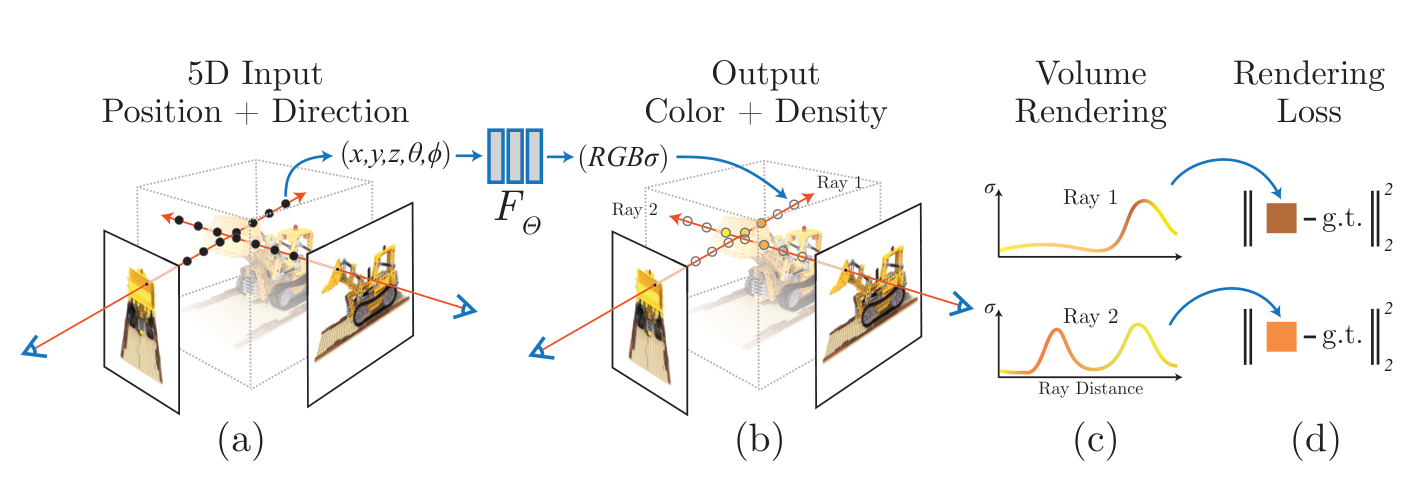
圖片來源: [5], arXiv:2003.08934v2, PDF 第 5 頁. 原始 PDF.
表示一個場,而非單張影像。 多層感知器接收三維位置 與觀看方向 ,預測非負體積密度 、RGB 色彩 。密度依位置改變,色彩還可依方向改變,以表示視角相關外觀。位置編碼將座標映射到多種正弦頻率,使網路比直接使用原座標更容易擬合細緻變化。
沿光線渲染。 對相機光線上的取樣位置,離散渲染為:
是像素預測色彩, 為第 點密度, 為到下一點的距離, 為依觀看方向決定的色彩, 為穿過前方樣本後的透射率。前方樣本可遮蔽後方樣本;此式將連續場連接到可微分成像,但密度不會自動成為乾淨表面網格。
把取樣用在重要位置。 粗網路先估計光線權重,階層重要性取樣再依此分布替精細網路增加樣本,減少空間或無資訊區域的浪費。使用已知相機光線與訓練影像像素誤差,監督兩個網路的渲染色彩;測試時改查詢新相機的光線。
結果
Table 1 在合成場景與真實前向拍攝場景,以保留視角、參考影像指標評估,支持這些條件下的新視角合成。重建訓練照片與渲染未見視角回答不同問題;只記住訓練視角不足以證明三維泛化。
原系統每條光線需要多次場查詢,且每個場景都要最佳化,因此品質須連同訓練/渲染成本看,不能套用後來加速變體的速度理解原論文。
消融實驗
Table 2 在真實感合成場景平均,分別移除位置編碼、觀看方向或階層取樣,檢查細緻座標表示、方向外觀與自適應取樣是否有用。Figure 4 則以視覺比較連接表示選擇與重建品質。
元件彼此互動,例如取樣分布改變,也會改變哪些位置收到影像監督。某元件在此流程有增益,不代表每個場景、相機覆蓋或照明都有相同改善。
結論
NeRF 透過可微分渲染器,把影像重建轉成連續密度/輻射場的最佳化;場表示、位置編碼與階層光線取樣共同支持新視角合成。
限制與問題
原方法假設靜態場景、相對一致的外觀與準確相機姿態。移動物體、稀疏視角、反光/透明表面或光照變化都可能造成瑕疵與幾何歧義;未見表面仍依賴先驗。照片渲染漂亮不代表度量幾何正確,每場景最佳化也不等於任意新場景的前饋預測。
參考文獻
- R. Hartley and A. Zisserman, Multiple View Geometry in Computer Vision, 2nd ed., Cambridge University Press, 2004. doi
- J. L. Schönberger and J.-M. Frahm, “Structure-from-motion revisited,” in Proc. IEEE CVPR, 2016. CVF
- J. L. Schönberger, E. Zheng, J.-M. Frahm and M. Pollefeys, “Pixelwise view selection for unstructured multi-view stereo,” in Proc. ECCV, 2016. doi
- J. L. Schönberger et al., “COLMAP,” official documentation (general-purpose structure-from-motion and multi-view stereo pipeline). link
- B. Mildenhall, P. P. Srinivasan, M. Tancik, J. T. Barron, R. Ramamoorthi and R. Ng, “NeRF: Representing scenes as neural radiance fields for view synthesis,” in Proc. ECCV, 2020; also Communications of the ACM, vol. 65, no. 1, pp. 99–106, 2022. doi · CACM doi · arXiv
- B. Kerbl, G. Kopanas, T. Leimkühler and G. Drettakis, “3D Gaussian Splatting for real-time radiance field rendering,” ACM Transactions on Graphics, vol. 42, no. 4, 2023. doi · arXiv
- H. C. Longuet-Higgins, “A computer algorithm for reconstructing a scene from two projections,” Nature, vol. 293, pp. 133–135, 1981. doi
- R. I. Hartley, “In defense of the eight-point algorithm,” IEEE TPAMI, vol. 19, no. 6, pp. 580–593, 1997. doi
- D. Nistér, “An efficient solution to the five-point relative pose problem,” IEEE TPAMI, vol. 26, no. 6, pp. 756–770, 2004. doi
- M. A. Fischler and R. C. Bolles, “Random sample consensus: A paradigm for model fitting with applications to image analysis and automated cartography,” Communications of the ACM, vol. 24, no. 6, pp. 381–395, 1981. doi
- D. G. Lowe, “Distinctive image features from scale-invariant keypoints,” International Journal of Computer Vision, vol. 60, no. 2, pp. 91–110, 2004. doi
- N. Snavely, S. M. Seitz and R. Szeliski, “Photo tourism: Exploring photo collections in 3D,” ACM Transactions on Graphics, vol. 25, no. 3, pp. 835–846, 2006. doi
- B. Triggs, P. F. McLauchlan, R. I. Hartley and A. W. Fitzgibbon, “Bundle adjustment — A modern synthesis,” in Vision Algorithms: Theory and Practice, LNCS 1883, pp. 298–372, Springer, 2000. doi
- R. T. Collins, “A space-sweep approach to true multi-image matching,” in Proc. IEEE CVPR, pp. 358–363, 1996. doi
- B. Curless and M. Levoy, “A volumetric method for building complex models from range images,” in Proc. SIGGRAPH, pp. 303–312, 1996. doi
- Y. Yao, Z. Luo, S. Li, T. Fang and L. Quan, “MVSNet: Depth inference for unstructured multi-view stereo,” in Proc. ECCV, 2018. CVF · doi
- N. Max, “Optical models for direct volume rendering,” IEEE Transactions on Visualization and Computer Graphics, vol. 1, no. 2, pp. 99–108, 1995. doi
- M. Tancik, P. P. Srinivasan, B. Mildenhall, S. Fridovich-Keil, N. Raghavan, U. Singhal, R. Ramamoorthi, J. T. Barron and R. Ng, “Fourier features let networks learn high frequency functions in low dimensional domains,” in Proc. NeurIPS, 2020. proceedings
- T. Müller, A. Evans, C. Schied and A. Keller, “Instant neural graphics primitives with a multiresolution hash encoding,” ACM Transactions on Graphics, vol. 41, no. 4, 2022. doi · arXiv
- J. J. Park, P. Florence, J. Straub, R. Newcombe and S. Lovegrove, “DeepSDF: Learning continuous signed distance functions for shape representation,” in Proc. IEEE/CVF CVPR, 2019. CVF
- L. Mescheder, M. Oechsle, M. Niemeyer, S. Nowozin and A. Geiger, “Occupancy networks: Learning 3D reconstruction in function space,” in Proc. IEEE/CVF CVPR, 2019. CVF
- P. Wang, L. Liu, Y. Liu, C. Theobalt, T. Komura and W. Wang, “NeuS: Learning neural implicit surfaces by volume rendering for multi-view reconstruction,” in Proc. NeurIPS, 2021. proceedings · arXiv
- M. Zwicker, H. Pfister, J. van Baar and M. Gross, “EWA volume splatting,” in Proc. IEEE Visualization, 2001. doi
- W. E. Lorensen and H. E. Cline, “Marching cubes: A high resolution 3D surface construction algorithm,” in Proc. SIGGRAPH, pp. 163–169, 1987. doi
- M. Kazhdan, M. Bolitho and H. Hoppe, “Poisson surface reconstruction,” in Proc. Eurographics Symposium on Geometry Processing, 2006. doi
- M. Kazhdan and H. Hoppe, “Screened Poisson surface reconstruction,” ACM Transactions on Graphics, vol. 32, no. 3, 2013. doi
- A. Guédon and V. Lepetit, “SuGaR: Surface-aligned Gaussian splatting for efficient 3D mesh reconstruction and high-quality mesh rendering,” in Proc. IEEE/CVF CVPR, 2024. CVF · arXiv
- B. Huang, Z. Yu, A. Chen, A. Geiger and S. Gao, “2D Gaussian splatting for geometrically accurate radiance fields,” in Proc. SIGGRAPH (Conference Papers), 2024. doi · arXiv
- S. Wang, V. Leroy, Y. Cabon, B. Chidlovskii and J. Revaud, “DUSt3R: Geometric 3D vision made easy,” in Proc. IEEE/CVF CVPR, 2024. CVF · arXiv
- V. Leroy, Y. Cabon and J. Revaud, “Grounding image matching in 3D with MASt3R,” in Proc. ECCV, 2024. doi · arXiv
- J. Wang, M. Chen, N. Karaev, A. Vedaldi, C. Rupprecht and D. Novotny, “VGGT: Visual geometry grounded transformer,” in Proc. IEEE/CVF CVPR, 2025. CVF · arXiv
- A. Pumarola, E. Corona, G. Pons-Moll and F. Moreno-Noguer, “D-NeRF: Neural radiance fields for dynamic scenes,” in Proc. IEEE/CVF CVPR, 2021. CVF
- G. Wu, T. Yi, J. Fang, L. Xie, X. Zhang, W. Wei, W. Liu, Q. Tian and X. Wang, “4D Gaussian splatting for real-time dynamic scene rendering,” in Proc. IEEE/CVF CVPR, 2024. CVF · arXiv
- Z. Wang, A. C. Bovik, H. R. Sheikh and E. P. Simoncelli, “Image quality assessment: From error visibility to structural similarity,” IEEE Transactions on Image Processing, vol. 13, no. 4, pp. 600–612, 2004. doi
- R. Zhang, P. Isola, A. A. Efros, E. Shechtman and O. Wang, “The unreasonable effectiveness of deep features as a perceptual metric,” in Proc. IEEE/CVF CVPR, 2018. CVF
- H. Fan, H. Su and L. J. Guibas, “A point set generation network for 3D object reconstruction from a single image,” in Proc. IEEE CVPR, 2017. CVF
- R. Jensen, A. Dahl, G. Vogiatzis, E. Tola and H. Aanæs, “Large scale multi-view stereopsis evaluation,” in Proc. IEEE CVPR, pp. 406–413, 2014. doi
- A. Knapitsch, J. Park, Q.-Y. Zhou and V. Koltun, “Tanks and Temples: Benchmarking large-scale scene reconstruction,” ACM Transactions on Graphics, vol. 36, no. 4, 2017. doi · benchmark
- J. T. Barron, B. Mildenhall, D. Verbin, P. P. Srinivasan and P. Hedman, “Mip-NeRF 360: Unbounded anti-aliased neural radiance fields,” in Proc. IEEE/CVF CVPR, 2022. CVF · arXiv
- D. Verbin, P. Hedman, B. Mildenhall, T. Zickler, J. T. Barron and P. P. Srinivasan, “Ref-NeRF: Structured view-dependent appearance for neural radiance fields,” in Proc. IEEE/CVF CVPR, 2022. CVF
- C.-H. Lin, W.-C. Ma, A. Torralba and S. Lucey, “BARF: Bundle-adjusting neural radiance fields,” in Proc. IEEE/CVF ICCV, 2021. CVF
- S. M. Seitz, B. Curless, J. Diebel, D. Scharstein and R. Szeliski, “A comparison and evaluation of multi-view stereo reconstruction algorithms,” in Proc. IEEE CVPR, vol. 1, pp. 519–528, 2006. doi
- Y. Furukawa and C. Hernández, “Multi-view stereo: A tutorial,” Foundations and Trends in Computer Graphics and Vision, vol. 9, no. 1–2, pp. 1–148, 2015. doi
- A. Tewari, J. Thies, B. Mildenhall, P. Srinivasan, E. Tretschk, W. Yifan, C. Lassner, V. Sitzmann et al., “Advances in neural rendering,” Computer Graphics Forum, vol. 41, no. 2, pp. 703–735, 2022. doi · arXiv
- G. Chen and W. Wang, “A survey on 3D Gaussian splatting,” ACM Computing Surveys, vol. 58, no. 12, 2026. doi · arXiv
- scikit-image contributors, “skimage.measure.marching_cubes,” scikit-image documentation (API reference). docs
- A. Dosovitskiy, L. Beyer, A. Kolesnikov, D. Weissenborn, X. Zhai et al., “An image is worth 16x16 words: Transformers for image recognition at scale,” in Proc. ICLR, 2021. arXiv
- A. Vaswani, N. Shazeer, N. Parmar, J. Uszkoreit, L. Jones, A. N. Gomez, Ł. Kaiser and I. Polosukhin, “Attention is all you need,” in Proc. NeurIPS, 2017. proceedings
- D. P. Kingma and J. Ba, “Adam: A method for stochastic optimization,” in Proc. ICLR, 2015. arXiv