Consistency Models:沿同一路徑預測相同端點(ICML 2023)
選讀・DLCV 12B・單步生成 的論文導讀(第 2/7 篇)。引用編號對應本頁底部的參考文獻。
導覽:本頁與本系列: 導覽:本頁與本系列
挑戰
Consistency Models [8] 讓網路從機率流路徑任意位置預測近乾淨端點,將單步生成改為直接預測;預算較多時也能多次細化。
只要求相等仍可能輸出無用常數,因此須乾淨邊界錨定與同一路徑配對。教師蒸餾與直接資料訓練,是不同的監督設定。
方法
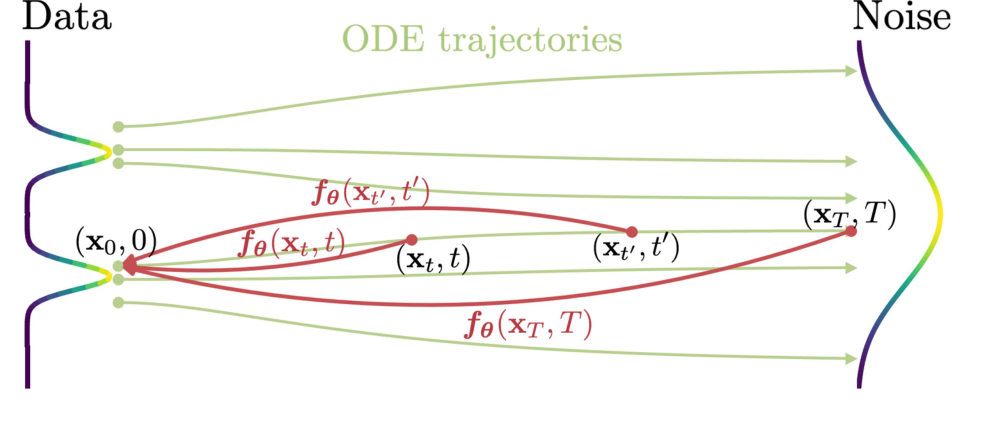
圖片來源: [8], arXiv:2303.01469v2, PDF 第 3 頁. 原始 PDF.
一致性函數。 路徑 上定義 , 是近資料邊界,輸出與影像同形狀。使用跳接參數化:
純量係數滿足 、, 為訓練網路。因此邊界精確回傳輸入,賦予一致性明確的端點意義。
一致性蒸餾。 從資料加雜訊取樣狀態,預訓練分數模型與 ODE 更新估計相鄰較乾淨狀態。線上模型的吵端預測符合目標網路的乾淨端預測,目標停止梯度,原演算法的目標權重追蹤線上權重的指數移動平均。
離散目標為 。 較吵, 為教師鄰點, 是距離, 是權重, 為目標參數, 停止梯度。求解器、網格及距離影響訓練品質,但單步部署不執行求解器。
直接訓練。 用資料和共用高斯雜訊建構鄰近雜訊程度配對,取代教師更新。理論關係屬漸近論證,有限配對並非精確 ODE 步。時間區間數及目標更新隨訓練排程改變;沒有獨立教師仍有自我目標與損失設計。
取樣。 從高雜訊評估一次端點函數;增加步數時,在較低程度重新加雜訊再預測。固定同一時間重複相同輸入,並不等價。
距離。 LPIPS [30] 是學得的感知距離,與像素損失強調不同誤差,但不是似然。外觀改善也可能伴隨其他分布或條件誤差。
結果
表 1:CIFAR-10 一步蒸餾 FID 3.55、兩步 2.93;同篇設定下漸進蒸餾為 8.34/5.58。表 2:ImageNet 64 × 64 一步/兩步蒸餾為 6.20/4.70,直接訓練則 13.0/11.1。直接訓練與蒸餾不能當成同一模型的同義描述。
結果支持端點學習及預算取捨,但不保證完全重現教師統計,也不能從小影像直接外推高解析度文字條件能力。
消融實驗
原文的距離/求解器研究顯示 LPIPS 優於比較的像素損失;固定網格下 Heun 目標優於 Euler,選用 18 個網格點。這是訓練建構,不是部署 18 步。直接訓練也受區間數和移動平均排程影響;曲線未列精確數值時,不捏造通用增益。
結論
乾淨邊界恆等式搭配端點函數,提供單步與少步路徑。蒸餾由教師供給軌跡,直接訓練由資料及近鄰雜訊程度建構監督。
限制與問題
自我目標誤差、跨時間一致性及有限離散化仍有限制。原始直接訓練在若干基準落後蒸餾,後續方法 [9] 改良權重與目標更新。模型定義也包含適用取樣器與排程。
參考文獻
- Y. Song, J. Sohl-Dickstein, D. P. Kingma, A. Kumar, S. Ermon, B. Poole, “Score-Based Generative Modeling through Stochastic Differential Equations,” ICLR, 2021. paper
- Y. Lipman, M. Havasi, P. Holderrieth, et al., “Flow Matching Guide and Code,” arXiv tutorial, 2024. paper
- T. Karras, M. Aittala, T. Aila, S. Laine, “Elucidating the Design Space of Diffusion-Based Generative Models,” NeurIPS, 2022. source
- X. Fan, Z. Wu, H. Wu, L. Cao, “A Survey on Pre-Trained Diffusion Model Distillations,” arXiv preprint, version 2, 2025. paper
- J. Song, C. Meng, S. Ermon, “Denoising Diffusion Implicit Models,” ICLR, 2021. paper
- C. Lu, Y. Zhou, F. Bao, J. Chen, C. Li, J. Zhu, “DPM-Solver: A Fast ODE Solver for Diffusion Probabilistic Model Sampling in Around 10 Steps,” NeurIPS, 2022. paper
- T. Salimans, J. Ho, “Progressive Distillation for Fast Sampling of Diffusion Models,” ICLR, 2022. paper
- Y. Song, P. Dhariwal, M. Chen, I. Sutskever, “Consistency Models,” ICML, 2023. paper
- Y. Song, P. Dhariwal, “Improved Techniques for Training Consistency Models,” ICLR, 2024. paper
- S. Luo, Y. Tan, L. Huang, J. Li, H. Zhao, “Latent Consistency Models: Synthesizing High-Resolution Images with Few-Step Inference,” arXiv preprint, 2023. paper
- R. Rombach, A. Blattmann, D. Lorenz, P. Esser, B. Ommer, “High-Resolution Image Synthesis with Latent Diffusion Models,” CVPR, 2022. source
- X. Liu, C. Gong, Q. Liu, “Flow Straight and Fast: Learning to Generate and Transfer Data with Rectified Flow,” ICLR, 2023. paper
- X. Liu, X. Zhang, J. Ma, J. Peng, Q. Liu, “InstaFlow: One Step is Enough for High-Quality Diffusion-Based Text-to-Image Generation,” ICLR, 2024. paper
- A. Sauer, D. Lorenz, A. Blattmann, R. Rombach, “Adversarial Diffusion Distillation,” ECCV, 2024. paper
- A. Sauer, F. Boesel, T. Dockhorn, A. Blattmann, P. Esser, R. Rombach, “Fast High-Resolution Image Synthesis with Latent Adversarial Diffusion Distillation,” SIGGRAPH Asia Conference Papers, 2024. paper · published version
- T. Yin, M. Gharbi, R. Zhang, E. Shechtman, F. Durand, W. T. Freeman, T. Park, “One-step Diffusion with Distribution Matching Distillation,” CVPR, 2024. paper
- T. H. Nguyen, A. Tran, “SwiftBrush: One-Step Text-to-Image Diffusion Model with Variational Score Distillation,” CVPR, 2024. paper
- M. Zhou, H. Zheng, Z. Wang, M. Yin, H. Huang, “Score identity Distillation: Exponentially Fast Distillation of Pretrained Diffusion Models for One-Step Generation,” ICML, 2024. paper
- T. Yin, M. Gharbi, T. Park, R. Zhang, E. Shechtman, F. Durand, W. T. Freeman, “Improved Distribution Matching Distillation for Fast Image Synthesis,” NeurIPS, 2024. paper
- K. Frans, D. Hafner, S. Levine, P. Abbeel, “One Step Diffusion via Shortcut Models,” ICLR, 2025. paper
- Z. Geng, M. Deng, X. Bai, J. Z. Kolter, K. He, “Mean Flows for One-step Generative Modeling,” NeurIPS, 2025. paper
- M. Heusel, H. Ramsauer, T. Unterthiner, B. Nessler, S. Hochreiter, “GANs Trained by a Two Time-Scale Update Rule Converge to a Local Nash Equilibrium,” NeurIPS, 2017. source
- A. Radford, J. W. Kim, C. Hallacy, et al., “Learning Transferable Visual Models From Natural Language Supervision,” ICML, 2021. paper
- D. Ghosh, H. Hajishirzi, L. Schmidt, “GenEval: An Object-Focused Framework for Evaluating Text-to-Image Alignment,” NeurIPS Datasets and Benchmarks, 2023. paper
- A. Krizhevsky, V. Nair and G. Hinton, “CIFAR-10 and CIFAR-100 datasets,” official dataset page; companion technical report: A. Krizhevsky, “Learning Multiple Layers of Features from Tiny Images,” 2009. dataset and report
- J. Deng, W. Dong, R. Socher, L. Li, Kai Li, Li Fei-Fei, “ImageNet: A large-scale hierarchical image database,” CVPR, 2009. doi
- T. Lin, M. Maire, S. Belongie, et al., “Microsoft COCO: Common Objects in Context,” ECCV, 2014. paper
- L. Yang, Z. Zhang, Y. Song, et al., “Diffusion Models: A Comprehensive Survey of Methods and Applications,” ACM Computing Surveys, 2023. paper
- Z. Yu, J. Yuan, H. Yang, et al., “DMAD: Distribution Matching as Adversarial Distillation for Fast Visual Generation,” arXiv preprint, 2026. paper
- R. Zhang, P. Isola, A. A. Efros, E. Shechtman and O. Wang, “The Unreasonable Effectiveness of Deep Features as a Perceptual Metric,” in Proc. IEEE/CVF CVPR, 2018, pp. 586–595. doi · arXiv
- C. Schuhmann, R. Beaumont, R. Vencu, et al., “LAION-5B: An open large-scale dataset for training next generation image-text models,” NeurIPS Datasets and Benchmarks, 2022. paper