綜述論文的詳細介紹
選讀・DLCV 09・深度影像復原:低階視覺 的論文導讀(第 13/13 篇)。引用編號對應本頁底部的參考文獻。
導覽:本頁與本系列: 導覽:本頁與本系列
本頁內容
- Wang、Chen 與 Hoi,〈Deep Learning for Image Super-resolution: A Survey〉(TPAMI 2021)
- Tian 等人,〈Deep Learning on Image Denoising: An Overview〉(Neural Networks 2020)
- Elad、Kawar 與 Vaksman,〈Image Denoising: The Deep Learning Revolution and Beyond〉(SIAM J. Imaging Sciences 2023)
- Zhang 等人,〈Deep Image Deblurring: A Survey〉(IJCV 2022)
- Gui 等人,〈A Comprehensive Survey and Taxonomy on Single Image Dehazing Based on Deep Learning〉(ACM Computing Surveys 2023)
- Yang 等人,〈Single Image Deraining: From Model-Based to Data-Driven and Beyond〉(TPAMI 2021)
- Jiang 等人,〈A Survey on All-in-One Image Restoration: Taxonomy, Evaluation and Future Trends〉(TPAMI 2025)
- Li 等人,〈Diffusion Models for Image Restoration and Enhancement: A Comprehensive Survey〉(IJCV 2025)
- 如何判讀這些論文的證據
- 參考文獻
電腦視覺深度學習
按退化來源、訓練監督、物理或生成先驗,以及評估目標,選擇適合的修復綜述。
白話版。 「現代觀點」以一行概述這些綜述;這裡列出它們的完整標題、出處、分類方式與重點。
Wang、Chen 與 Hoi,〈Deep Learning for Image Super-resolution: A Survey〉(TPAMI 2021)
[66]。把 SR 分成監督式、非監督式與特定領域 SR;在監督式 SR 中,再依上採樣位置(前、後、漸進、迭代上下採樣)、上採樣運算(插值、轉置卷積、子像素)、網路設計(殘差、遞迴、密集、注意力、多路徑)、損失函數與訓練策略來拆解模型。重點:大部分 SR 的進展都能描述成在這些軸上的選擇,而非監督/真實世界 SR 被點名為主要的開放方向,領域後來也確實往這裡走。
Tian 等人,〈Deep Learning on Image Denoising: An Overview〉(Neural Networks 2020)
[67]。把 CNN 去雜訊方法分成加性白雜訊、真實雜訊、盲去雜訊,以及混合了模糊或低解析度的雜訊四類,並在公開基準上比較。重點:瓶頸往往是雜訊模型的真實程度,而不是網路。
Elad、Kawar 與 Vaksman,〈Image Denoising: The Deep Learning Revolution and Beyond〉(SIAM J. Imaging Sciences 2023)
[68]。回顧去雜訊從傳統先驗到深度網路的歷史,接著主張去雜訊器如今是其他反問題(plug-and-play、regularization by denoising)以及擴散式影像生成的基本元件,並主張復原應該接受多個合理解(後驗取樣),而不是只給一個答案。重點:前沿已經從「更好的 MMSE 去雜訊器」移到「從後驗分布取樣」。
Zhang 等人,〈Deep Image Deblurring: A Survey〉(IJCV 2022)
[69]。涵蓋模糊成因、資料集與指標,以及依架構、損失函數與應用(人臉、文字、立體)分類的 CNN 去模糊方法,包含盲與非盲設定。重點:動態場景去模糊已從估計模糊核,轉向以 GoPro 這類實拍配對訓練的端到端多尺度網路。
Gui 等人,〈A Comprehensive Survey and Taxonomy on Single Image Dehazing Based on Deep Learning〉(ACM Computing Surveys 2023)
[70]。把方法分成監督式、半監督式與非監督式,並在各類中依是否及如何使用散射模型細分;也整理資料集、網路模組、損失函數與指標,並實驗比較基準方法。重點:物理引導與無物理的設計並存,合成到真實的落差是主要未解問題。
Yang 等人,〈Single Image Deraining: From Model-Based to Data-Driven and Beyond〉(TPAMI 2021)
[71]。回顧雨的外觀模型、以模型為基礎的方法(先驗與最佳化),以及資料驅動的方法(架構、限制條件、損失函數、資料集)。重點:真實的雨模型與真實世界的評估,比在合成資料上繼續微調架構更重要。
Jiang 等人,〈A Survey on All-in-One Image Restoration: Taxonomy, Evaluation and Future Trends〉(TPAMI 2025)
[72]。依架構設計、學習範式與核心創新(退化表徵、提示、混合專家、語言引導)整理 all-in-one 方法,並彙整資料集與評估協定。重點:各論文的任務組合不一致,讓比較變得困難;對未見過與混合退化的泛化仍是開放問題。
Li 等人,〈Diffusion Models for Image Restoration and Enhancement: A Comprehensive Survey〉(IJCV 2025)
[73]。依學習範式(監督式 vs. 零樣本使用預訓練先驗)、條件策略、框架設計與建模策略分類以擴散模型為基礎的復原,聚焦於 SR、去模糊、修補與盲/真實世界復原。重點:擴散模型的感知品質最好,但運算成本高,也有保真度與捏造細節的疑慮;蒸餾成少步驟與更好的評估方式是關鍵方向。
如何判讀這些論文的證據
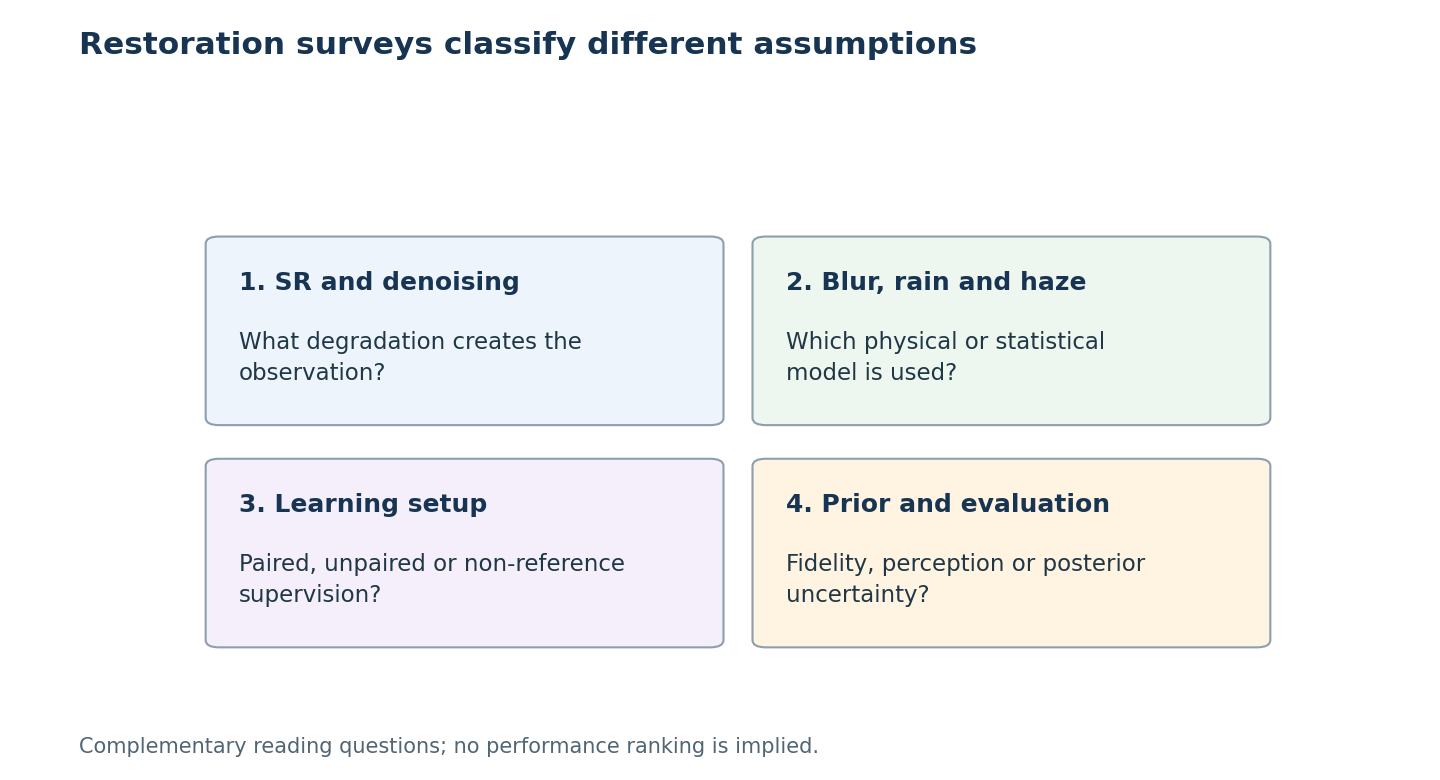
工作綜述解釋不同資訊缺失,一般修復、反問題回顧則連接訓練方式、先驗與評估。分類不是競爭標籤:同一模型可同時是監督式、物理引導、Transformer;生成修復還可能追求合理後驗樣本,而非唯一最小誤差估計。先辨識分類軸,再比較類別。
核心是測試是否符合目標觀測過程。合成模糊、雜訊、壓縮方便成對訓練,卻可能不代表真實影像;強先驗改善外觀也可能改內容。效率須計前處理、尺寸、取樣步數,品質須分參考、人類及無參考判斷。綜述用來找假設、基準,再回原流程、消融;並列表格不能建立跨工作受控架構排名。
參考文獻
- Shyandram, “Low-Level Vision Task-Image Restoration簡介,” Medium post, 2023; updated 2026. link
- Z. Chen, Z. Wu, E. Zamfir, K. Zhang, Y. Zhang, R. Timofte et al., “NTIRE 2024 Challenge on Image Super-Resolution (×4): Methods and Results,” in Proc. IEEE/CVF CVPR Workshops, 2024. arXiv
- Z. Chen, K. Liu, J. Gong, J. Wang, L. Sun et al., “NTIRE 2025 Challenge on Image Super-Resolution (×4): Methods and Results,” in Proc. IEEE/CVF CVPR Workshops, 2025. arXiv
- X. Wang, L. Xie, C. Dong and Y. Shan, “Real-ESRGAN: Training Real-World Blind Super-Resolution with Pure Synthetic Data,” in Proc. IEEE/CVF ICCV Workshops, 2021. arXiv
- E. H. Land and J. J. McCann, “Lightness and Retinex Theory,” Journal of the Optical Society of America, vol. 61, no. 1, pp. 1–11, 1971. doi
- C. Dong, C. C. Loy, K. He and X. Tang, “Image Super-Resolution Using Deep Convolutional Networks,” IEEE TPAMI, 2016 (conference version ECCV 2014). arXiv
- C. Dong, C. C. Loy and X. Tang, “Accelerating the Super-Resolution Convolutional Neural Network,” in Proc. ECCV, 2016. arXiv
- W. Shi, J. Caballero, F. Huszár, J. Totz, A. P. Aitken, R. Bishop, D. Rueckert and Z. Wang, “Real-Time Single Image and Video Super-Resolution Using an Efficient Sub-Pixel Convolutional Neural Network,” in Proc. IEEE CVPR, 2016. arXiv
- A. Odena, V. Dumoulin and C. Olah, “Deconvolution and Checkerboard Artifacts,” Distill, 2016. link
- B. Lim, S. Son, H. Kim, S. Nah and K. M. Lee, “Enhanced Deep Residual Networks for Single Image Super-Resolution,” in Proc. IEEE CVPR Workshops, 2017. arXiv
- Y. Zhang, K. Li, K. Li, L. Wang, B. Zhong and Y. Fu, “Image Super-Resolution Using Very Deep Residual Channel Attention Networks,” in Proc. ECCV, 2018. arXiv
- C. Ledig, L. Theis, F. Huszár, J. Caballero, A. Cunningham, A. Acosta, A. Aitken, A. Tejani, J. Totz, Z. Wang and W. Shi, “Photo-Realistic Single Image Super-Resolution Using a Generative Adversarial Network,” in Proc. IEEE CVPR, 2017. arXiv
- X. Wang, K. Yu, S. Wu, J. Gu, Y. Liu, C. Dong, C. C. Loy, Y. Qiao and X. Tang, “ESRGAN: Enhanced Super-Resolution Generative Adversarial Networks,” in Proc. ECCV Workshops, 2018. arXiv
- J. Liang, J. Cao, G. Sun, K. Zhang, L. Van Gool and R. Timofte, “SwinIR: Image Restoration Using Swin Transformer,” in Proc. IEEE/CVF ICCV Workshops, 2021. arXiv
- X. Chen, X. Wang, J. Zhou, Y. Qiao and C. Dong, “Activating More Pixels in Image Super-Resolution Transformer,” in Proc. IEEE/CVF CVPR, 2023. arXiv
- X. Lin, J. He, Z. Chen, Z. Lyu, B. Dai, F. Yu, W. Ouyang, Y. Qiao and C. Dong, “DiffBIR: Towards Blind Image Restoration with Generative Diffusion Prior,” arXiv:2308.15070, 2023. arXiv
- F. Yu, J. Gu, Z. Li, J. Hu, X. Kong, X. Wang, J. He, Y. Qiao and C. Dong, “Scaling Up to Excellence: Practicing Model Scaling for Photo-Realistic Image Restoration In the Wild,” in Proc. IEEE/CVF CVPR, 2024. arXiv
- R. Wu, L. Sun, Z. Ma and L. Zhang, “One-Step Effective Diffusion Network for Real-World Image Super-Resolution,” in Proc. NeurIPS, 2024. arXiv
- E. Agustsson and R. Timofte, “NTIRE 2017 Challenge on Single Image Super-Resolution: Dataset and Study,” in Proc. IEEE CVPR Workshops, 2017. doi
- K. Zhang, W. Zuo, Y. Chen, D. Meng and L. Zhang, “Beyond a Gaussian Denoiser: Residual Learning of Deep CNN for Image Denoising,” IEEE Transactions on Image Processing, vol. 26, no. 7, pp. 3142–3155, 2017. arXiv
- K. Zhang, W. Zuo and L. Zhang, “FFDNet: Toward a Fast and Flexible Solution for CNN-Based Image Denoising,” IEEE Transactions on Image Processing, 2018. arXiv
- A. Abdelhamed, S. Lin and M. S. Brown, “A High-Quality Denoising Dataset for Smartphone Cameras,” in Proc. IEEE/CVF CVPR, 2018. doi
- S. W. Zamir, A. Arora, S. Khan, M. Hayat, F. S. Khan and M.-H. Yang, “Restormer: Efficient Transformer for High-Resolution Image Restoration,” in Proc. IEEE/CVF CVPR, 2022. arXiv
- L. Chen, X. Chu, X. Zhang and J. Sun, “Simple Baselines for Image Restoration,” in Proc. ECCV, 2022. arXiv
- K. He, J. Sun and X. Tang, “Single Image Haze Removal Using Dark Channel Prior,” in Proc. IEEE CVPR, 2009. doi
- B. Cai, X. Xu, K. Jia, C. Qing and D. Tao, “DehazeNet: An End-to-End System for Single Image Haze Removal,” IEEE Transactions on Image Processing, 2016. arXiv
- B. Li, X. Peng, Z. Wang, J. Xu and D. Feng, “AOD-Net: All-in-One Dehazing Network,” in Proc. IEEE ICCV, 2017. doi · arXiv
- X. Liu, Y. Ma, Z. Shi and J. Chen, “GridDehazeNet: Attention-Based Multi-Scale Network for Image Dehazing,” in Proc. IEEE/CVF ICCV, 2019. arXiv
- X. Qin, Z. Wang, Y. Bai, X. Xie and H. Jia, “FFA-Net: Feature Fusion Attention Network for Single Image Dehazing,” in Proc. AAAI, 2020. arXiv
- S. W. Zamir, A. Arora, S. Khan, M. Hayat, F. S. Khan, M.-H. Yang and L. Shao, “Learning Enriched Features for Real Image Restoration and Enhancement,” in Proc. ECCV, 2020. arXiv
- Y. Song, Z. He, H. Qian and X. Du, “Vision Transformers for Single Image Dehazing,” IEEE Transactions on Image Processing, vol. 32, 2023. arXiv
- B. Li, W. Ren, D. Fu, D. Tao, D. Feng, W. Zeng and Z. Wang, “Benchmarking Single-Image Dehazing and Beyond,” IEEE Transactions on Image Processing, 2019. arXiv
- C. O. Ancuti, C. Ancuti, R. Timofte and C. De Vleeschouwer, “O-HAZE: A Dehazing Benchmark with Real Hazy and Haze-Free Outdoor Images,” in Proc. IEEE/CVF CVPR Workshops, 2018. doi
- C. O. Ancuti, C. Ancuti, M. Sbert and R. Timofte, “Dense-Haze: A Benchmark for Image Dehazing with Dense-Haze and Haze-Free Images,” in Proc. IEEE ICIP, 2019. doi
- A. Geiger, P. Lenz and R. Urtasun, “Are We Ready for Autonomous Driving? The KITTI Vision Benchmark Suite,” in Proc. IEEE CVPR, 2012. project page
- Y.-F. Liu, D.-W. Jaw, S.-C. Huang and J.-N. Hwang, “DesnowNet: Context-Aware Deep Network for Snow Removal,” IEEE Transactions on Image Processing, 2018. arXiv
- W.-T. Chen, H.-Y. Fang, J.-J. Ding, C.-C. Tsai and S.-Y. Kuo, “JSTASR: Joint Size and Transparency-Aware Snow Removal Algorithm Based on Modified Partial Convolution and Veiling Effect Removal,” in Proc. ECCV, 2020. doi
- W. Yang, R. T. Tan, J. Feng, J. Liu, Z. Guo and S. Yan, “Deep Joint Rain Detection and Removal from a Single Image,” in Proc. IEEE CVPR, 2017. arXiv
- R. Qian, R. T. Tan, W. Yang, J. Su and J. Liu, “Attentive Generative Adversarial Network for Raindrop Removal from a Single Image,” in Proc. IEEE/CVF CVPR, 2018. arXiv
- X. Li, Y. Jin, X. Jin, Z. Wu, B. Li, Y. Wang et al., “NTIRE 2025 Challenge on Day and Night Raindrop Removal for Dual-Focused Images: Methods and Results,” in Proc. IEEE/CVF CVPR Workshops, 2025. arXiv
- C. Wei, W. Wang, W. Yang and J. Liu, “Deep Retinex Decomposition for Low-Light Enhancement,” in Proc. BMVC, 2018. arXiv
- Y. Cai, H. Bian, J. Lin, H. Wang, R. Timofte and Y. Zhang, “Retinexformer: One-stage Retinex-based Transformer for Low-light Image Enhancement,” in Proc. IEEE/CVF ICCV, 2023. arXiv
- H. Zhang, H. Xu, X. Tian, J. Jiang and J. Ma, “Image Fusion Meets Deep Learning: A Survey and Perspective,” Information Fusion, vol. 76, pp. 323–336, 2021. doi
- S. Nah, T. H. Kim and K. M. Lee, “Deep Multi-scale Convolutional Neural Network for Dynamic Scene Deblurring,” in Proc. IEEE CVPR, 2017. doi · arXiv
- K. He, X. Chen, S. Xie, Y. Li, P. Dollár and R. Girshick, “Masked Autoencoders Are Scalable Vision Learners,” in Proc. IEEE/CVF CVPR, 2022. arXiv
- R. Suvorov, E. Logacheva, A. Mashikhin, A. Remizova, A. Ashukha, A. Silvestrov, N. Kong, H. Goka, K. Park and V. Lempitsky, “Resolution-robust Large Mask Inpainting with Fourier Convolutions,” in Proc. IEEE/CVF WACV, 2022. arXiv
- S. Sengupta, V. Jayaram, B. Curless, S. Seitz and I. Kemelmacher-Shlizerman, “Background Matting: The World is Your Green Screen,” in Proc. IEEE/CVF CVPR, 2020. arXiv
- O. Ronneberger, P. Fischer and T. Brox, “U-Net: Convolutional Networks for Biomedical Image Segmentation,” in Proc. MICCAI, 2015. arXiv
- H. Guo, J. Li, T. Dai, Z. Ouyang, X. Ren and S.-T. Xia, “MambaIR: A Simple Baseline for Image Restoration with State-Space Model,” in Proc. ECCV, 2024. arXiv
- H. Guo, Y. Guo, Y. Zha, Y. Zhang, W. Li, T. Dai, S.-T. Xia and Y. Li, “MambaIRv2: Attentive State Space Restoration,” in Proc. IEEE/CVF CVPR, 2025. arXiv
- B. Li, X. Liu, P. Hu, Z. Wu, J. Lv and X. Peng, “All-In-One Image Restoration for Unknown Corruption,” in Proc. IEEE/CVF CVPR, 2022. code & paper
- J. M. J. Valanarasu, R. Yasarla and V. M. Patel, “TransWeather: Transformer-based Restoration of Images Degraded by Adverse Weather Conditions,” in Proc. IEEE/CVF CVPR, 2022. arXiv
- V. Potlapalli, S. W. Zamir, S. Khan and F. S. Khan, “PromptIR: Prompting for All-in-One Image Restoration,” in Proc. NeurIPS, 2023. arXiv
- Y. Cui, S. W. Zamir, S. Khan, A. Knoll, M. Shah and F. S. Khan, “AdaIR: Adaptive All-in-One Image Restoration via Frequency Mining and Modulation,” in Proc. ICLR, 2025. arXiv
- Z. Luo, F. K. Gustafsson, Z. Zhao, J. Sjölund and T. B. Schön, “Controlling Vision-Language Models for Multi-Task Image Restoration,” in Proc. ICLR, 2024. arXiv
- M. V. Conde, G. Geigle and R. Timofte, “InstructIR: High-Quality Image Restoration Following Human Instructions,” in Proc. ECCV, 2024. arXiv
- H. Zhao, O. Gallo, I. Frosio and J. Kautz, “Loss Functions for Image Restoration with Neural Networks,” IEEE Transactions on Computational Imaging, 2017 (arXiv title: “Loss Functions for Neural Networks for Image Processing”). arXiv
- J. Johnson, A. Alahi and L. Fei-Fei, “Perceptual Losses for Real-Time Style Transfer and Super-Resolution,” in Proc. ECCV, 2016. doi · arXiv
- L. Jiang, B. Dai, W. Wu and C. C. Loy, “Focal Frequency Loss for Image Reconstruction and Synthesis,” in Proc. IEEE/CVF ICCV, 2021. arXiv
- Z. Wang, A. C. Bovik, H. R. Sheikh and E. P. Simoncelli, “Image Quality Assessment: From Error Visibility to Structural Similarity,” IEEE Transactions on Image Processing, vol. 13, no. 4, pp. 600–612, 2004. doi
- R. Zhang, P. Isola, A. A. Efros, E. Shechtman and O. Wang, “The Unreasonable Effectiveness of Deep Features as a Perceptual Metric,” in Proc. IEEE/CVF CVPR, 2018. arXiv
- A. Mittal, R. Soundararajan and A. C. Bovik, “Making a ‘Completely Blind’ Image Quality Analyzer,” IEEE Signal Processing Letters, 2013. doi
- Y. Blau, R. Mechrez, R. Timofte, T. Michaeli and L. Zelnik-Manor, “The 2018 PIRM Challenge on Perceptual Image Super-resolution,” in Proc. ECCV Workshops, 2018. arXiv
- M. Heusel, H. Ramsauer, T. Unterthiner, B. Nessler and S. Hochreiter, “GANs Trained by a Two Time-Scale Update Rule Converge to a Local Nash Equilibrium,” in Proc. NeurIPS, 2017. arXiv
- Y. Blau and T. Michaeli, “The Perception-Distortion Tradeoff,” in Proc. IEEE/CVF CVPR, 2018. arXiv
- Z. Wang, J. Chen and S. C. H. Hoi, “Deep Learning for Image Super-Resolution: A Survey,” IEEE TPAMI, 2021. arXiv
- C. Tian, L. Fei, W. Zheng, Y. Xu, W. Zuo and C.-W. Lin, “Deep Learning on Image Denoising: An Overview,” Neural Networks, vol. 131, pp. 251–275, 2020. arXiv
- M. Elad, B. Kawar and G. Vaksman, “Image Denoising: The Deep Learning Revolution and Beyond — A Survey Paper,” SIAM Journal on Imaging Sciences, vol. 16, no. 3, pp. 1594–1654, 2023. doi · arXiv
- K. Zhang, W. Ren, W. Luo, W.-S. Lai, B. Stenger, M.-H. Yang and H. Li, “Deep Image Deblurring: A Survey,” International Journal of Computer Vision, 2022. arXiv
- J. Gui, X. Cong, Y. Cao, W. Ren, J. Zhang, J. Zhang, J. Cao and D. Tao, “A Comprehensive Survey and Taxonomy on Single Image Dehazing Based on Deep Learning,” ACM Computing Surveys, 2023. doi · arXiv
- W. Yang, R. T. Tan, S. Wang, Y. Fang and J. Liu, “Single Image Deraining: From Model-Based to Data-Driven and Beyond,” IEEE TPAMI, 2021. doi · arXiv
- J. Jiang, Z. Zuo, G. Wu, K. Jiang and X. Liu, “A Survey on All-in-One Image Restoration: Taxonomy, Evaluation and Future Trends,” IEEE TPAMI, 2025. arXiv
- X. Li, Y. Ren, X. Jin, C. Lan, X. Wang, W. Zeng, X. Wang and Z. Chen, “Diffusion Models for Image Restoration and Enhancement: A Comprehensive Survey,” International Journal of Computer Vision, 2025. arXiv
- A. Levin, Y. Weiss, F. Durand and W. T. Freeman, “Understanding and Evaluating Blind Deconvolution Algorithms,” in Proc. IEEE CVPR, 2009, pp. 1964–1971. doi
- R. Fergus, B. Singh, A. Hertzmann, S. T. Roweis and W. T. Freeman, “Removing Camera Shake from a Single Photograph,” ACM Transactions on Graphics (Proc. SIGGRAPH), vol. 25, no. 3, pp. 787–794, 2006. doi
- Q. Shan, J. Jia and A. Agarwala, “High-quality Motion Deblurring from a Single Image,” ACM Transactions on Graphics (Proc. SIGGRAPH), vol. 27, no. 3, 2008. doi
- S. Cho and S. Lee, “Fast Motion Deblurring,” ACM Transactions on Graphics (Proc. SIGGRAPH Asia), vol. 28, no. 5, 2009. doi
- L. Xu and J. Jia, “Two-Phase Kernel Estimation for Robust Motion Deblurring,” in Proc. ECCV, 2010, pp. 157–170. doi
- D. Krishnan, T. Tay and R. Fergus, “Blind Deconvolution Using a Normalized Sparsity Measure,” in Proc. IEEE CVPR, 2011, pp. 233–240. doi
- J. Pan, D. Sun, H. Pfister and M.-H. Yang, “Blind Image Deblurring Using Dark Channel Prior,” in Proc. IEEE CVPR, 2016, pp. 1628–1636. doi
- J. Sun, W. Cao, Z. Xu and J. Ponce, “Learning a Convolutional Neural Network for Non-uniform Motion Blur Removal,” in Proc. IEEE CVPR, 2015. arXiv
- C. J. Schuler, M. Hirsch, S. Harmeling and B. Schölkopf, “Learning to Deblur,” IEEE TPAMI, vol. 38, no. 7, pp. 1439–1451, 2016. doi · arXiv
- A. Chakrabarti, “A Neural Approach to Blind Motion Deblurring,” in Proc. ECCV, 2016. arXiv
- D. Ulyanov, A. Vedaldi and V. Lempitsky, “Deep Image Prior,” in Proc. IEEE/CVF CVPR, 2018, pp. 9446–9454. doi · arXiv
- D. Ren, K. Zhang, Q. Wang, Q. Hu and W. Zuo, “Neural Blind Deconvolution Using Deep Priors,” in Proc. IEEE/CVF CVPR, 2020. arXiv
- O. Kupyn, V. Budzan, M. Mykhailych, D. Mishkin and J. Matas, “DeblurGAN: Blind Motion Deblurring Using Conditional Adversarial Networks,” in Proc. IEEE/CVF CVPR, 2018. arXiv
- K. Zhang, W. Zuo and L. Zhang, “Learning a Single Convolutional Super-Resolution Network for Multiple Degradations,” in Proc. IEEE/CVF CVPR, 2018. arXiv
- J. Gu, H. Lu, W. Zuo and C. Dong, “Blind Super-Resolution With Iterative Kernel Correction,” in Proc. IEEE/CVF CVPR, 2019. arXiv
- S. Bell-Kligler, A. Shocher and M. Irani, “Blind Super-Resolution Kernel Estimation using an Internal-GAN,” in Proc. NeurIPS, 2019. link · arXiv
- Z. Luo, Y. Huang, S. Li, L. Wang and T. Tan, “Unfolding the Alternating Optimization for Blind Super Resolution,” in Proc. NeurIPS, 2020. arXiv
- K. Zhang, L. Van Gool and R. Timofte, “Deep Unfolding Network for Image Super-Resolution,” in Proc. IEEE/CVF CVPR, 2020. arXiv
- K. Zhang, J. Liang, L. Van Gool and R. Timofte, “Designing a Practical Degradation Model for Deep Blind Image Super-Resolution,” in Proc. IEEE/CVF ICCV, 2021. arXiv
- A. Liu, Y. Liu, J. Gu, Y. Qiao and C. Dong, “Blind Image Super-Resolution: A Survey and Beyond,” IEEE TPAMI, 2022 (early access). doi · arXiv
- A. Mittal, A. K. Moorthy and A. C. Bovik, “No-Reference Image Quality Assessment in the Spatial Domain,” IEEE Transactions on Image Processing, vol. 21, no. 12, pp. 4695–4708, 2012. doi
- C. Ma, C.-Y. Yang, X. Yang and M.-H. Yang, “Learning a No-Reference Quality Metric for Single-Image Super-Resolution,” Computer Vision and Image Understanding, vol. 158, pp. 1–16, 2017. doi · arXiv
- N. Venkatanath, D. Praneeth, M. C. Bh, S. S. Channappayya and S. S. Medasani, “Blind Image Quality Evaluation Using Perception Based Features,” in Proc. Twenty First National Conference on Communications (NCC), 2015, pp. 1–6. doi · MATLAB documentation
- H. Talebi and P. Milanfar, “NIMA: Neural Image Assessment,” IEEE Transactions on Image Processing, vol. 27, no. 8, pp. 3998–4011, 2018. doi · arXiv
- S. Su, Q. Yan, Y. Zhu, C. Zhang, X. Ge, J. Sun and Y. Zhang, “Blindly Assess Image Quality in the Wild Guided by a Self-Adaptive Hyper Network,” in Proc. IEEE/CVF CVPR, 2020, pp. 3664–3673. doi
- J. Ke, Q. Wang, Y. Wang, P. Milanfar and F. Yang, “MUSIQ: Multi-scale Image Quality Transformer,” in Proc. IEEE/CVF ICCV, 2021, pp. 5128–5137. doi · arXiv
- S. Yang, T. Wu, S. Shi, S. Lao, Y. Gong, M. Cao, J. Wang and Y. Yang, “MANIQA: Multi-dimension Attention Network for No-Reference Image Quality Assessment,” in Proc. IEEE/CVF CVPR Workshops, 2022, pp. 1190–1199. doi · arXiv
- C. Chen, J. Mo, J. Hou, H. Wu, L. Liao, W. Sun, Q. Yan and W. Lin, “TOPIQ: A Top-Down Approach From Semantics to Distortions for Image Quality Assessment,” IEEE Transactions on Image Processing, vol. 33, pp. 2404–2418, 2024. doi · arXiv
- J. Wang, K. C. K. Chan and C. C. Loy, “Exploring CLIP for Assessing the Look and Feel of Images,” in Proc. AAAI Conference on Artificial Intelligence, 2023. arXiv
- H. Wu, Z. Zhang, W. Zhang, C. Chen, L. Liao, C. Li, Y. Gao, A. Wang, E. Zhang, W. Sun, Q. Yan, X. Min, G. Zhai and W. Lin, “Q-Align: Teaching LMMs for Visual Scoring via Discrete Text-Defined Levels,” in Proc. ICML, PMLR 235, pp. 54015–54029, 2024. link · arXiv
- H. R. Sheikh, M. F. Sabir and A. C. Bovik, “A Statistical Evaluation of Recent Full Reference Image Quality Assessment Algorithms,” IEEE Transactions on Image Processing, vol. 15, no. 11, pp. 3440–3451, 2006 (LIVE Image Quality Assessment Database). doi · database
- N. Ponomarenko, L. Jin, O. Ieremeiev, V. Lukin, K. Egiazarian, J. Astola, B. Vozel, K. Chehdi, M. Carli, F. Battisti and C.-C. J. Kuo, “Image Database TID2013: Peculiarities, Results and Perspectives,” Signal Processing: Image Communication, vol. 30, pp. 57–77, 2015. doi · database
- H. Lin, V. Hosu and D. Saupe, “KADID-10k: A Large-scale Artificially Distorted IQA Database,” in Proc. Eleventh International Conference on Quality of Multimedia Experience (QoMEX), 2019. doi · database
- V. Hosu, H. Lin, T. Sziranyi and D. Saupe, “KonIQ-10k: An Ecologically Valid Database for Deep Learning of Blind Image Quality Assessment,” IEEE Transactions on Image Processing, vol. 29, pp. 4041–4056, 2020. arXiv
- Y. Fang, H. Zhu, Y. Zeng, K. Ma and Z. Wang, “Perceptual Quality Assessment of Smartphone Photography,” in Proc. IEEE/CVF CVPR, 2020, pp. 3674–3683. doi
- J. Gu, H. Cai, H. Chen, X. Ye, J. Ren and C. Dong, “PIPAL: A Large-Scale Image Quality Assessment Dataset for Perceptual Image Restoration,” in Proc. ECCV, 2020. arXiv
- C. Chen and J. Mo, “IQA-PyTorch: PyTorch Toolbox for Image Quality Assessment,” software (pip package
pyiqa), 2022. GitHub - ITU-R, “Recommendation BT.500-15: Methodologies for the Subjective Assessment of the Quality of Television Images,” 2023. ITU
- R. A. Bradley and M. E. Terry, “Rank Analysis of Incomplete Block Designs: The Method of Paired Comparisons,” Biometrika, vol. 39, no. 3–4, pp. 324–345, 1952. doi
- D. Geman and C. Yang, “Nonlinear Image Recovery with Half-Quadratic Regularization,” IEEE Transactions on Image Processing, vol. 4, no. 7, pp. 932–946, 1995. doi
- S. V. Venkatakrishnan, C. A. Bouman and B. Wohlberg, “Plug-and-Play Priors for Model Based Reconstruction,” in Proc. IEEE Global Conference on Signal and Information Processing (GlobalSIP), 2013, pp. 945–948. doi
- K. Zhang, W. Zuo, S. Gu and L. Zhang, “Learning Deep CNN Denoiser Prior for Image Restoration,” in Proc. IEEE/CVF CVPR, 2017, pp. 2808–2817. doi · arXiv
- A. Chambolle, “An Algorithm for Total Variation Minimization and Applications,” Journal of Mathematical Imaging and Vision, vol. 20, no. 1–2, pp. 89–97, 2004. doi
- A. Buades, B. Coll and J.-M. Morel, “A Non-Local Algorithm for Image Denoising,” in Proc. IEEE CVPR, vol. 2, 2005, pp. 60–65. doi
- D. Ulyanov, A. Vedaldi and V. Lempitsky, “Deep Image Prior,” International Journal of Computer Vision, vol. 128, no. 7, pp. 1867–1888, 2020. doi · arXiv
- Y. Jiang, Z. Zhang, T. Xue and J. Gu, “AutoDIR: Automatic All-in-One Image Restoration with Latent Diffusion,” in Proc. ECCV, 2024. paper
- K. Zhu, J. Gu, Z. You, Y. Qiao and C. Dong, “An Intelligent Agentic System for Complex Image Restoration Problems,” in Proc. ICLR, 2025. paper
- Y. Zuo, Q. Zheng, M. Wu, X. Jiang, R. Li, J. Wang, Y. Zhang, G. Mai, L. V. Wang, J. Zou, X. Wang, M.-H. Yang and Z. Tu, “4KAgent: Agentic Any Image to 4K Super-Resolution,” in Proc. NeurIPS, 2025. paper
- Y. Yu, Z. Zeng, H. Hua, J. Fu and J. Luo, “PromptFix: You Prompt and We Fix the Photo,” in Proc. NeurIPS, 2024. paper