JiT — clean-image prediction in pixel space
Optional · paper guide 5 of 6 for ML 08 · Diffusion Models and Flow Matching. Citation numbers refer to the reference list at the bottom of this page.
Navigate: this page and this track: Navigate: this page and this track
On this page
- DDPM — noise prediction and the quality–likelihood tradeoff
- Flow Matching — regress a velocity, then integrate it
- MeanFlow — average velocity over an interval
- Improved MeanFlow — prediction inputs and flexible guidance
- JiT — clean-image prediction in pixel space
- Pixel MeanFlow — one-step pixels through a denoised field
Machine Learning
Question and thesis
Why can large-patch pixel Transformers work when asked to predict clean images yet fail when directly predicting noise or velocity? Li and He argue that clean natural images occupy a much lower-dimensional structure than the surrounding noisy space [42]. Their Just image Transformers, or JiT, study the interaction between prediction target and network capacity. Read ViT patch dimensions and the chapter’s distinction between direct output and loss space first.
Method and figure
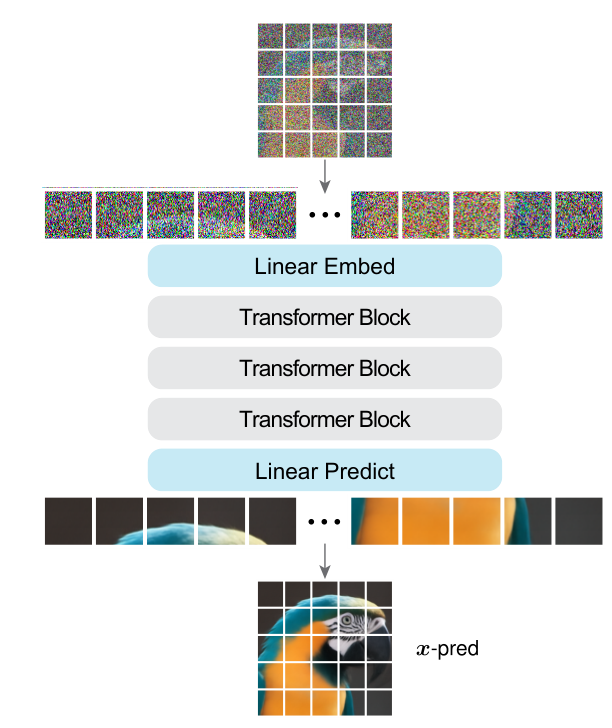
Figure 3 shows pixel patches, a linear embedding, Transformer blocks and a linear prediction of image patches. Time and class condition the network. There is no separate learned latent encoder/decoder in this generator. However, predicting a clean image at each time is not the same as learning a complete one-step generative map.
To make the time-direction difference explicit, call JiT’s time : noise is at zero and data at one. Then
Here is clean data, is prior noise, is the interpolated input, is the direct network output, and is the derived instantaneous velocity. The equation holds for before numerical safeguards. In MeanFlow’s convention, substitute and reverse the velocity sign. The solver uses velocity even though the network predicts an image; the velocity loss is a time-weighted image error, not an unweighted image MSE.
Evidence
Table 2 crosses three direct outputs with three loss spaces. For JiT-B/16 on ImageNet 256×256, 200 epochs and CFG, the velocity-loss row gives FID 8.62 with image output, 372.38 with noise output and 96.53 with velocity output. The smaller 64×64, patch-4 setting does not show the same decisive separation. This controls the loss while revealing a capacity-sensitive prediction-space effect. Figure 4 separately shows that a bottleneck patch embedding can remain effective with image prediction.
Design analysis
A patch’s scalar dimension is different from the number of patches. Increasing image resolution and patch size together can hold token count fixed while increasing the information per token. The paper’s synthetic embedding experiment and image ablations support its manifold explanation under finite network capacity. They do not prove that all clean-image predictors universally outperform every noise predictor. Adjusting loss weights or noise sampling alone also does not reproduce the architectural comparison.
Reading checkpoint
Name three distinct quantities: the direct output, the loss target and the quantity consumed by the ODE solver. Then explain why a single clean prediction from highly noisy input may be an average over possibilities rather than a sharp sample from the image distribution.
Limits and next step
JiT targets class-conditioned generation and still uses numerical sampling; it is not inherently a one-step or freeform text-to-image model. Its no-tokenizer recipe also should not be conflated with every later pixel generator’s use of pretrained losses. Continue to Pixel MeanFlow, which adds a two-time denoised-image field and an interval objective to support one-call pixel generation.
Continue reading: Pixel MeanFlow — one-step pixels through a denoised field
References
- L. Yang, Z. Zhang, Y. Song, S. Hong, R. Xu, Y. Zhao, W. Zhang, B. Cui and M.-H. Yang, “Diffusion Models: A Comprehensive Survey of Methods and Applications,” ACM Computing Surveys, 2023. arXiv
- Y. Lipman, M. Havasi, P. Holderrieth, N. Shaul, M. Le, B. Karrer, R. T. Q. Chen, D. Lopez-Paz, H. Ben-Hamu and I. Gat, “Flow Matching Guide and Code,” arXiv:2412.06264, 2024. arXiv
- J. Ho, A. Jain and P. Abbeel, “Denoising Diffusion Probabilistic Models,” NeurIPS, 2020. arXiv
- Y. Song, J. Sohl-Dickstein, D. P. Kingma, A. Kumar, S. Ermon and B. Poole, “Score-Based Generative Modeling through Stochastic Differential Equations,” ICLR, 2021. arXiv
- J. Song, C. Meng and S. Ermon, “Denoising Diffusion Implicit Models,” ICLR, 2021. arXiv
- J. Ho and T. Salimans, “Classifier-Free Diffusion Guidance,” NeurIPS 2021 Workshop on Deep Generative Models and Downstream Applications; arXiv:2207.12598, 2022. arXiv
- R. Rombach, A. Blattmann, D. Lorenz, P. Esser and B. Ommer, “High-Resolution Image Synthesis with Latent Diffusion Models,” CVPR, 2022. arXiv
- W. Peebles and S. Xie, “Scalable Diffusion Models with Transformers,” ICCV, 2023. arXiv
- P. Esser, S. Kulal, A. Blattmann et al., “Scaling Rectified Flow Transformers for High-Resolution Image Synthesis,” ICML, PMLR 235, 2024. PMLR
- Y. Lipman, R. T. Q. Chen, H. Ben-Hamu, M. Nickel and M. Le, “Flow Matching for Generative Modeling,” ICLR, 2023. arXiv
- X. Liu, C. Gong and Q. Liu, “Flow Straight and Fast: Learning to Generate and Transfer Data with Rectified Flow,” ICLR, 2023. arXiv
- Y. Song, P. Dhariwal, M. Chen and I. Sutskever, “Consistency Models,” ICML, 2023. arXiv
- Z. Geng, M. Deng, X. Bai, J. Z. Kolter and K. He, “Mean Flows for One-step Generative Modeling,” NeurIPS, 2025. arXiv
- S. J. D. Prince, Understanding Deep Learning, MIT Press, 2023. book site
- J. Sohl-Dickstein, E. Weiss, N. Maheswaranathan and S. Ganguli, “Deep Unsupervised Learning using Nonequilibrium Thermodynamics,” ICML, PMLR 37, 2015. PMLR
- P. Vincent, “A Connection Between Score Matching and Denoising Autoencoders,” Neural Computation, vol. 23, no. 7, pp. 1661–1674, 2011. doi
- Y. Song and S. Ermon, “Generative Modeling by Estimating Gradients of the Data Distribution,” NeurIPS, 2019. arXiv
- P. Dhariwal and A. Nichol, “Diffusion Models Beat GANs on Image Synthesis,” NeurIPS, 2021. NeurIPS
- A. Q. Nichol and P. Dhariwal, “Improved Denoising Diffusion Probabilistic Models,” ICML, PMLR 139, 2021. PMLR
- T. Karras, M. Aittala, T. Aila and S. Laine, “Elucidating the Design Space of Diffusion-Based Generative Models,” NeurIPS, 2022. arXiv
- C. Lu, Y. Zhou, F. Bao, J. Chen, C. Li and J. Zhu, “DPM-Solver: A Fast ODE Solver for Diffusion Probabilistic Model Sampling in Around 10 Steps,” NeurIPS, 2022. arXiv
- T. Salimans and J. Ho, “Progressive Distillation for Fast Sampling of Diffusion Models,” ICLR, 2022. arXiv
- M. Heusel, H. Ramsauer, T. Unterthiner, B. Nessler and S. Hochreiter, “GANs Trained by a Two Time-Scale Update Rule Converge to a Local Nash Equilibrium,” NeurIPS (NIPS), 2017. arXiv
- T. Kynkäänniemi, T. Karras, S. Laine, J. Lehtinen and T. Aila, “Improved Precision and Recall Metric for Assessing Generative Models,” NeurIPS, 2019. arXiv
- G. Stein, J. C. Cresswell, R. Hosseinzadeh et al., “Exposing Flaws of Generative Model Evaluation Metrics and Their Unfair Treatment of Diffusion Models,” NeurIPS, 2023. arXiv
- S. Jayasumana, S. Ramalingam, A. Veit, D. Glasner, A. Chakrabarti and S. Kumar, “Rethinking FID: Towards a Better Evaluation Metric for Image Generation,” CVPR, 2024. CVF
- F.-A. Croitoru, V. Hondru, R. T. Ionescu and M. Shah, “Diffusion Models in Vision: A Survey,” IEEE Transactions on Pattern Analysis and Machine Intelligence, 2023. doi
- H. Cao, C. Tan, Z. Gao, Y. Xu, G. Chen, P.-A. Heng and S. Z. Li, “A Survey on Generative Diffusion Models,” IEEE Transactions on Knowledge and Data Engineering, vol. 36, no. 7, pp. 2814–2830, 2024. doi
- C.-H. Lai, Y. Song, D. Kim, Y. Mitsufuji and S. Ermon, “The Principles of Diffusion Models,” monograph, arXiv:2510.21890, 2025. arXiv
- H. Shen, J. Zhang, B. Xiong et al., “Efficient Diffusion Models: A Survey,” Transactions on Machine Learning Research, 2025. arXiv
- A. Melnik, M. Ljubljanac, C. Lu, Q. Yan, W. Ren and H. Ritter, “Video Diffusion Models: A Survey,” Transactions on Machine Learning Research, 2024. arXiv
- C. Lu and Y. Song, “Simplifying, Stabilizing and Scaling Continuous-Time Consistency Models,” ICLR, 2025. arXiv
- A. Sauer, D. Lorenz, A. Blattmann and R. Rombach, “Adversarial Diffusion Distillation,” ECCV, 2024. arXiv
- M. S. Albergo and E. Vanden-Eijnden, “Building Normalizing Flows with Stochastic Interpolants,” ICLR, 2023. arXiv
- J. Deng, W. Dong, R. Socher, L.-J. Li, K. Li and L. Fei-Fei, “ImageNet: A Large-Scale Hierarchical Image Database,” CVPR, 2009, pp. 248–255. doi
- C. Szegedy, V. Vanhoucke, S. Ioffe, J. Shlens and Z. Wojna, “Rethinking the Inception Architecture for Computer Vision,” CVPR, 2016, pp. 2818–2826. arXiv
- O. Ronneberger, P. Fischer and T. Brox, “U-Net: Convolutional Networks for Biomedical Image Segmentation,” MICCAI, LNCS 9351, pp. 234–241, 2015. arXiv
- A. Radford, J. W. Kim, C. Hallacy et al., “Learning Transferable Visual Models From Natural Language Supervision,” ICML, 2021. arXiv
- M. Oquab, T. Darcet, T. Moutakanni et al., “DINOv2: Learning Robust Visual Features without Supervision,” Transactions on Machine Learning Research, 2024. arXiv
- B. Efron, “Tweedie’s Formula and Selection Bias,” Journal of the American Statistical Association, vol. 106, no. 496, pp. 1602–1614, 2011. doi
- A. Dosovitskiy, L. Beyer, A. Kolesnikov et al., “An Image is Worth 16x16 Words: Transformers for Image Recognition at Scale,” ICLR, 2021. arXiv
- T. Li and K. He, “Back to Basics: Let Denoising Generative Models Denoise,” CVPR, 2026 (preprint 2025). paper, publication record, official JiT code.
- B. Zheng, N. Ma, S. Tong and S. Xie, “Diffusion Transformers with Representation Autoencoders,” ICLR, 2026 (preprint 2025). proceedings, manuscript.
- S. Tong, B. Zheng, Z. Wang, B. Tang, N. Ma, E. Brown, J. Yang, R. Fergus, Y. LeCun and S. Xie, “Scaling Text-to-Image Diffusion Transformers with Representation Autoencoders,” CVPR Findings Track, 2026. manuscript, author publication record.
- D. Podell, Z. English, K. Lacey, A. Blattmann, T. Dockhorn, J. Müller, J. Penna and R. Rombach, “SDXL: Improving Latent Diffusion Models for High-Resolution Image Synthesis,” ICLR, 2024. proceedings, official model card.
- Black Forest Labs, “FLUX.1 [dev],” official pretrained-model card, 2024. model card.
- W. Kong, Q. Tian, Z. Zhang et al., “HunyuanVideo: A Systematic Framework For Large Video Generative Models,” technical report, arXiv:2412.03603, 2024. report, official release.
- Team Wan, A. Wang, B. Ai, B. Wen et al., “Wan: Open and Advanced Large-Scale Video Generative Models,” technical report, arXiv:2503.20314, 2025. report, official Wan2.1 release.
- Z. Geng, Y. Lu, Z. Wu, E. Shechtman, J. Z. Kolter and K. He, “Improved Mean Flows: On the Challenges of Fastforward Generative Models,” CVPR, pp. 30467–30476, 2026. CVF
- Y. Lu, S. Lu, Q. Sun, H. Zhao, Z. Jiang, X. Wang, T. Li, Z. Geng and K. He, “One-step Latent-free Image Generation with Pixel Mean Flows,” ICML, PMLR 306, pp. 81265–81277, 2026. PMLR