Flow Matching — regress a velocity, then integrate it
Optional · paper guide 2 of 6 for ML 08 · Diffusion Models and Flow Matching. Citation numbers refer to the reference list at the bottom of this page.
Navigate: this page and this track: Navigate: this page and this track
On this page
- DDPM — noise prediction and the quality–likelihood tradeoff
- Flow Matching — regress a velocity, then integrate it
- MeanFlow — average velocity over an interval
- Improved MeanFlow — prediction inputs and flexible guidance
- JiT — clean-image prediction in pixel space
- Pixel MeanFlow — one-step pixels through a denoised field
Machine Learning
Question and thesis
Can a continuous generative flow be trained without simulating its differential equation at every training update? Lipman et al. regress a velocity field against targets from chosen probability paths [10]. Read conditional expectation, Gaussian paths and ordinary differential equations first. “Simulation-free” describes this training construction; generation still requires numerical integration.
Method and figure
For the paper’s conditional optimal-transport path, one convenient sampling form is
Here is standard Gaussian noise, is an independently sampled data point, is sampled in the interval from zero to one, is a small positive endpoint noise scale, and is the learned velocity. The expectation averages over these draws. The target in brackets is the derivative of this sampled path. At the endpoint, the distribution remains slightly smoothed when is positive.
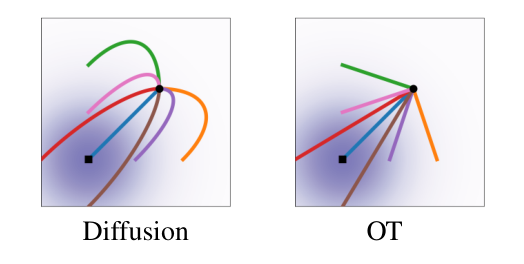
Theorem 2 relates conditional and marginal flow-matching objectives: under its regularity and positive-density assumptions, their parameter gradients agree. This permits tractable conditional targets without explicitly computing the generally difficult marginal velocity. Figure 3 compares conditional path shapes, not every resulting learned trajectory.
Evidence
Table 1 compares diffusion-path and optimal-transport-path flow matching with the same architecture on ImageNet at 64-pixel resolution. The diffusion-path row reports FID 16.88 and 187 function evaluations; the optimal-transport-path row reports FID 14.45 and 138 evaluations. Read these as results under that paper’s solver and evaluation protocol. Function evaluations measure network calls, not automatically wall-clock speed or a universal fixed sampling budget.
Design analysis
Path selection changes the regression targets and the difficulty of integrating the learned field. The conditional straight-line construction uses independently paired noise and data; calling it conditional optimal transport does not mean those pairs form a globally optimal coupling between full distributions. Likewise, averaging conditional velocities can yield curved marginal trajectories. These distinctions prevent turning a useful construction into an unsupported global guarantee.
Reading checkpoint
Differentiate the displayed path with respect to time and recover the regression target. Explain which quantities can be sampled directly during training, then identify the differential equation that must still be solved to generate a new sample using the trained velocity field.
Limits and next step
Approximation error, path choice and solver tolerance affect generation. Fewer function evaluations under one tolerance do not prove equal accuracy under another. Return to the chapter’s diffusion-versus-flow comparison, then ML 11 evaluation: report quality, likelihood where available, solver settings and actual runtime as separate measurements.
Continue reading: MeanFlow — average velocity over an interval
References
- L. Yang, Z. Zhang, Y. Song, S. Hong, R. Xu, Y. Zhao, W. Zhang, B. Cui and M.-H. Yang, “Diffusion Models: A Comprehensive Survey of Methods and Applications,” ACM Computing Surveys, 2023. arXiv
- Y. Lipman, M. Havasi, P. Holderrieth, N. Shaul, M. Le, B. Karrer, R. T. Q. Chen, D. Lopez-Paz, H. Ben-Hamu and I. Gat, “Flow Matching Guide and Code,” arXiv:2412.06264, 2024. arXiv
- J. Ho, A. Jain and P. Abbeel, “Denoising Diffusion Probabilistic Models,” NeurIPS, 2020. arXiv
- Y. Song, J. Sohl-Dickstein, D. P. Kingma, A. Kumar, S. Ermon and B. Poole, “Score-Based Generative Modeling through Stochastic Differential Equations,” ICLR, 2021. arXiv
- J. Song, C. Meng and S. Ermon, “Denoising Diffusion Implicit Models,” ICLR, 2021. arXiv
- J. Ho and T. Salimans, “Classifier-Free Diffusion Guidance,” NeurIPS 2021 Workshop on Deep Generative Models and Downstream Applications; arXiv:2207.12598, 2022. arXiv
- R. Rombach, A. Blattmann, D. Lorenz, P. Esser and B. Ommer, “High-Resolution Image Synthesis with Latent Diffusion Models,” CVPR, 2022. arXiv
- W. Peebles and S. Xie, “Scalable Diffusion Models with Transformers,” ICCV, 2023. arXiv
- P. Esser, S. Kulal, A. Blattmann et al., “Scaling Rectified Flow Transformers for High-Resolution Image Synthesis,” ICML, PMLR 235, 2024. PMLR
- Y. Lipman, R. T. Q. Chen, H. Ben-Hamu, M. Nickel and M. Le, “Flow Matching for Generative Modeling,” ICLR, 2023. arXiv
- X. Liu, C. Gong and Q. Liu, “Flow Straight and Fast: Learning to Generate and Transfer Data with Rectified Flow,” ICLR, 2023. arXiv
- Y. Song, P. Dhariwal, M. Chen and I. Sutskever, “Consistency Models,” ICML, 2023. arXiv
- Z. Geng, M. Deng, X. Bai, J. Z. Kolter and K. He, “Mean Flows for One-step Generative Modeling,” NeurIPS, 2025. arXiv
- S. J. D. Prince, Understanding Deep Learning, MIT Press, 2023. book site
- J. Sohl-Dickstein, E. Weiss, N. Maheswaranathan and S. Ganguli, “Deep Unsupervised Learning using Nonequilibrium Thermodynamics,” ICML, PMLR 37, 2015. PMLR
- P. Vincent, “A Connection Between Score Matching and Denoising Autoencoders,” Neural Computation, vol. 23, no. 7, pp. 1661–1674, 2011. doi
- Y. Song and S. Ermon, “Generative Modeling by Estimating Gradients of the Data Distribution,” NeurIPS, 2019. arXiv
- P. Dhariwal and A. Nichol, “Diffusion Models Beat GANs on Image Synthesis,” NeurIPS, 2021. NeurIPS
- A. Q. Nichol and P. Dhariwal, “Improved Denoising Diffusion Probabilistic Models,” ICML, PMLR 139, 2021. PMLR
- T. Karras, M. Aittala, T. Aila and S. Laine, “Elucidating the Design Space of Diffusion-Based Generative Models,” NeurIPS, 2022. arXiv
- C. Lu, Y. Zhou, F. Bao, J. Chen, C. Li and J. Zhu, “DPM-Solver: A Fast ODE Solver for Diffusion Probabilistic Model Sampling in Around 10 Steps,” NeurIPS, 2022. arXiv
- T. Salimans and J. Ho, “Progressive Distillation for Fast Sampling of Diffusion Models,” ICLR, 2022. arXiv
- M. Heusel, H. Ramsauer, T. Unterthiner, B. Nessler and S. Hochreiter, “GANs Trained by a Two Time-Scale Update Rule Converge to a Local Nash Equilibrium,” NeurIPS (NIPS), 2017. arXiv
- T. Kynkäänniemi, T. Karras, S. Laine, J. Lehtinen and T. Aila, “Improved Precision and Recall Metric for Assessing Generative Models,” NeurIPS, 2019. arXiv
- G. Stein, J. C. Cresswell, R. Hosseinzadeh et al., “Exposing Flaws of Generative Model Evaluation Metrics and Their Unfair Treatment of Diffusion Models,” NeurIPS, 2023. arXiv
- S. Jayasumana, S. Ramalingam, A. Veit, D. Glasner, A. Chakrabarti and S. Kumar, “Rethinking FID: Towards a Better Evaluation Metric for Image Generation,” CVPR, 2024. CVF
- F.-A. Croitoru, V. Hondru, R. T. Ionescu and M. Shah, “Diffusion Models in Vision: A Survey,” IEEE Transactions on Pattern Analysis and Machine Intelligence, 2023. doi
- H. Cao, C. Tan, Z. Gao, Y. Xu, G. Chen, P.-A. Heng and S. Z. Li, “A Survey on Generative Diffusion Models,” IEEE Transactions on Knowledge and Data Engineering, vol. 36, no. 7, pp. 2814–2830, 2024. doi
- C.-H. Lai, Y. Song, D. Kim, Y. Mitsufuji and S. Ermon, “The Principles of Diffusion Models,” monograph, arXiv:2510.21890, 2025. arXiv
- H. Shen, J. Zhang, B. Xiong et al., “Efficient Diffusion Models: A Survey,” Transactions on Machine Learning Research, 2025. arXiv
- A. Melnik, M. Ljubljanac, C. Lu, Q. Yan, W. Ren and H. Ritter, “Video Diffusion Models: A Survey,” Transactions on Machine Learning Research, 2024. arXiv
- C. Lu and Y. Song, “Simplifying, Stabilizing and Scaling Continuous-Time Consistency Models,” ICLR, 2025. arXiv
- A. Sauer, D. Lorenz, A. Blattmann and R. Rombach, “Adversarial Diffusion Distillation,” ECCV, 2024. arXiv
- M. S. Albergo and E. Vanden-Eijnden, “Building Normalizing Flows with Stochastic Interpolants,” ICLR, 2023. arXiv
- J. Deng, W. Dong, R. Socher, L.-J. Li, K. Li and L. Fei-Fei, “ImageNet: A Large-Scale Hierarchical Image Database,” CVPR, 2009, pp. 248–255. doi
- C. Szegedy, V. Vanhoucke, S. Ioffe, J. Shlens and Z. Wojna, “Rethinking the Inception Architecture for Computer Vision,” CVPR, 2016, pp. 2818–2826. arXiv
- O. Ronneberger, P. Fischer and T. Brox, “U-Net: Convolutional Networks for Biomedical Image Segmentation,” MICCAI, LNCS 9351, pp. 234–241, 2015. arXiv
- A. Radford, J. W. Kim, C. Hallacy et al., “Learning Transferable Visual Models From Natural Language Supervision,” ICML, 2021. arXiv
- M. Oquab, T. Darcet, T. Moutakanni et al., “DINOv2: Learning Robust Visual Features without Supervision,” Transactions on Machine Learning Research, 2024. arXiv
- B. Efron, “Tweedie’s Formula and Selection Bias,” Journal of the American Statistical Association, vol. 106, no. 496, pp. 1602–1614, 2011. doi
- A. Dosovitskiy, L. Beyer, A. Kolesnikov et al., “An Image is Worth 16x16 Words: Transformers for Image Recognition at Scale,” ICLR, 2021. arXiv
- T. Li and K. He, “Back to Basics: Let Denoising Generative Models Denoise,” CVPR, 2026 (preprint 2025). paper, publication record, official JiT code.
- B. Zheng, N. Ma, S. Tong and S. Xie, “Diffusion Transformers with Representation Autoencoders,” ICLR, 2026 (preprint 2025). proceedings, manuscript.
- S. Tong, B. Zheng, Z. Wang, B. Tang, N. Ma, E. Brown, J. Yang, R. Fergus, Y. LeCun and S. Xie, “Scaling Text-to-Image Diffusion Transformers with Representation Autoencoders,” CVPR Findings Track, 2026. manuscript, author publication record.
- D. Podell, Z. English, K. Lacey, A. Blattmann, T. Dockhorn, J. Müller, J. Penna and R. Rombach, “SDXL: Improving Latent Diffusion Models for High-Resolution Image Synthesis,” ICLR, 2024. proceedings, official model card.
- Black Forest Labs, “FLUX.1 [dev],” official pretrained-model card, 2024. model card.
- W. Kong, Q. Tian, Z. Zhang et al., “HunyuanVideo: A Systematic Framework For Large Video Generative Models,” technical report, arXiv:2412.03603, 2024. report, official release.
- Team Wan, A. Wang, B. Ai, B. Wen et al., “Wan: Open and Advanced Large-Scale Video Generative Models,” technical report, arXiv:2503.20314, 2025. report, official Wan2.1 release.
- Z. Geng, Y. Lu, Z. Wu, E. Shechtman, J. Z. Kolter and K. He, “Improved Mean Flows: On the Challenges of Fastforward Generative Models,” CVPR, pp. 30467–30476, 2026. CVF
- Y. Lu, S. Lu, Q. Sun, H. Zhao, Z. Jiang, X. Wang, T. Li, Z. Geng and K. He, “One-step Latent-free Image Generation with Pixel Mean Flows,” ICML, PMLR 306, pp. 81265–81277, 2026. PMLR