BERT — Pre-training of Deep Bidirectional Transformers for Language Understanding
選讀・NLP 10・預訓練模型:BERT 的論文導讀(第 1/1 篇)。引用編號對應本頁底部的參考文獻。
導覽:本頁與本系列: 導覽:本頁與本系列
挑戰
由左至右的語言模型,在建立目前 token 的表示時不能使用後方詞彙。Devlin 等人提出預訓練深層雙向 Transformer 編碼器,再適配多種理解任務 [1]。論點是遮罩 token 預測能提供雙向訓練,同時避免直接把每個 token 本身當成答案暴露給模型。先理解本章的編碼器自注意力、token 表示與任務輸出頭。
方法
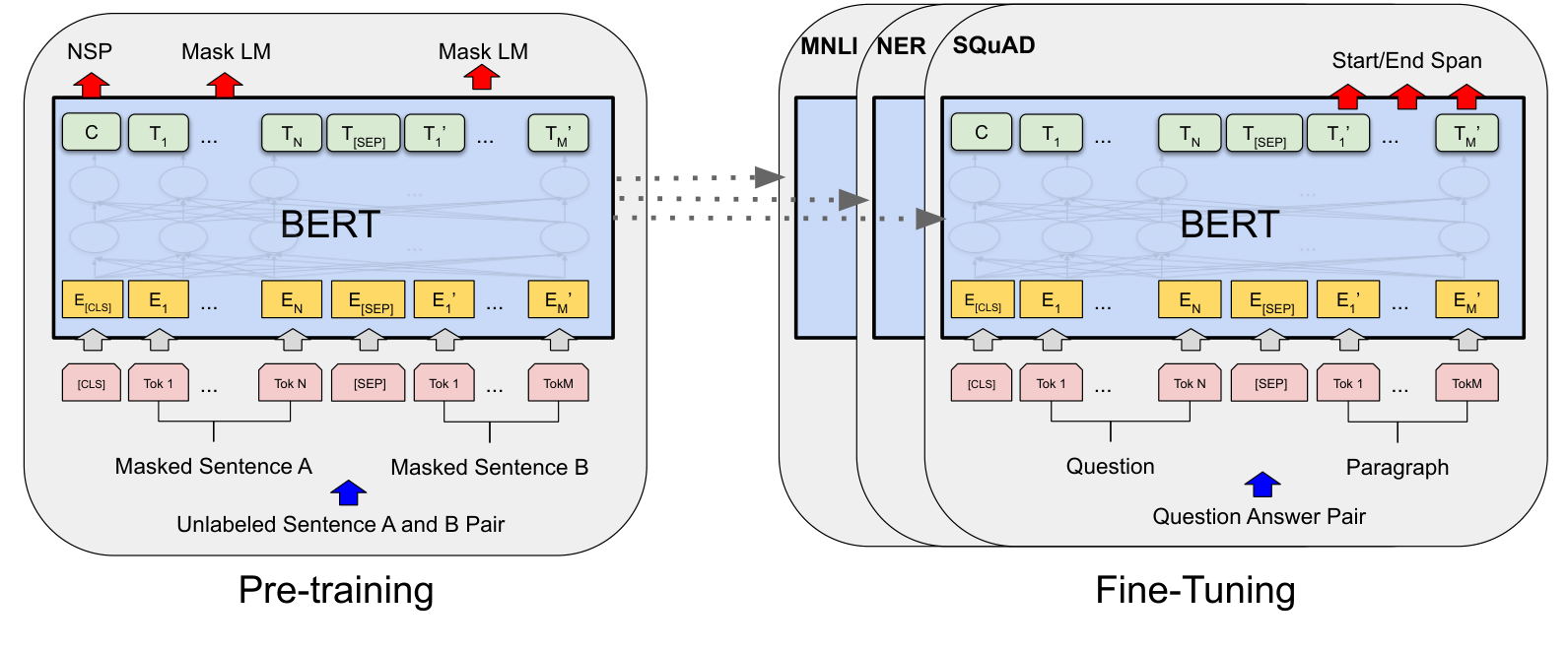
BERT 選取 15% 的 token 位置進行遮罩語言模型(MLM)訓練。在選中位置內,80% 改成遮罩 token、10% 改成隨機 token、10% 維持原樣。這三個百分比的分母是選中子集,不是整句。目標可簡寫為:
是位置 的原始 token, 是選中的預測位置, 是擾動後輸入, 是參數為 的編碼器與預測頭所產生的 token 分佈。損失 監督選中位置,也包含選中但保留原樣的 token;不是要求預測每個未遮罩輸入。
原始流程也使用下一句預測(NSP):一半配對延續同一文件,另一半的第二段隨機取樣。token、區段與位置嵌入共同輸入同一編碼器。微調時,分類頭可讀取特殊的句級表示,token 或跨度輸出頭則讀取 token 狀態。圖 1 表示不同任務共用預訓練結構,不是要求凍結編碼器。
結果
表 5 提供條件明確的一組證據:BERT-base 在開發集的 MNLI 準確率為 84.4、QNLI 準確率 88.4、SQuAD F1 88.5。這些是 base 模型的開發集結果,不是摘要中的 large 模型測試提交。各基準須依自身指標解讀;分類準確率與答案跨度 F1 不是共同的語言理解單位。論文其他任務表格則展示調整輸出頭後的跨任務遷移。
消融與設計證據
表 5 中移除 NSP,QNLI 準確率從 88.4 降至 84.9,SQuAD F1 從 88.5 降至 87.9。改成由左至右預訓練且沒有 NSP,SQuAD F1 為 77.8;微調時加入隨機初始化的雙向 LSTM,也只回復到 84.9。這支持原始流程中雙向預訓練的價值,但不能證明所有後續語料、排程或編碼器設計都必須使用 NSP。
結論
BERT 讓同一預訓練編碼器轉成多種任務預測器。檢查理解時,標出哪些輸入位置被擾動、哪些位置計入 MLM 損失,以及微調時更新哪些參數。接著讀 NLP 11 的 Sentence-BERT 導讀,理解好的 token 表示為何不會自動變成好的句子相似度向量。
問題與限制
MLM 不是由左至右的序列機率分解,不能直接比較一般自迴歸困惑度。隨機負例 NSP 可能獎勵主題線索,而非深入篇章理解。預訓練資料、tokenizer 與上下文長度限制遷移,監督式微調仍需要具代表性的標籤。雙向性讓模型看得到上下文,卻不保證推理、事實正確或跨領域穩健性。
參考文獻
- Jacob Devlin, Ming-Wei Chang, Kenton Lee and Kristina Toutanova, “BERT: Pre-training of Deep Bidirectional Transformers for Language Understanding,” NAACL, 2019. Paper
- Google Research, BERT: original implementation and released models, software, 2018. Encoder and pooler · Tokenizer · Multilingual and Chinese models
- Ashish Vaswani et al., “Attention Is All You Need,” NeurIPS, 2017. Paper
- Alec Radford, Karthik Narasimhan, Tim Salimans and Ilya Sutskever, “Improving Language Understanding by Generative Pre-Training,” OpenAI technical report, 2018. Paper
- Matthew E. Peters, Mark Neumann, Mohit Iyyer, Matt Gardner, Christopher Clark, Kenton Lee and Luke Zettlemoyer, “Deep Contextualized Word Representations,” NAACL, 2018. Paper
- Tomas Mikolov, Kai Chen, Greg Corrado and Jeffrey Dean, “Efficient Estimation of Word Representations in Vector Space,” ICLR Workshop, 2013. Paper
- Yonghui Wu et al., “Google’s Neural Machine Translation System: Bridging the Gap between Human and Machine Translation,” arXiv:1609.08144, 2016. Paper
- Dan Hendrycks and Kevin Gimpel, “Gaussian Error Linear Units (GELUs),” arXiv:1606.08415, 2016, revised 2023. Paper
- Jimmy Lei Ba, Jamie Ryan Kiros and Geoffrey E. Hinton, “Layer Normalization,” arXiv:1607.06450, 2016. Paper
- Ilya Loshchilov and Frank Hutter, “Decoupled Weight Decay Regularization,” ICLR, 2019. Paper
- Yinhan Liu et al., “RoBERTa: A Robustly Optimized BERT Pretraining Approach,” arXiv:1907.11692, 2019. Paper
- Zhenzhong Lan, Mingda Chen, Sebastian Goodman, Kevin Gimpel, Piyush Sharma and Radu Soricut, “ALBERT: A Lite BERT for Self-supervised Learning of Language Representations,” ICLR, 2020. Paper
- Victor Sanh, Lysandre Debut, Julien Chaumond and Thomas Wolf, “DistilBERT, a distilled version of BERT: smaller, faster, cheaper and lighter,” 5th Workshop on Energy Efficient Machine Learning and Cognitive Computing at NeurIPS, 2019. Paper
- Kevin Clark, Minh-Thang Luong, Quoc V. Le and Christopher D. Manning, “ELECTRA: Pre-training Text Encoders as Discriminators Rather Than Generators,” ICLR, 2020. Paper
- Telmo Pires, Eva Schlinger and Dan Garrette, “How Multilingual is Multilingual BERT?,” ACL, 2019. Paper
- Alexis Conneau et al., “Unsupervised Cross-lingual Representation Learning at Scale,” ACL, 2020. Paper
- Yiming Cui, Wanxiang Che, Ting Liu, Bing Qin and Ziqing Yang, “Pre-Training With Whole Word Masking for Chinese BERT,” IEEE/ACM Transactions on Audio, Speech, and Language Processing 29, 2021. Publisher · Author manuscript
- Masato Hagiwara, Real-World Natural Language Processing: Practical Applications with Deep Learning, Chapter 9, Manning, 2021. Publisher
- Kawin Ethayarajh, “How Contextual are Contextualized Word Representations? Comparing the Geometry of BERT, ELMo, and GPT-2 Embeddings,” EMNLP-IJCNLP, 2019. Paper
- Ian Tenney, Dipanjan Das and Ellie Pavlick, “BERT Rediscovers the Classical NLP Pipeline,” ACL, 2019. Paper
- John Hewitt and Christopher D. Manning, “A Structural Probe for Finding Syntax in Word Representations,” NAACL, 2019. Paper
- John Hewitt and Percy Liang, “Designing and Interpreting Probes with Control Tasks,” EMNLP-IJCNLP, 2019. Paper
- Kevin Clark, Urvashi Khandelwal, Omer Levy and Christopher D. Manning, “What Does BERT Look at? An Analysis of BERT’s Attention,” BlackboxNLP Workshop, 2019. Paper
- Anna Rogers, Olga Kovaleva and Anna Rumshisky, “A Primer in BERTology: What We Know About How BERT Works,” Transactions of the Association for Computational Linguistics 8, 2020. Paper
- Benjamin Warner et al., “Smarter, Better, Faster, Longer: A Modern Bidirectional Encoder for Fast, Memory Efficient, and Long Context Finetuning and Inference,” ACL, 2025. Paper
- Wayne Xin Zhao et al., “A Survey of Large Language Models,” Frontiers of Computer Science, 2026. Updated survey
- Colin Raffel, Noam Shazeer, Adam Roberts, Katherine Lee, Sharan Narang, Michael Matena, Yanqi Zhou, Wei Li and Peter J. Liu, “Exploring the Limits of Transfer Learning with a Unified Text-to-Text Transformer,” JMLR 21(140), 2020. Paper