TextCNN — Convolutional Neural Networks for Sentence Classification
Optional · paper guide 1 of 1 for NLP 03 · Neural Networks for NLP. Citation numbers refer to the reference list at the bottom of this page.
Navigate: this page and this track: Navigate: this page and this track
Challenge
Can a sentence classifier learn useful phrase detectors without a full syntactic parser or a recurrent network? Kim’s EMNLP 2014 paper argues that a small convolutional model becomes a strong baseline when initialized with pretrained word vectors [10]. Read embeddings, convolution and classification loss in this chapter first. The key distinction is between learning local features and deciding which local features matter for the whole sentence.
Method
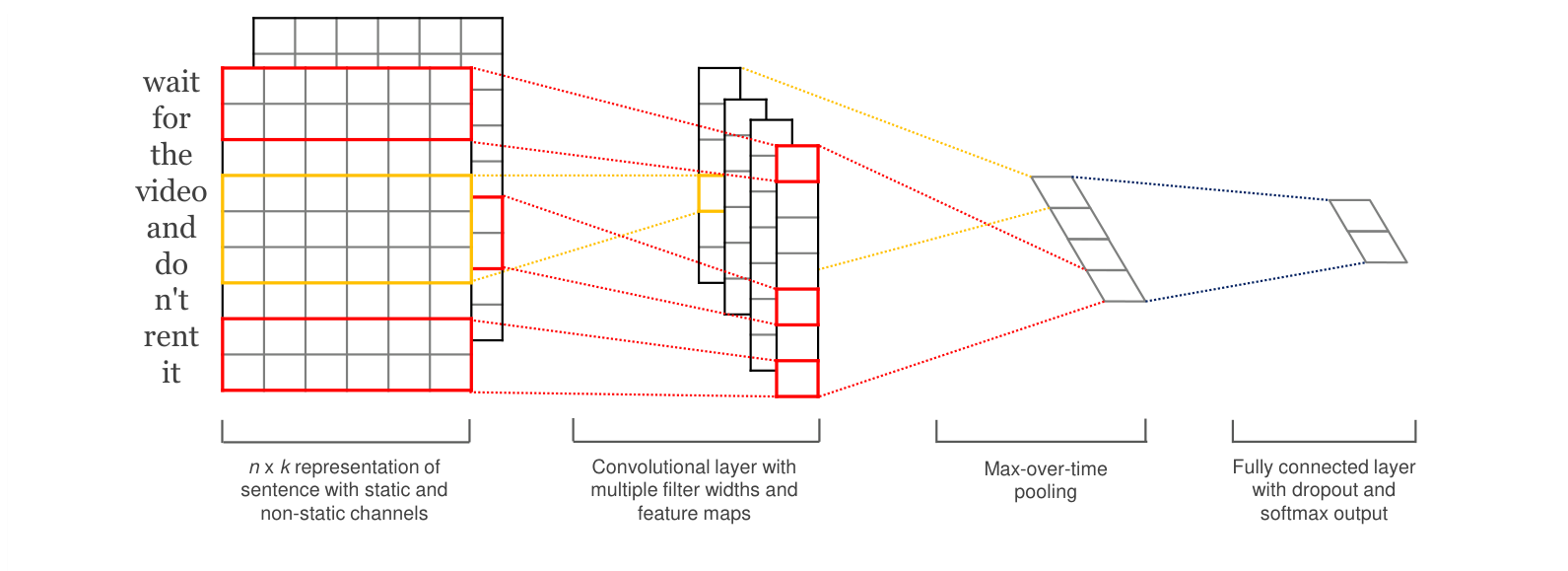
Stack the word vectors into a sentence matrix. A filter covers several consecutive words and all embedding coordinates. Slide it over the sentence to produce a feature map, then keep its largest response:
Here concatenates the embeddings of words starting at position ; is the matching filter vector, its scalar bias, and a nonlinear activation. The scalar is one window’s response and is that filter’s pooled sentence feature. Concatenate the pooled features from many filters, apply dropout during training, and predict the class with a softmax layer.
A width-three filter can detect a local pattern wherever it occurs. Max pooling preserves the strongest evidence, not its location or number of occurrences. In the two-channel model, one embedding table stays fixed and the other is fine-tuned; each filter operates on both channels and adds their responses. The pretrained vectors supply information from external text, so this is not learning everything from the small classification dataset.
Results
Table 2 gives MR accuracy of 76.1 for randomly initialized CNN-rand, 81.0 for pretrained CNN-static and 81.5 for CNN-non-static. These numbers support the value of pretraining and task adaptation in this setup, rather than establishing that convolution alone causes the gain. Dataset protocols differ across the table: some use fixed test splits and others cross-validation. Compare model rows within a dataset before comparing scores across tasks.
Ablations
The static, non-static and multichannel variants test how embeddings are adapted. Multichannel improves SST-2 accuracy from non-static’s 87.2 to 88.1, but lowers TREC accuracy from 93.6 to 92.2. A second channel is therefore not an unconditional upgrade. The paper keeps fold assignments and relevant random initializations consistent within a dataset to make these comparisons more meaningful. Filter-width and regularization choices still affect the baseline you reproduce.
Conclusion
This is a useful first neural text classifier because its information flow is inspectable: word vectors → local responses → pooled evidence → class. Try explaining which three-word window drives a filter, then ask what changes if that phrase appears twice. Continue to NLP 04 for where the pretrained vectors come from.
Problems
Local word order survives inside a filter window, but max pooling discards much of the sentence’s global structure. Negation with a distant scope, several interacting clauses, or counts of repeated evidence can be hard to represent. A high activation is a model response, not a causal explanation of the label. Evaluate against a simple non-neural baseline and control external training data before attributing improvements to architecture.
References
- M. Hagiwara, Real-World Natural Language Processing: Practical Applications with Deep Learning, Manning, 2021; Chapters 2–4, 7 and 10–11. publisher
- S. McRoy, Principles of Natural Language Processing, open textbook, 2021; Chapter 6, “Benchmark Tasks for Language Modelling.” chapter
- Scikit-learn developers, “Text feature extraction,” scikit-learn documentation, current online edition. documentation
- Scikit-learn developers, “Logistic regression,” scikit-learn documentation, current online edition. documentation
- Y. Goldberg, “A primer on neural network models for natural language processing,” Journal of Artificial Intelligence Research 57, 2016. paper
- M. Iyyer, V. Manjunatha, J. Boyd-Graber and H. Daumé III, “Deep unordered composition rivals syntactic methods for text classification,” ACL-IJCNLP, 2015. paper
- A. Joulin, E. Grave, P. Bojanowski and T. Mikolov, “Bag of tricks for efficient text classification,” EACL, 2017. paper
- Y. Bengio, R. Ducharme, P. Vincent and C. Jauvin, “A neural probabilistic language model,” Journal of Machine Learning Research 3, 2003. paper
- R. Collobert, J. Weston, L. Bottou, M. Karlen, K. Kavukcuoglu and P. Kuksa, “Natural language processing (almost) from scratch,” Journal of Machine Learning Research 12, 2011. paper
- Y. Kim, “Convolutional neural networks for sentence classification,” EMNLP, 2014. paper
- Y. Zhang and B. Wallace, “A sensitivity analysis of (and practitioners’ guide to) convolutional neural networks for sentence classification,” IJCNLP, 2017. paper
- N. Srivastava, G. Hinton, A. Krizhevsky, I. Sutskever and R. Salakhutdinov, “Dropout: a simple way to prevent neural networks from overfitting,” Journal of Machine Learning Research 15, 2014. paper
- Scikit-learn developers, “Classification metrics,” scikit-learn documentation, current online edition. documentation
- C. Guo, G. Pleiss, Y. Sun and K. Q. Weinberger, “On calibration of modern neural networks,” ICML, 2017. paper
- S. Minaee, N. Kalchbrenner, E. Cambria, N. Nikzad, M. Chenaghlu and J. Gao, “Deep learning-based text classification: a comprehensive review,” ACM Computing Surveys 54(3), 2021. survey
- W. X. Zhao et al., “A survey of large language models,” Frontiers of Computer Science, 2026; online manuscript updated March 2026. survey
- Y. Chang et al., “A survey on evaluation of large language models,” ACM Transactions on Intelligent Systems and Technology, 2024. survey
- G. Sperduti and A. Moreo, “Misspellings in natural language processing: a survey,” arXiv:2501.16836, 2025. survey