Bilateral filtering: average nearby pixels without crossing a strong edge
Optional · paper guide 2 of 3 for IP 03 · Intensity Transformations and Spatial Filtering. Citation numbers refer to the reference list at the bottom of this page.
Navigate: this page and this track: Navigate: this page and this track
Challenge
A spatial average reduces noise but mixes both sides of an edge. Tomasi and Manduchi’s ICCV 1998 paper [6] asks whether a simple, noniterative filter can smooth an image while respecting sharp changes in intensity or color. Its central claim is that proximity must be measured in two spaces: image position and appearance. Read the chapter’s Gaussian smoothing first; the new ingredient is an input-dependent weight, not a learned network.
Method
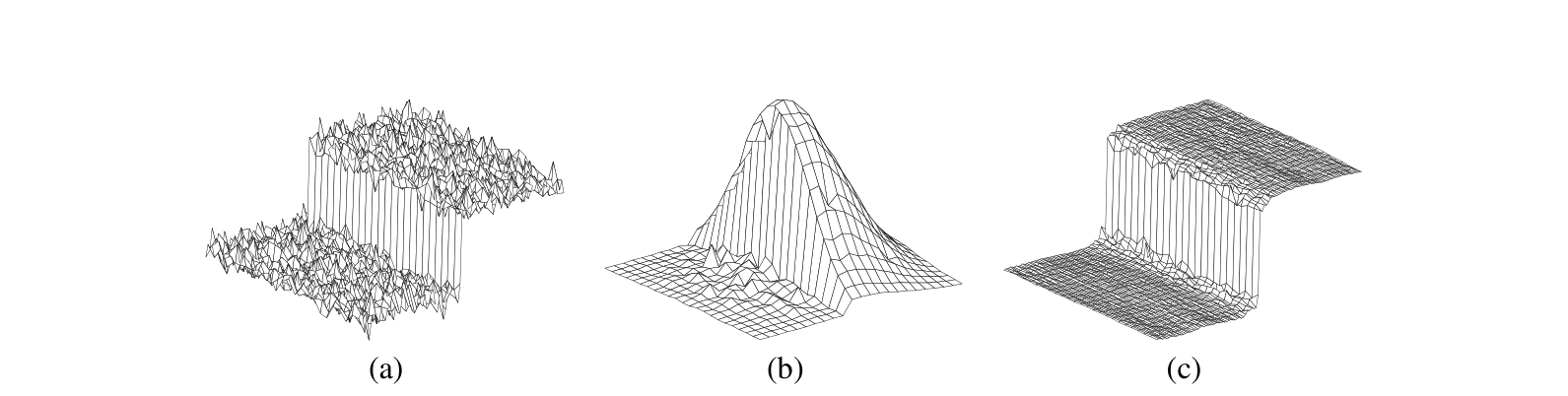
Source: Tomasi and Manduchi [6], ICCV 1998, PDF page 3, figure 1. Original PDF.
For a scalar image, a discrete Gaussian bilateral filter is
is the input intensity at pixel position , is a candidate neighbor in window , is the output, and is its unnormalized weight. The spatial bandwidth is measured in pixels; the range bandwidth uses the image’s intensity units. The denominator makes the weights sum to one, preserving constant images.
Read the source figure from left to right. Near the bright side of the step, equally close dark pixels receive less range weight than bright pixels. Inside a nearly uniform region, range weights are similar and the operation resembles ordinary smoothing. For color, the paper uses a perceptual color distance in CIE-Lab and one shared weight for the color vector; filtering each channel independently can create combinations that were not supported by neighboring colors.
Two controls, two effects. Increasing admits farther samples; increasing admits more dissimilar intensities. With a very large range bandwidth the filter approaches spatial Gaussian smoothing. With a very small bandwidth, noise-induced intensity differences can prevent useful averaging. Rescaling image values requires rescaling too: a value chosen for byte intensities is not directly transferable to an image normalized to the unit interval.
Results
The paper provides analytical reasoning and visual examples rather than a modern dataset-wide ranking. Figure 1 demonstrates the step-edge mechanism. Figure 3 varies spatial and range parameters; figures 5–6 illustrate texture simplification and color filtering. These support controllable edge-aware smoothing, not a claim that the method universally reconstructs the unknown clean image. Texture removal can be desirable for simplification and undesirable for restoration.
Ablations and parameter evidence
The domain-only and range-only analyses explain why both factors matter. A range filter with no spatial awareness reduces to an intensity remapping based on the image histogram; it cannot identify which same-colored pixels belong to one object. The parameter grid in figure 3 is a sensitivity study, not a learned-module ablation. Inspect it along one parameter axis at a time instead of crediting every visual change to edge preservation.
Conclusion
Bilateral filtering makes a neighborhood depend on the image itself. It is a useful baseline when the desired boundary has a strong appearance contrast and a simple local filter is sufficient. Next, read Guided Filter to see how a local linear model uses a separate guidance image, then Non-Local Means in IP 05 to replace single-pixel similarity with patch similarity.
Problems
A noisy center pixel also corrupts its own similarity weights. Weak boundaries may be smoothed away, while strong noise or texture may be retained as if it were a boundary. Direct computation becomes expensive with large windows, and repeated filtering changes the effective operation. Edge-aware smoothing also does not guarantee artifact-free detail enhancement: amplifying a residual formed from the smoothed image is a separate procedure with its own failure modes.
References
- R. C. Gonzalez and R. E. Woods, Digital Image Processing, 4th ed., Pearson, 2018, Ch. 3. publisher page
- S. M. Pizer, E. P. Amburn, J. D. Austin, R. Cromartie, A. Geselowitz, T. Greer, B. ter Haar Romeny, J. B. Zimmerman and K. Zuiderveld, “Adaptive histogram equalization and its variations,” Computer Vision, Graphics, and Image Processing, 1987. doi
- K. Zuiderveld, “Contrast limited adaptive histogram equalization,” in P. S. Heckbert (ed.), Graphics Gems IV, Morgan Kaufmann, 1994, pp. 474–485. entry
- A. M. Reza, “Realization of the contrast limited adaptive histogram equalization (CLAHE) for real-time image enhancement,” Journal of VLSI Signal Processing, 2004. doi
- D. Coltuc, P. Bolon and J.-M. Chassery, “Exact histogram specification,” IEEE Transactions on Image Processing, 2006. doi
- C. Tomasi and R. Manduchi, “Bilateral filtering for gray and color images,” in Proc. IEEE International Conference on Computer Vision (ICCV), 1998. pdf
- S. Paris, P. Kornprobst, J. Tumblin and F. Durand, “Bilateral filtering: Theory and applications,” Foundations and Trends in Computer Graphics and Vision, vol. 4, no. 1, pp. 1–73, 2009. doi
- K. He, J. Sun and X. Tang, “Guided image filtering,” IEEE Transactions on Pattern Analysis and Machine Intelligence, 35(6):1397–1409, 2013 (first presented at ECCV 2010). doi
- P. Milanfar, “A tour of modern image filtering,” IEEE Signal Processing Magazine, vol. 30, no. 1, pp. 106–128, 2013. IEEE Xplore
- S. Gingichashvili and D. Lischinski, “Evaluation and comparison of edge-preserving filters,” arXiv:2012.13778, 2020. arXiv
- Y. Qi, Z. Yang, W. Sun et al., “A comprehensive overview of image enhancement techniques,” Archives of Computational Methods in Engineering, 2021. doi
- C. Li, C. Guo, L. Han, J. Jiang, M.-M. Cheng, J. Gu and C. C. Loy, “Low-light image and video enhancement using deep learning: A survey,” IEEE Transactions on Pattern Analysis and Machine Intelligence, 2021 (arXiv:2104.10729). arXiv
- C. Guo, C. Li, J. Guo, C. C. Loy, J. Hou, S. Kwong and R. Cong, “Zero-reference deep curve estimation for low-light image enhancement,” in Proc. IEEE/CVF CVPR, 2020. arXiv
- H. Zeng, J. Cai, L. Li, Z. Cao and L. Zhang, “Learning image-adaptive 3D lookup tables for high performance photo enhancement in real-time,” IEEE Transactions on Pattern Analysis and Machine Intelligence, 2020. arXiv
- M. Gharbi, J. Chen, J. T. Barron, S. W. Hasinoff and F. Durand, “Deep bilateral learning for real-time image enhancement,” ACM Transactions on Graphics (SIGGRAPH), 2017. arXiv
- H. Wu, S. Zheng, J. Zhang and K. Huang, “Fast end-to-end trainable guided filter,” in Proc. IEEE/CVF CVPR, 2018. arXiv
- Y. Cai, H. Bian, J. Lin, H. Wang, R. Timofte and Y. Zhang, “Retinexformer: One-stage Retinex-based transformer for low-light image enhancement,” in Proc. IEEE/CVF ICCV, 2023. arXiv
- S. Paris and F. Durand, “A fast approximation of the bilateral filter using a signal processing approach,” International Journal of Computer Vision, vol. 81, no. 1, pp. 24–52, 2009 (first presented at ECCV 2006). doi