The Modern view in more detail
Optional · paper guide 1 of 3 for IP 03 · Intensity Transformations and Spatial Filtering. Citation numbers refer to the reference list at the bottom of this page.
Navigate: this page and this track: Navigate: this page and this track
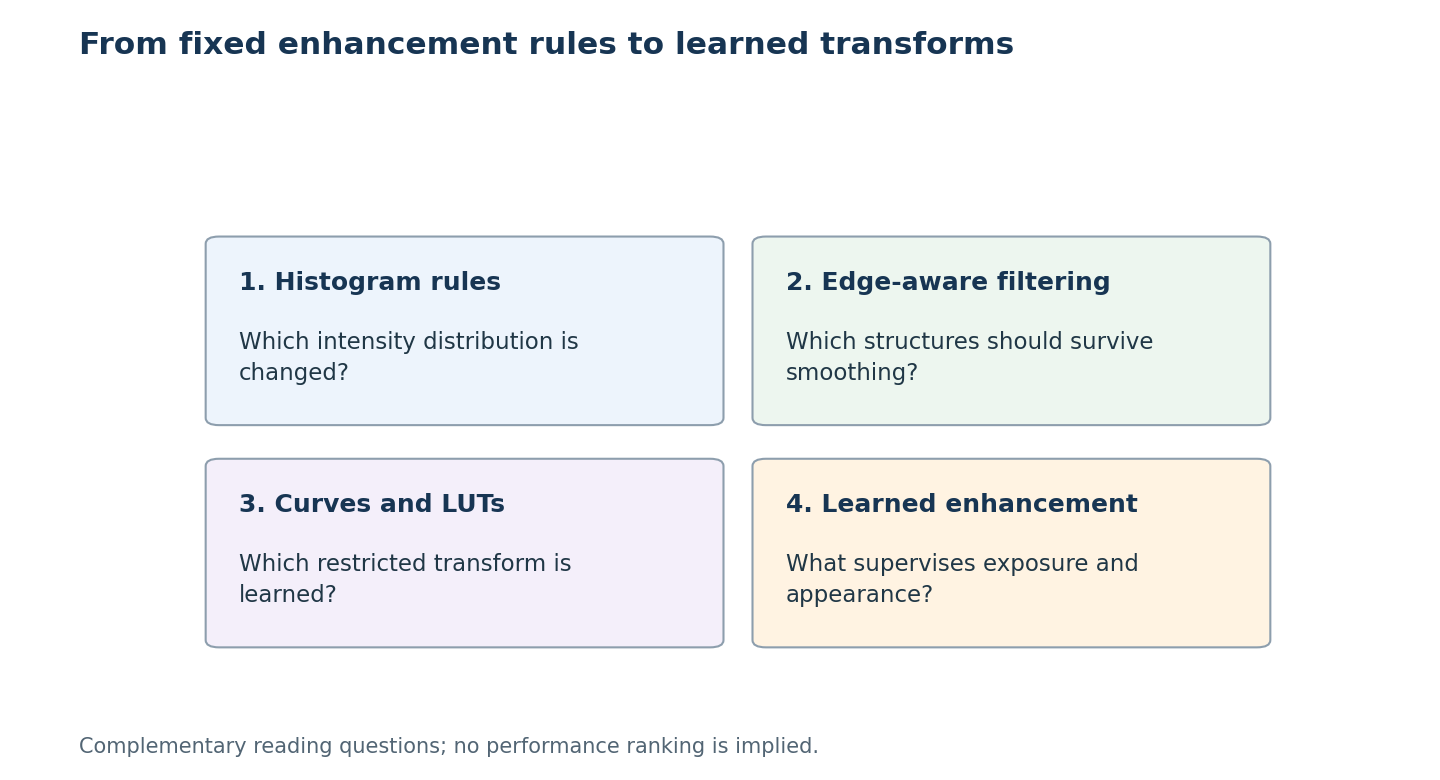
Choose a reading by topic: Histogram rules, Edge-aware filtering, Curves and LUTs, Learned enhancement.
Contrast enhancement and histogram methods
Pizer et al. [2] remains the reference analysis of adaptive histogram equalization: it describes how local mappings behave, why AHE over-enhances noise in uniform regions, and the variants (including contrast limiting and interpolation between tile mappings) that made the method practical. Zuiderveld’s chapter [3] is the compact CLAHE implementation that later libraries follow, and Reza [4] shows the same algorithm mapped to real-time hardware. On the histogram-specification side, Coltuc, Bolon and Chassery [5] show how to obtain an exact target histogram by strictly ordering pixels with local means. For a broader map of the field, Qi et al. [11] survey image-enhancement methods from the past two decades, organizing them into supervised and unsupervised algorithms and covering quality evaluation as a third pillar; it is useful for its side-by-side discussion of the limitations, merits and drawbacks of each family.
Edge-preserving filters
The weakness of the box and Gaussian filters is that they average across edges. The bilateral filter of Tomasi and Manduchi [6] fixes this by multiplying the spatial Gaussian weight by a second weight that decays with intensity difference, so a pixel on the other side of an edge contributes little. The survey by Paris, Kornprobst, Tumblin and Durand [7] explains its behavior, fast implementations and applications such as tone mapping and detail enhancement, where an image is split into a smooth base layer and a detail layer. The guided filter of He, Sun and Tang [8] assumes that the output is a local linear function of a guidance image. It is computed only with box filters of local means and variances, so its cost does not depend on the radius, and it behaves better than the bilateral filter near strong edges, where the bilateral filter can produce gradient-reversal artifacts in detail enhancement. Milanfar’s tutorial [9] unifies bilateral, non-local means and related filters as data-adaptive weighted averages, where the kernel weights depend on the image itself, and analyzes them with linear-algebra tools. Gingichashvili and Lischinski [10] point out that the many edge-preserving filters had been compared mostly by eye, and propose a systematic methodology and common baseline for evaluating them.
How deep learning changed things
The most interesting finding is how much of this chapter survives inside learned systems. Many successful enhancement networks do not output pixels directly; they predict the parameters of a classical operator and then apply it.
Learned curves
Zero-DCE [13] (2020) predicts pixel-wise, high-order curves (built by iterating a simple quadratic of the form , with predicted per pixel) to brighten low-light images. It is trained without any reference images, using non-reference losses that score the enhanced result directly. It is the gamma and contrast-stretching idea, with the curve chosen per pixel by a small CNN.
Learned lookup tables
Zeng et al. [14] (2020) learn a few basis 3-D color lookup tables and a tiny CNN that predicts how to blend them for each image, which runs in real time on high-resolution photos. This is the lookup-table view of intensity transformations, extended from gray levels to color.
Learned edge-aware filters
HDRNet by Gharbi et al. [15] predicts local affine color transforms in a low-resolution bilateral grid and applies them at full resolution guided by the input, which is the bilateral filter’s edge-awareness turned into a learned layer. Wu et al. [16] made the guided filter a differentiable layer that can be trained end-to-end inside a network.
Low-light enhancement
The survey by Li et al. [12] reviews deep low-light image and video enhancement by learning strategy, network structure, loss functions and training data, and introduces a new low-light dataset captured with various phones under diverse illumination, plus an online platform for comparing methods. Later models such as Retinexformer [17] (2023) combine the Retinex model (an image as illumination times reflectance) with transformer attention guided by an illumination estimate.
Reading these papers critically
Separate a transform’s expressiveness from the evidence used to fit it. A histogram rule works from the input distribution; an edge-aware filter uses spatial guidance; a learned curve or lookup table restricts the output mapping; and a learned enhancement system may use paired, unpaired or non-reference objectives. These choices determine which changes are possible and which errors training can notice. A curve that is monotone can preserve ordering without guaranteeing natural color or recovery of clipped detail.
Read comparisons with both the spatial and color assumptions in view. The same brightness increase can hide halos, amplify noise or move color ratios, and a globally shared mapping cannot adapt independently to every region. A qualitative example illustrates a behavior but cannot establish broad superiority. To choose a paper, first identify whether the problem is contrast distribution, edge preservation, color mapping or missing low-light evidence, then inspect supervision and failure cases for that problem.
References
- R. C. Gonzalez and R. E. Woods, Digital Image Processing, 4th ed., Pearson, 2018, Ch. 3. publisher page
- S. M. Pizer, E. P. Amburn, J. D. Austin, R. Cromartie, A. Geselowitz, T. Greer, B. ter Haar Romeny, J. B. Zimmerman and K. Zuiderveld, “Adaptive histogram equalization and its variations,” Computer Vision, Graphics, and Image Processing, 1987. doi
- K. Zuiderveld, “Contrast limited adaptive histogram equalization,” in P. S. Heckbert (ed.), Graphics Gems IV, Morgan Kaufmann, 1994, pp. 474–485. entry
- A. M. Reza, “Realization of the contrast limited adaptive histogram equalization (CLAHE) for real-time image enhancement,” Journal of VLSI Signal Processing, 2004. doi
- D. Coltuc, P. Bolon and J.-M. Chassery, “Exact histogram specification,” IEEE Transactions on Image Processing, 2006. doi
- C. Tomasi and R. Manduchi, “Bilateral filtering for gray and color images,” in Proc. IEEE International Conference on Computer Vision (ICCV), 1998. pdf
- S. Paris, P. Kornprobst, J. Tumblin and F. Durand, “Bilateral filtering: Theory and applications,” Foundations and Trends in Computer Graphics and Vision, vol. 4, no. 1, pp. 1–73, 2009. doi
- K. He, J. Sun and X. Tang, “Guided image filtering,” IEEE Transactions on Pattern Analysis and Machine Intelligence, 35(6):1397–1409, 2013 (first presented at ECCV 2010). doi
- P. Milanfar, “A tour of modern image filtering,” IEEE Signal Processing Magazine, vol. 30, no. 1, pp. 106–128, 2013. IEEE Xplore
- S. Gingichashvili and D. Lischinski, “Evaluation and comparison of edge-preserving filters,” arXiv:2012.13778, 2020. arXiv
- Y. Qi, Z. Yang, W. Sun et al., “A comprehensive overview of image enhancement techniques,” Archives of Computational Methods in Engineering, 2021. doi
- C. Li, C. Guo, L. Han, J. Jiang, M.-M. Cheng, J. Gu and C. C. Loy, “Low-light image and video enhancement using deep learning: A survey,” IEEE Transactions on Pattern Analysis and Machine Intelligence, 2021 (arXiv:2104.10729). arXiv
- C. Guo, C. Li, J. Guo, C. C. Loy, J. Hou, S. Kwong and R. Cong, “Zero-reference deep curve estimation for low-light image enhancement,” in Proc. IEEE/CVF CVPR, 2020. arXiv
- H. Zeng, J. Cai, L. Li, Z. Cao and L. Zhang, “Learning image-adaptive 3D lookup tables for high performance photo enhancement in real-time,” IEEE Transactions on Pattern Analysis and Machine Intelligence, 2020. arXiv
- M. Gharbi, J. Chen, J. T. Barron, S. W. Hasinoff and F. Durand, “Deep bilateral learning for real-time image enhancement,” ACM Transactions on Graphics (SIGGRAPH), 2017. arXiv
- H. Wu, S. Zheng, J. Zhang and K. Huang, “Fast end-to-end trainable guided filter,” in Proc. IEEE/CVF CVPR, 2018. arXiv
- Y. Cai, H. Bian, J. Lin, H. Wang, R. Timofte and Y. Zhang, “Retinexformer: One-stage Retinex-based transformer for low-light image enhancement,” in Proc. IEEE/CVF ICCV, 2023. arXiv
- S. Paris and F. Durand, “A fast approximation of the bilateral filter using a signal processing approach,” International Journal of Computer Vision, vol. 81, no. 1, pp. 24–52, 2009 (first presented at ECCV 2006). doi