BM3D:把相似區塊分組,協同去除雜訊
選讀・IP 05・影像復原與重建 的論文導讀(第 3/3 篇)。引用編號對應本頁底部的參考文獻。
導覽:本頁與本系列: 導覽:本頁與本系列
挑戰
單一小區塊可能很難去雜訊,多個相似區塊卻可能具有精簡的共同表徵。Dabov 等人的 TIP 2007 論文 [8] 把這個觀察變成演算法:匹配區塊分組、共同轉換、在轉換域抑制雜訊,再聚合重疊估計。「3D」是二維影像區塊的堆疊,不要求輸入是體積影像。可先讀 NLM,理解遠處區塊為何能提供有效資訊。
方法
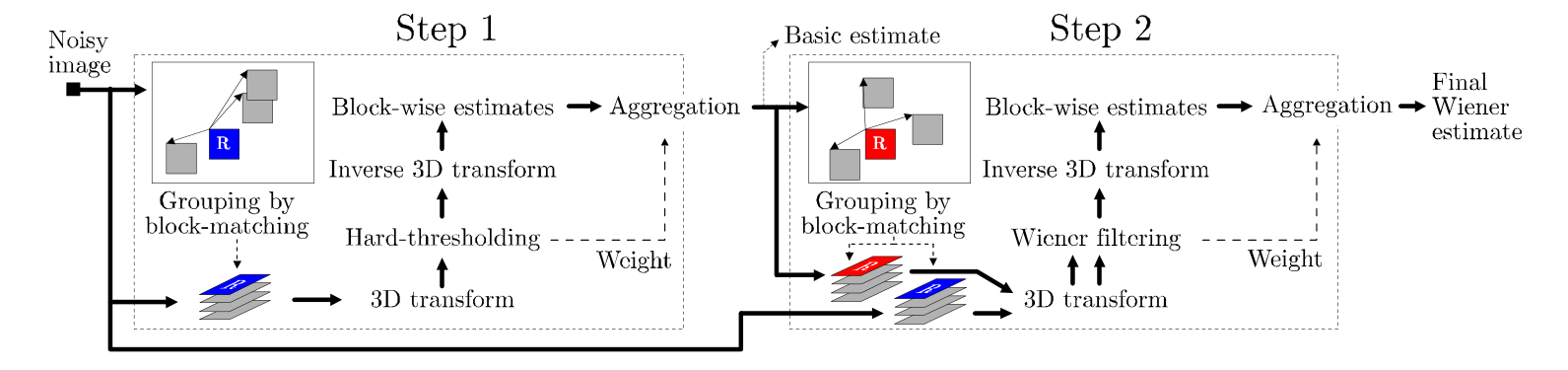
來源:Dabov 等人 [8],TIP 2007 接受後作者稿,PDF 第 5 頁、圖 3。原始 PDF。
第一階段:建立可用估計。 對每個參考區塊,在搜尋區域找到相似區塊並堆成群組 。可分離轉換 分別作用於區塊內與群組維度,對係數做閾值處理,再反轉換:
是含雜訊區塊群組, 是濾波後估計, 是三維轉換, 是假設的高斯雜訊標準差, 是閾值乘數。 把絕對值低於 的係數設為零。相似區塊的共同訊號集中到較少係數,其餘係數較可能是雜訊。再把濾波區塊放回原位置,以可靠度權重結合重疊估計,形成基礎影像估計。
第二階段:利用基礎估計,但不把它當真值。 在基礎估計中匹配區塊,依相同位置分別從基礎影像與原始含雜訊影像建立群組。在正交正規轉換的理想形式下,係數增益為
是基礎群組的第 個係數, 是對應的原始含雜訊係數, 是 Wiener 增益, 是濾波後係數。實作必須考慮所選轉換的雜訊變異數與正規化;此式用來解釋收縮原理。接著反轉換並再次聚合。若只濾波基礎影像,就錯誤捨棄了原圖顯示的原始量測路徑。
結果
表 III 比較測試影像與不同高斯雜訊強度下的灰階去雜訊 PSNR,圖 6–8 提供視覺比較,表 IV 則另外評估彩色擴充。證據適用於指定的加性雜訊模型與影像集合,不能直接推到任意原始相機雜訊、模糊或壓縮。論文也報告當時硬體的運算時間;未實際量測前,不能直接套用到現代 CPU 或函式庫實作。
消融與參數證據
表 II 在維持 Normal Profile 設定下改變轉換。群組軸只保留直流項的「DC-only」表現不如較完整的群組轉換:匹配區塊只是相似,不是完全相同,只留平均會損失有效差異。研究也指出,區塊內精確採用哪一種轉換,影響比直覺預期小。圖 9 比較參數設定檔,包含較強雜訊的設定。這些是受控設計比較;較快的設定改變品質與成本取捨,並不證明完整方法沒有必要。
結論
BM3D 結合自相似性與稀疏轉換域估計。NLM 主要平均相容觀測;BM3D 則能透過轉換係數,保留群組內的差異。它是實用、無須訓練的高斯去雜訊基準,也能幫助理解分組、收縮、聚合為何是三項不同的設計決定。
限制與問題
雜訊強度設錯,會同時改變匹配與收縮。嚴重雜訊可能讓不相關區塊看似相近,獨特結構則可能缺少匹配。聚合群組彼此重疊並共用觀測,因此誤差不獨立。彩色處理與訊號相依雜訊需要明確建模;灰階公式不會自動成為完整的相機雜訊流程。第二階段可改善估計,但無法保證恢復觀測未支持的細節。
參考文獻
- R. C. Gonzalez and R. E. Woods, Digital Image Processing, 4th ed., Pearson, 2018, Ch. 5. publisher page
- H. Hwang and R. A. Haddad, “Adaptive median filters: new algorithms and results,” IEEE Transactions on Image Processing, vol. 4, no. 4, pp. 499–502, 1995. DOI
- B. R. Hunt, “The application of constrained least squares estimation to image restoration by digital computer,” IEEE Transactions on Computers, vol. C-22, no. 9, pp. 805–812, 1973. DOI
- A. C. Kak and M. Slaney, Principles of Computerized Tomographic Imaging, IEEE Press, 1988 (SIAM reprint 2001). free online edition
- L. A. Shepp and B. F. Logan, “The Fourier reconstruction of a head section,” IEEE Transactions on Nuclear Science, vol. 21, no. 3, pp. 21–43, 1974. DOI
- scikit-image developers, “Radon transform,” scikit-image documentation (gallery example). docs
- A. Buades, B. Coll and J.-M. Morel, “A non-local algorithm for image denoising,” IEEE CVPR, vol. 2, pp. 60–65, 2005. DOI
- K. Dabov, A. Foi, V. Katkovnik and K. Egiazarian, “Image denoising by sparse 3-D transform-domain collaborative filtering,” IEEE Transactions on Image Processing, vol. 16, no. 8, pp. 2080–2095, 2007. DOI
- K. Zhang, W. Zuo, Y. Chen, D. Meng and L. Zhang, “Beyond a Gaussian denoiser: Residual learning of deep CNN for image denoising,” IEEE Transactions on Image Processing, vol. 26, no. 7, pp. 3142–3155, 2017. doi · arXiv
- C. Tian, L. Fei, W. Zheng, Y. Xu, W. Zuo and C.-W. Lin, “Deep learning on image denoising: An overview,” Neural Networks, vol. 131, pp. 251–275, 2020. arXiv
- M. Elad, B. Kawar and G. Vaksman, “Image denoising: The deep learning revolution and beyond — A survey paper,” SIAM Journal on Imaging Sciences, vol. 16, no. 3, pp. 1594–1654, 2023. arXiv
- K. Zhang, W. Ren, W. Luo, W.-S. Lai, B. Stenger, M.-H. Yang and H. Li, “Deep image deblurring: A survey,” International Journal of Computer Vision, 2022. arXiv
- G. Ongie, A. Jalal, C. A. Metzler, R. G. Baraniuk, A. G. Dimakis and R. Willett, “Deep learning techniques for inverse problems in imaging,” arXiv:2005.06001, 2020. arXiv
- U. S. Kamilov, C. A. Bouman, G. T. Buzzard and B. Wohlberg, “Plug-and-play methods for integrating physical and learned models in computational imaging: Theory, algorithms, and applications,” IEEE Signal Processing Magazine, vol. 40, no. 1, pp. 85–97, 2023. arXiv
- K. Zhang, Y. Li, W. Zuo, L. Zhang, L. Van Gool and R. Timofte, “Plug-and-play image restoration with deep denoiser prior,” IEEE Transactions on Pattern Analysis and Machine Intelligence, vol. 44, no. 10, pp. 6360–6376, 2022. arXiv
- K. H. Jin, M. T. McCann, E. Froustey and M. Unser, “Deep convolutional neural network for inverse problems in imaging,” IEEE Transactions on Image Processing, vol. 26, no. 9, pp. 4509–4522, 2017. arXiv
- J. Adler and O. Öktem, “Learned primal-dual reconstruction,” IEEE Transactions on Medical Imaging, 2018. arXiv
- V. Monga, Y. Li and Y. C. Eldar, “Algorithm unrolling: Interpretable, efficient deep learning for signal and image processing,” arXiv:1912.10557, 2019. arXiv
- G. Wang, J. C. Ye and B. De Man, “Deep learning for tomographic image reconstruction,” Nature Machine Intelligence, vol. 2, no. 12, pp. 737–748, 2020. DOI
- A. Buades, B. Coll and J.-M. Morel, “A review of image denoising algorithms, with a new one,” Multiscale Modeling & Simulation, vol. 4, no. 2, pp. 490–530, 2005. DOI
- L. I. Rudin, S. Osher and E. Fatemi, “Nonlinear total variation based noise removal algorithms,” Physica D: Nonlinear Phenomena, vol. 60, no. 1–4, pp. 259–268, 1992. DOI
- A. Chambolle, “An algorithm for total variation minimization and applications,” Journal of Mathematical Imaging and Vision, vol. 20, no. 1–2, pp. 89–97, 2004. DOI
- A. Buades, B. Coll and J.-M. Morel, “Non-Local Means Denoising,” Image Processing On Line, vol. 1, pp. 208–212, 2011. DOI · article and implementation