BM3D: denoise groups of similar patches collaboratively
Optional · paper guide 3 of 3 for IP 05 · Image Restoration and Reconstruction. Citation numbers refer to the reference list at the bottom of this page.
Navigate: this page and this track: Navigate: this page and this track
Challenge
A small patch can be difficult to denoise alone, yet several similar patches may share a compact representation. Dabov et al.’s TIP 2007 paper [8] makes that observation operational: group matching blocks, transform them together, suppress noise in the transform domain, and aggregate their overlapping estimates. The “3D” is a stack of two-dimensional image blocks, not a requirement for a volumetric image. Read NLM first to understand why distant patches can supply useful evidence.
Method
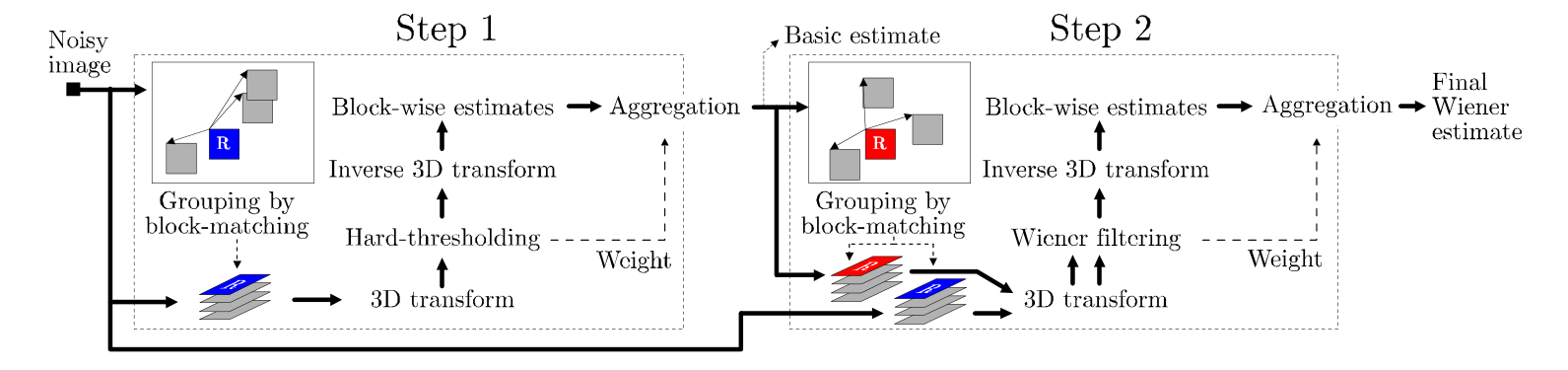
Source: Dabov et al. [8], TIP 2007 accepted author manuscript, PDF page 5, figure 3. Original PDF.
First pass: build a usable estimate. For each reference block, find similar blocks in a search region and stack them into a group . Apply a separable transform across each block and across the group dimension, threshold the coefficients, then invert:
is a group of noisy blocks, its filtered estimate, the three-dimensional transform, the assumed Gaussian noise standard deviation, and a threshold multiplier. sets coefficients with magnitude below to zero. Similar blocks concentrate their common signal into relatively few coefficients; the remaining coefficients are more likely to be noise. Return the filtered blocks to their original positions and combine overlapping estimates with reliability weights to form a basic image estimate.
Second pass: use the basic estimate without treating it as truth. Match blocks in the basic estimate. At those same locations, form groups from both the basic and original noisy images. In an orthonormal-transform idealization, a coefficient gain is
is coefficient from the basic group, the corresponding original noisy coefficient, the Wiener gain, and the filtered coefficient. The implementation must account for the selected transform’s noise variance/normalization; the expression explains the shrinkage principle. Invert the transform and aggregate again. Filtering only the basic image would incorrectly discard the original measurement path shown in the figure.
Results
Table III compares grayscale denoising PSNR across test images and Gaussian noise levels; figures 6–8 show visual comparisons. Table IV evaluates the color extension separately. The evidence is for the stated additive-noise models and image sets, not arbitrary raw-camera noise, blur or compression. The paper also reports computation on contemporary hardware; those times should not be transferred to a modern CPU or library implementation without measurement.
Ablations and parameter evidence
Table II changes the transforms while retaining the Normal Profile settings. Its “DC-only” group-axis transform performs poorly relative to richer group transforms: matching blocks are similar, not identical, so retaining only their average loses useful differences. The study also finds that the precise within-block transform matters less than one might expect. Figure 9 compares parameter profiles, including settings for stronger noise. These are controlled design comparisons; a faster profile changes the quality–cost trade-off rather than proving the full method unnecessary.
Conclusion
BM3D combines self-similarity with sparse transform-domain estimation. NLM mainly averages compatible observations; BM3D can retain variation within a group through transform coefficients. It is a useful training-free Gaussian-denoising baseline and a way to understand why grouping, shrinkage and aggregation are separate design decisions.
Problems
An incorrect noise level changes both matching and shrinkage. Severe noise can make unrelated blocks appear similar, while unique structures may have too few matches. Aggregated groups overlap and share observations, so their errors are not independent. Color handling and signal-dependent noise require explicit treatment; the grayscale formula is not automatically a complete camera-noise pipeline. The second pass improves an estimate but cannot guarantee recovery of details unsupported by the observation.
References
- R. C. Gonzalez and R. E. Woods, Digital Image Processing, 4th ed., Pearson, 2018, Ch. 5. publisher page
- H. Hwang and R. A. Haddad, “Adaptive median filters: new algorithms and results,” IEEE Transactions on Image Processing, vol. 4, no. 4, pp. 499–502, 1995. DOI
- B. R. Hunt, “The application of constrained least squares estimation to image restoration by digital computer,” IEEE Transactions on Computers, vol. C-22, no. 9, pp. 805–812, 1973. DOI
- A. C. Kak and M. Slaney, Principles of Computerized Tomographic Imaging, IEEE Press, 1988 (SIAM reprint 2001). free online edition
- L. A. Shepp and B. F. Logan, “The Fourier reconstruction of a head section,” IEEE Transactions on Nuclear Science, vol. 21, no. 3, pp. 21–43, 1974. DOI
- scikit-image developers, “Radon transform,” scikit-image documentation (gallery example). docs
- A. Buades, B. Coll and J.-M. Morel, “A non-local algorithm for image denoising,” IEEE CVPR, vol. 2, pp. 60–65, 2005. DOI
- K. Dabov, A. Foi, V. Katkovnik and K. Egiazarian, “Image denoising by sparse 3-D transform-domain collaborative filtering,” IEEE Transactions on Image Processing, vol. 16, no. 8, pp. 2080–2095, 2007. DOI
- K. Zhang, W. Zuo, Y. Chen, D. Meng and L. Zhang, “Beyond a Gaussian denoiser: Residual learning of deep CNN for image denoising,” IEEE Transactions on Image Processing, vol. 26, no. 7, pp. 3142–3155, 2017. doi · arXiv
- C. Tian, L. Fei, W. Zheng, Y. Xu, W. Zuo and C.-W. Lin, “Deep learning on image denoising: An overview,” Neural Networks, vol. 131, pp. 251–275, 2020. arXiv
- M. Elad, B. Kawar and G. Vaksman, “Image denoising: The deep learning revolution and beyond — A survey paper,” SIAM Journal on Imaging Sciences, vol. 16, no. 3, pp. 1594–1654, 2023. arXiv
- K. Zhang, W. Ren, W. Luo, W.-S. Lai, B. Stenger, M.-H. Yang and H. Li, “Deep image deblurring: A survey,” International Journal of Computer Vision, 2022. arXiv
- G. Ongie, A. Jalal, C. A. Metzler, R. G. Baraniuk, A. G. Dimakis and R. Willett, “Deep learning techniques for inverse problems in imaging,” arXiv:2005.06001, 2020. arXiv
- U. S. Kamilov, C. A. Bouman, G. T. Buzzard and B. Wohlberg, “Plug-and-play methods for integrating physical and learned models in computational imaging: Theory, algorithms, and applications,” IEEE Signal Processing Magazine, vol. 40, no. 1, pp. 85–97, 2023. arXiv
- K. Zhang, Y. Li, W. Zuo, L. Zhang, L. Van Gool and R. Timofte, “Plug-and-play image restoration with deep denoiser prior,” IEEE Transactions on Pattern Analysis and Machine Intelligence, vol. 44, no. 10, pp. 6360–6376, 2022. arXiv
- K. H. Jin, M. T. McCann, E. Froustey and M. Unser, “Deep convolutional neural network for inverse problems in imaging,” IEEE Transactions on Image Processing, vol. 26, no. 9, pp. 4509–4522, 2017. arXiv
- J. Adler and O. Öktem, “Learned primal-dual reconstruction,” IEEE Transactions on Medical Imaging, 2018. arXiv
- V. Monga, Y. Li and Y. C. Eldar, “Algorithm unrolling: Interpretable, efficient deep learning for signal and image processing,” arXiv:1912.10557, 2019. arXiv
- G. Wang, J. C. Ye and B. De Man, “Deep learning for tomographic image reconstruction,” Nature Machine Intelligence, vol. 2, no. 12, pp. 737–748, 2020. DOI
- A. Buades, B. Coll and J.-M. Morel, “A review of image denoising algorithms, with a new one,” Multiscale Modeling & Simulation, vol. 4, no. 2, pp. 490–530, 2005. DOI
- L. I. Rudin, S. Osher and E. Fatemi, “Nonlinear total variation based noise removal algorithms,” Physica D: Nonlinear Phenomena, vol. 60, no. 1–4, pp. 259–268, 1992. DOI
- A. Chambolle, “An algorithm for total variation minimization and applications,” Journal of Mathematical Imaging and Vision, vol. 20, no. 1–2, pp. 89–97, 2004. DOI
- A. Buades, B. Coll and J.-M. Morel, “Non-Local Means Denoising,” Image Processing On Line, vol. 1, pp. 208–212, 2011. DOI · article and implementation