現代觀點綜述詳讀
選讀・IP 05・影像復原與重建 的論文導讀(第 1/3 篇)。引用編號對應本頁底部的參考文獻。
導覽:本頁與本系列: 導覽:本頁與本系列
本頁內容
- 去雜訊
- Tian 等人,〈Deep learning on image denoising: An overview〉(2020)
- Elad、Kawar 與 Vaksman,〈Image Denoising: The Deep Learning Revolution and Beyond〉(2023)
- 去模糊與一般反問題
- Zhang 等人,〈Deep Image Deblurring: A Survey〉(IJCV 2022)
- Ongie 等人,〈Deep Learning Techniques for Inverse Problems in Imaging〉(2020)
- Kamilov、Bouman、Buzzard 與 Wohlberg,〈Plug-and-Play Methods for Integrating Physical and Learned Models in Computational Imaging〉(2023)
- CT 重建
- 後處理:
- 展開式(學習式迭代)重建:
- Wang、Ye 與 De Man,〈Deep learning for tomographic image reconstruction〉(2020)
- 如何判讀這些論文的證據
- 參考文獻
影像處理
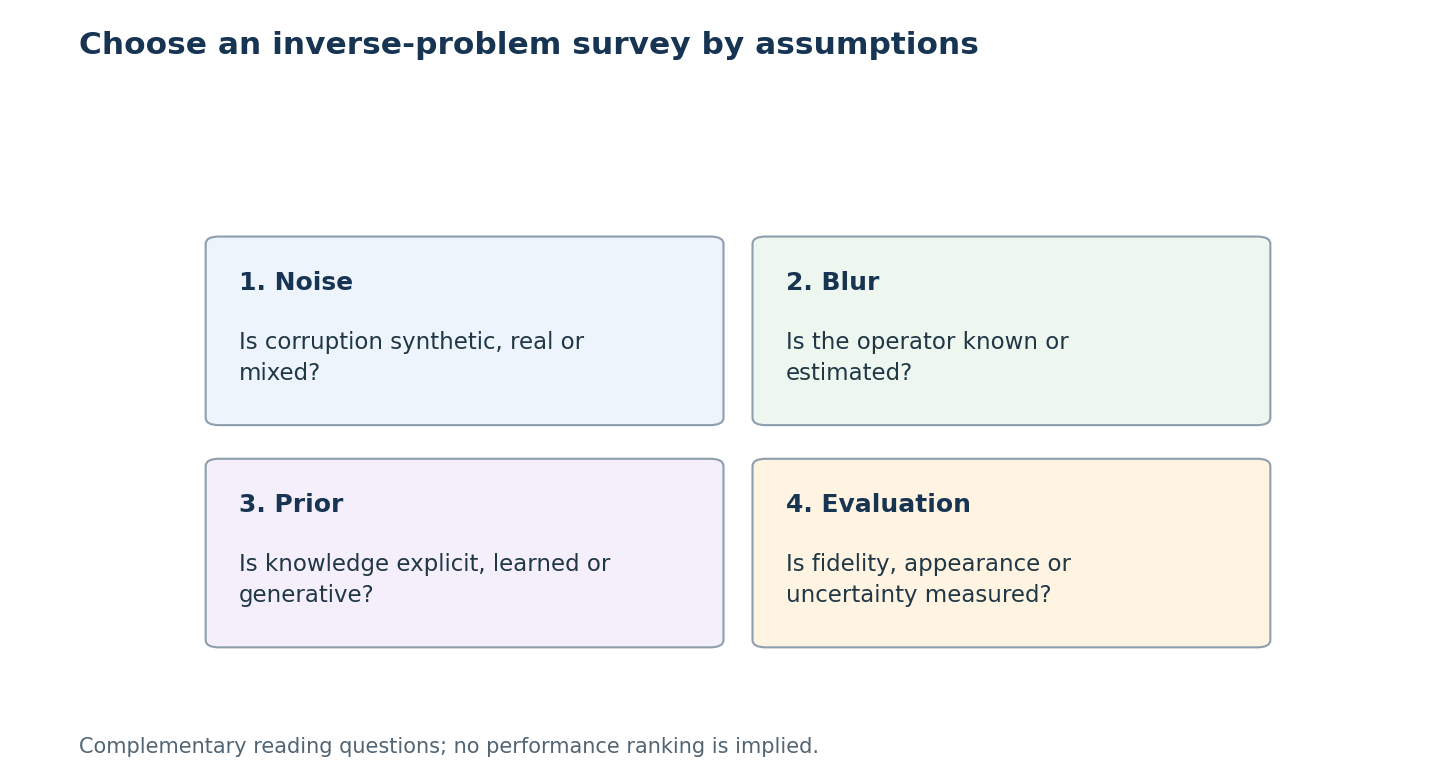
依雜訊、模糊、已知算子與先驗需求選擇反問題綜述,並一起檢查資料與評估假設。
去雜訊
Tian 等人,〈Deep learning on image denoising: An overview〉(2020)
[10]。把 CNN 去雜訊方法分成四類:加成性白高斯雜訊、真實(相機)雜訊、盲去雜訊(雜訊未知),以及同時含有模糊或低解析度的混合情況。重點(我們的解讀):這個分類本身就是依雜訊類型組織的,真實相機雜訊與未知雜訊強度被列為和合成高斯雜訊不同的類別。本章的雜訊模型以及它有多貼近真實,在深度去雜訊中依然關鍵。
Elad、Kawar 與 Vaksman,〈Image Denoising: The Deep Learning Revolution and Beyond〉(2023)
[11]。回顧從經典先驗到深度去雜訊器的歷史,並主張去雜訊器的意義遠超過去雜訊本身:好的去雜訊器可以當作解其他反問題時的先驗,也是擴散式影像生成的引擎。重點:本章「只有雜訊」的經典問題,已經成為幾乎所有其他問題的基本構件。
去模糊與一般反問題
Zhang 等人,〈Deep Image Deblurring: A Survey〉(IJCV 2022)
[12]。涵蓋模糊成因、資料集與評估指標,再依架構與損失函數整理以 CNN 為基礎的非盲與盲去模糊方法,以及特定領域(人臉、文字、立體影像)。重點:非盲去模糊(如本章, 已知)主要在對付我們在逆濾波看到的雜訊放大與振鈴;盲去模糊還得估計 ,至今仍是比較難的問題。
Ongie 等人,〈Deep Learning Techniques for Inverse Problems in Imaging〉(2020)
[13]。為任何 問題提出分類:前向模型 在訓練時已知、只在測試時已知,還是完全未知?訓練是監督式還是非監督式?重點(我們的解讀):對 了解多少,是第一個設計決策,綜述也討論了這些方法的失效模式。像本章這樣已知 ,就能使用純端對端網路忽略掉的選項。
Kamilov、Bouman、Buzzard 與 Wohlberg,〈Plug-and-Play Methods for Integrating Physical and Learned Models in Computational Imaging〉(2023)
[14]。回顧隨插即用(plug-and-play, PnP)先驗:在「滿足物理()」的步驟與「呼叫去雜訊器(代替先驗)」的步驟之間交替的迭代演算法。重點:前向模型和學習式先驗可以分開開發,執行時再組合。DPIR [15] 是廣泛使用的例子,它把深度 CNN 去雜訊器插入半二次分裂(half-quadratic splitting)演算法,用於去模糊、超解析度與去馬賽克。
CT 重建
後處理:
先做 FBP,再用 CNN 去除偽影。FBPConvNet [16] 正是用 CNN 這樣做,並報告在稀疏視角 CT 上比全變分重建品質更好,而執行時間只需一小部分。
展開式(學習式迭代)重建:
取一個迭代演算法,固定迭代次數,把每次迭代的部分步驟換成小型網路,再端對端訓練。Learned Primal-Dual [17] 展開一個原始-對偶(primal-dual)演算法,並在每次迭代中保留前向投影與反投影。Monga、Li 與 Eldar,〈Algorithm Unrolling〉(2019) [18] 綜述了這種設計模式在訊號與影像處理中的應用。重點:由於每一層都對應演算法的一個步驟,展開式網路比通用網路更容易解讀,也更有效率。
Wang、Ye 與 De Man,〈Deep learning for tomographic image reconstruction〉(2020)
[19] 回顧 CT 及其他斷層成像模態的全貌:影像域、感測器域與混合式網路、融入物理的設計,以及資料取得、穩健性與臨床驗證等開放問題。
如何判讀這些論文的證據
最有用的比較是各方法假設什麼,而非發表年份。去雜訊可按雜訊類型分類,去模糊可按架構、模糊形成分類,反問題可區分明確算子與學習映射,擴散又需分開條件訓練與測試時概似引導。分類軸可以交叉,同一方法落入不同類別不代表綜述矛盾。
逐項記錄推論知道什麼、退化/乾淨影像如何建構。已知模糊核不能證明盲式能力,合成高斯雜訊不代表所有感測器。先用綜述找不同問題表述,再讀原方法與流程;歷史表格把分數並列,不等於共用資料的受控實驗。
參考文獻
- R. C. Gonzalez and R. E. Woods, Digital Image Processing, 4th ed., Pearson, 2018, Ch. 5. publisher page
- H. Hwang and R. A. Haddad, “Adaptive median filters: new algorithms and results,” IEEE Transactions on Image Processing, vol. 4, no. 4, pp. 499–502, 1995. DOI
- B. R. Hunt, “The application of constrained least squares estimation to image restoration by digital computer,” IEEE Transactions on Computers, vol. C-22, no. 9, pp. 805–812, 1973. DOI
- A. C. Kak and M. Slaney, Principles of Computerized Tomographic Imaging, IEEE Press, 1988 (SIAM reprint 2001). free online edition
- L. A. Shepp and B. F. Logan, “The Fourier reconstruction of a head section,” IEEE Transactions on Nuclear Science, vol. 21, no. 3, pp. 21–43, 1974. DOI
- scikit-image developers, “Radon transform,” scikit-image documentation (gallery example). docs
- A. Buades, B. Coll and J.-M. Morel, “A non-local algorithm for image denoising,” IEEE CVPR, vol. 2, pp. 60–65, 2005. DOI
- K. Dabov, A. Foi, V. Katkovnik and K. Egiazarian, “Image denoising by sparse 3-D transform-domain collaborative filtering,” IEEE Transactions on Image Processing, vol. 16, no. 8, pp. 2080–2095, 2007. DOI
- K. Zhang, W. Zuo, Y. Chen, D. Meng and L. Zhang, “Beyond a Gaussian denoiser: Residual learning of deep CNN for image denoising,” IEEE Transactions on Image Processing, vol. 26, no. 7, pp. 3142–3155, 2017. doi · arXiv
- C. Tian, L. Fei, W. Zheng, Y. Xu, W. Zuo and C.-W. Lin, “Deep learning on image denoising: An overview,” Neural Networks, vol. 131, pp. 251–275, 2020. arXiv
- M. Elad, B. Kawar and G. Vaksman, “Image denoising: The deep learning revolution and beyond — A survey paper,” SIAM Journal on Imaging Sciences, vol. 16, no. 3, pp. 1594–1654, 2023. arXiv
- K. Zhang, W. Ren, W. Luo, W.-S. Lai, B. Stenger, M.-H. Yang and H. Li, “Deep image deblurring: A survey,” International Journal of Computer Vision, 2022. arXiv
- G. Ongie, A. Jalal, C. A. Metzler, R. G. Baraniuk, A. G. Dimakis and R. Willett, “Deep learning techniques for inverse problems in imaging,” arXiv:2005.06001, 2020. arXiv
- U. S. Kamilov, C. A. Bouman, G. T. Buzzard and B. Wohlberg, “Plug-and-play methods for integrating physical and learned models in computational imaging: Theory, algorithms, and applications,” IEEE Signal Processing Magazine, vol. 40, no. 1, pp. 85–97, 2023. arXiv
- K. Zhang, Y. Li, W. Zuo, L. Zhang, L. Van Gool and R. Timofte, “Plug-and-play image restoration with deep denoiser prior,” IEEE Transactions on Pattern Analysis and Machine Intelligence, vol. 44, no. 10, pp. 6360–6376, 2022. arXiv
- K. H. Jin, M. T. McCann, E. Froustey and M. Unser, “Deep convolutional neural network for inverse problems in imaging,” IEEE Transactions on Image Processing, vol. 26, no. 9, pp. 4509–4522, 2017. arXiv
- J. Adler and O. Öktem, “Learned primal-dual reconstruction,” IEEE Transactions on Medical Imaging, 2018. arXiv
- V. Monga, Y. Li and Y. C. Eldar, “Algorithm unrolling: Interpretable, efficient deep learning for signal and image processing,” arXiv:1912.10557, 2019. arXiv
- G. Wang, J. C. Ye and B. De Man, “Deep learning for tomographic image reconstruction,” Nature Machine Intelligence, vol. 2, no. 12, pp. 737–748, 2020. DOI
- A. Buades, B. Coll and J.-M. Morel, “A review of image denoising algorithms, with a new one,” Multiscale Modeling & Simulation, vol. 4, no. 2, pp. 490–530, 2005. DOI
- L. I. Rudin, S. Osher and E. Fatemi, “Nonlinear total variation based noise removal algorithms,” Physica D: Nonlinear Phenomena, vol. 60, no. 1–4, pp. 259–268, 1992. DOI
- A. Chambolle, “An algorithm for total variation minimization and applications,” Journal of Mathematical Imaging and Vision, vol. 20, no. 1–2, pp. 89–97, 2004. DOI
- A. Buades, B. Coll and J.-M. Morel, “Non-Local Means Denoising,” Image Processing On Line, vol. 1, pp. 208–212, 2011. DOI · article and implementation