現代觀點綜述詳讀
選讀・IP 08・影像壓縮與浮水印 的論文導讀(第 1/1 篇)。引用編號對應本頁底部的參考文獻。
導覽:本頁與本系列: 導覽:本頁與本系列
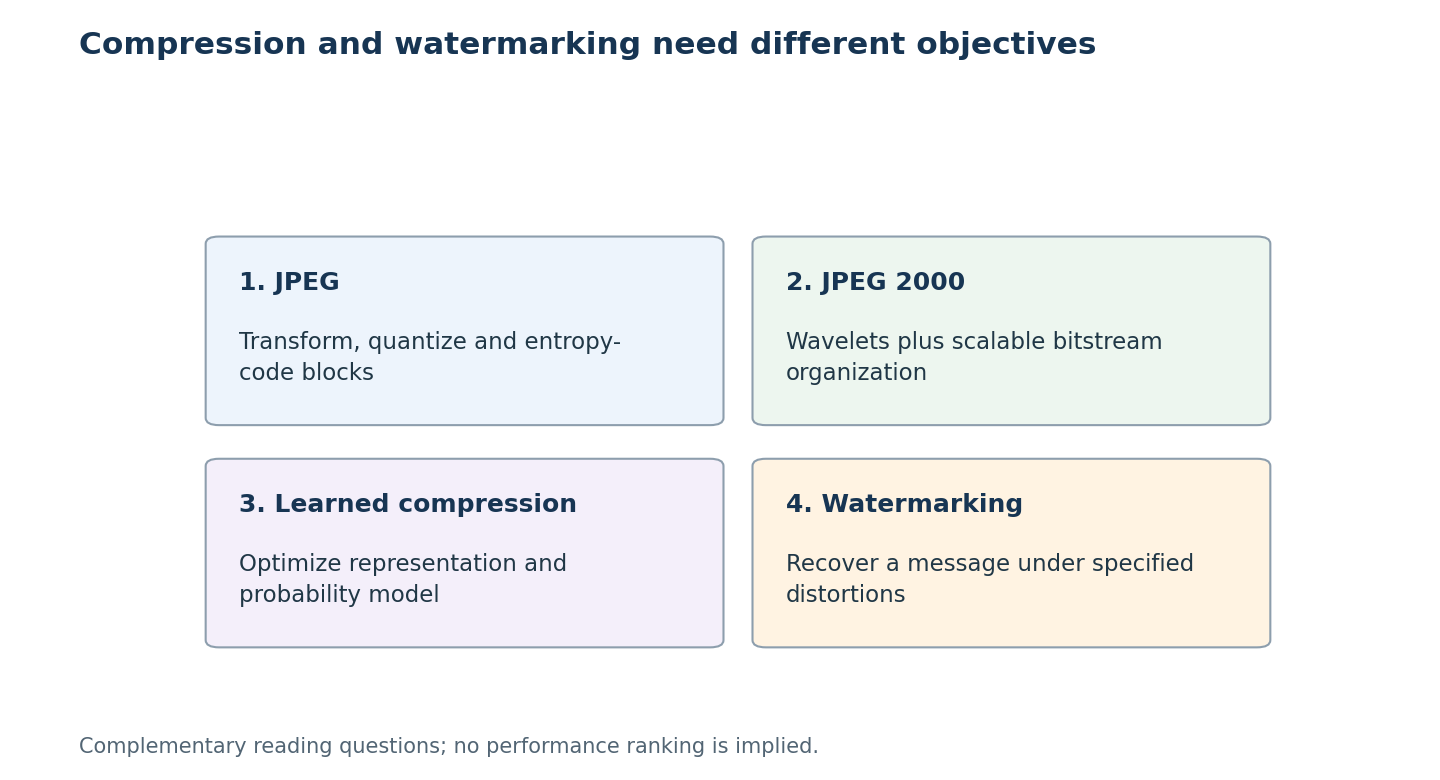
壓縮要比較位元率與失真,浮水印還要檢查負載及擷取可靠度;先確認要評估的目標。
Wallace(1992)
[13] 仍是 JPEG 設計最清楚的概述:DCT、量化表、之字形排序,以及霍夫曼與算術編碼兩種選項。適合搭配區塊轉換編碼一節閱讀。
Skodras、Christopoulos 與 Ebrahimi(2001)
[14] 是 JPEG 2000 的教學型回顧:tile 切割、9/7 與 5/3 小波、死區量化、編碼區塊的位元平面編碼與位元率控制。重點是:JPEG 2000 的價值與其說在單純的壓縮效率,不如說在功能——可分級性、感興趣區域編碼,以及在同一個位元流中支援無失真。
Hu、Yang、Ma 與 Liu(2021)
[16] 沿著網路架構、熵模型與位元率控制三個軸向綜述端到端學習式有失真影像壓縮,整理各自的里程碑,並在 CPU 與 GPU 上評測代表性方法。他們自己提出的由粗到細超先驗(coarse-to-fine hyperprior)也呼應了綜述的主軸:許多進展在於熵模型能多準確地預測潛在表示。
Yang、Mandt 與 Theis(2023)
[17] 是一本專書篇幅的神經壓縮入門,寫給機器學習讀者。它先回顧所需的資訊理論(熵編碼、率失真理論)以及影像品質與感知度量,再帶讀者認識以正規化流、變分自編碼器、擴散模型與 GAN 建構的編解碼器。
Zhong、Das、Alrasheedi 與 Tanvir(2023)
[18] 綜述深度學習影像浮水印,將方法分成三類:聯合訓練的嵌入器—擷取器網路、把網路當作特徵轉換再搭配傳統嵌入規則,以及兩者混合。
如何判讀這些論文的證據
壓縮須比較完整率失真行為,不能只看轉換或重建分數。位元率要包含表示與傳送的輔助資訊;學得機率模型只有在編解碼器一致、必要位元都被計入時才構成壓縮改善。解碼速度、記憶體與實作限制也需要獨立評估。
浮水印則要求在指定攻擊或處理通道後恢復訊息,須一起報負載、視覺失真與擷取可靠度。通過某個 JPEG 品質或縮放,不代表任意編輯都可靠;不易察覺也不證明真實性、安全性。先用綜述分類尋找符合目標的基準,再重現原編碼或攻擊流程,才能判讀改善。
參考文獻
- R. C. Gonzalez and R. E. Woods, Digital Image Processing, 4th ed., Pearson, 2018, Ch. 8. publisher page
- Joint Photographic Experts Group, “JPEG 1 (ISO/IEC 10918-1 | ITU-T Rec. T.81): Digital compression and coding of continuous-tone still images,” JPEG overview page. jpeg.org
- Joint Photographic Experts Group, “JPEG 2000 (ISO/IEC 15444),” JPEG overview page. jpeg.org
- W3C, “Portable Network Graphics (PNG) Specification (Third Edition),” W3C Recommendation, 2025. w3.org
- Joint Photographic Experts Group, “JPEG XL (ISO/IEC 18181),” JPEG overview page. jpeg.org
- Alliance for Open Media, “AV1 Image File Format (AVIF),” v1.2.0, 2025. aomediacodec.github.io
- Nokia Technologies, “High Efficiency Image File Format (HEIF), ISO/IEC 23008-12: technical information.” nokiatech.github.io
- D. A. Huffman, “A Method for the Construction of Minimum-Redundancy Codes,” Proceedings of the IRE, vol. 40, pp. 1098–1101, 1952. doi
- S. W. Golomb, “Run-length encodings,” IEEE Transactions on Information Theory, vol. 12, pp. 399–401, 1966. doi
- M. J. Weinberger, G. Seroussi and G. Sapiro, “The LOCO-I lossless image compression algorithm: principles and standardization into JPEG-LS,” IEEE Transactions on Image Processing, vol. 9, pp. 1309–1324, 2000. doi
- I. H. Witten, R. M. Neal and J. G. Cleary, “Arithmetic coding for data compression,” Communications of the ACM, vol. 30, pp. 520–540, 1987. doi
- T. A. Welch, “A Technique for High-Performance Data Compression,” Computer, vol. 17, pp. 8–19, 1984. doi
- G. K. Wallace, “The JPEG still picture compression standard,” IEEE Transactions on Consumer Electronics, vol. 38, no. 1, pp. xviii–xxxiv, 1992. doi
- A. Skodras, C. Christopoulos and T. Ebrahimi, “The JPEG 2000 still image compression standard,” IEEE Signal Processing Magazine, vol. 18, pp. 36–58, 2001. doi
- J. Ballé, D. Minnen, S. Singh, S. J. Hwang and N. Johnston, “Variational image compression with a scale hyperprior,” ICLR, 2018. arXiv
- Y. Hu, W. Yang, Z. Ma and J. Liu, “Learning End-to-End Lossy Image Compression: A Benchmark,” IEEE Transactions on Pattern Analysis and Machine Intelligence, 2021. arXiv
- Y. Yang, S. Mandt and L. Theis, “An Introduction to Neural Data Compression,” Foundations and Trends in Computer Graphics and Vision, vol. 15, no. 2, 2023. arXiv
- X. Zhong, A. Das, F. Alrasheedi and A. Tanvir, “A Brief Yet In-Depth Survey of Deep Learning-Based Image Watermarking,” Applied Sciences, 2023. arXiv
- J. Zhu, R. Kaplan, J. Johnson and L. Fei-Fei, “HiDDeN: Hiding Data With Deep Networks,” arXiv:1807.09937, 2018. arXiv
- P. Fernandez, G. Couairon, H. Jégou, M. Douze and T. Furon, “The Stable Signature: Rooting Watermarks in Latent Diffusion Models,” ICCV, 2023. arXiv