The Modern view surveys in more detail
Optional · paper guide 1 of 1 for IP 08 · Image Compression and Watermarking. Citation numbers refer to the reference list at the bottom of this page.
Navigate: this page and this track: Navigate: this page and this track
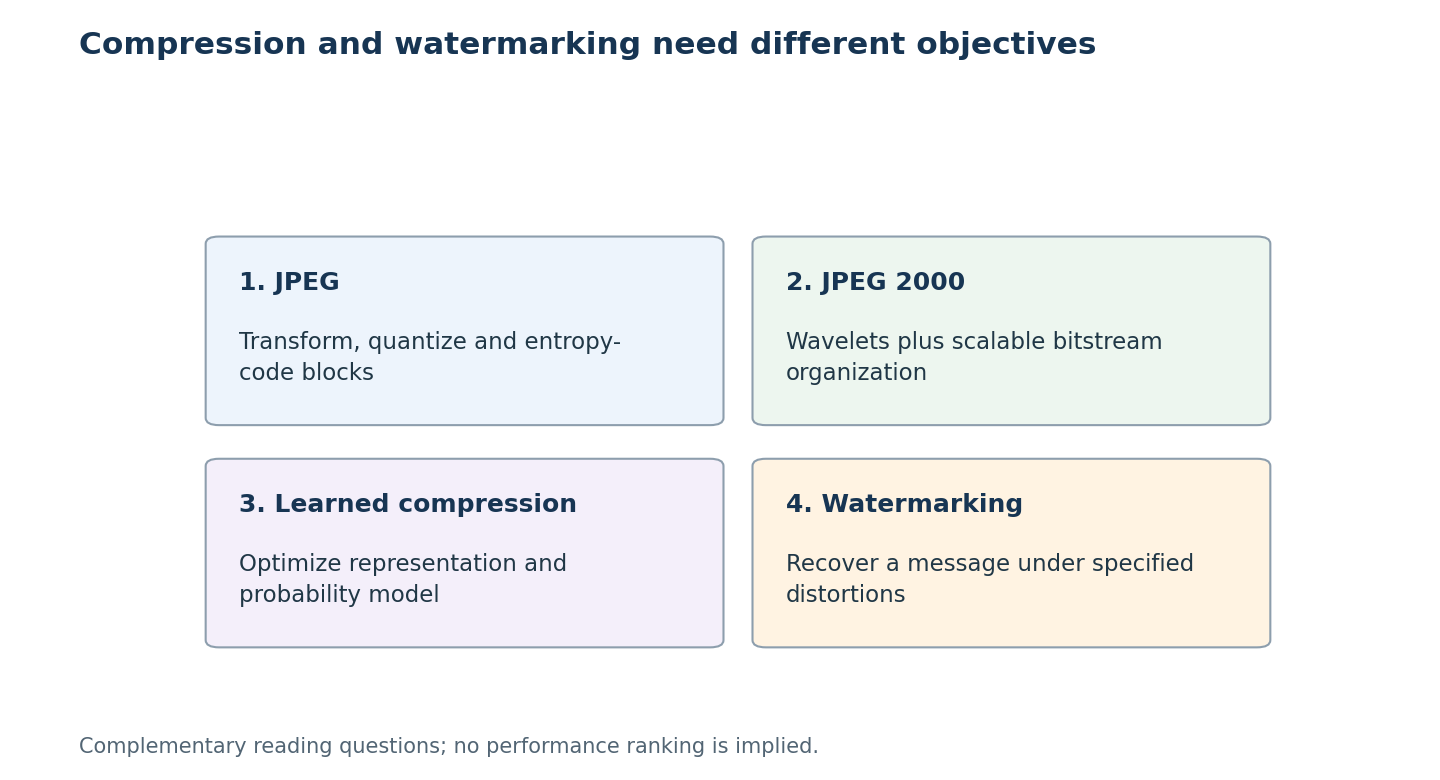
Choose a reading by its objective: coding rate and distortion, learned probability models, or watermark payload and recovery reliability.
Wallace (1992)
[13] remains the clearest overview of JPEG’s design: the DCT, quantization tables, zigzag ordering, and the Huffman and arithmetic options. It is the right companion to the block transform section.
Skodras, Christopoulos and Ebrahimi (2001)
[14] is a tutorial review of JPEG 2000: tiling, the 9/7 and 5/3 wavelets, dead-zone quantization, code-block bit-plane coding and rate control. Its main takeaway is that JPEG 2000’s value lies less in raw efficiency than in features: scalability, region-of-interest coding and lossless operation in one bit stream.
Hu, Yang, Ma and Liu (2021)
[16] survey end-to-end learned lossy image compression along three axes, network architecture, entropy model and rate control, trace the milestones of each, and benchmark representative methods on CPU and GPU. Their own contribution, a coarse-to-fine hyperprior, illustrates the survey’s central theme: much of the progress lies in how well the entropy model predicts the latent representation.
Yang, Mandt and Theis (2023)
[17] is a monograph-length introduction to neural compression for a machine-learning audience. It reviews the information theory (entropy coding, rate-distortion theory) and the image-quality and perceptual metrics you need, then guides the reader through codecs built on normalizing flows, variational autoencoders, diffusion models and GANs.
Zhong, Das, Alrasheedi and Tanvir (2023)
[18] survey deep-learning image watermarking and sort methods into three families: jointly trained embedder–extractor networks, networks used as feature transforms around a classical embedding rule, and hybrids.
Reading these papers critically
For compression, compare complete rate–distortion behavior rather than a transform or a reconstruction score alone. The rate must include the coded representation and any transmitted side information. Learned probability models improve coding only when encoder and decoder agree on the same distribution and when the evaluation counts the necessary bits. Decoder speed, memory and implementation constraints are additional axes, not consequences of a favorable distortion score.
Watermarking solves a different problem: preserving or recovering a payload after a defined attack or processing channel. Report payload, visual distortion and extraction reliability together. Robustness to the tested JPEG quality or resize does not establish robustness to arbitrary editing, and imperceptibility does not prove authenticity or security. These surveys are therefore best read as a map of objectives and system components. Use their taxonomies to find an appropriate baseline, then reproduce the original coding or attack protocol before comparing a claimed improvement.
References
- R. C. Gonzalez and R. E. Woods, Digital Image Processing, 4th ed., Pearson, 2018, Ch. 8. publisher page
- Joint Photographic Experts Group, “JPEG 1 (ISO/IEC 10918-1 | ITU-T Rec. T.81): Digital compression and coding of continuous-tone still images,” JPEG overview page. jpeg.org
- Joint Photographic Experts Group, “JPEG 2000 (ISO/IEC 15444),” JPEG overview page. jpeg.org
- W3C, “Portable Network Graphics (PNG) Specification (Third Edition),” W3C Recommendation, 2025. w3.org
- Joint Photographic Experts Group, “JPEG XL (ISO/IEC 18181),” JPEG overview page. jpeg.org
- Alliance for Open Media, “AV1 Image File Format (AVIF),” v1.2.0, 2025. aomediacodec.github.io
- Nokia Technologies, “High Efficiency Image File Format (HEIF), ISO/IEC 23008-12: technical information.” nokiatech.github.io
- D. A. Huffman, “A Method for the Construction of Minimum-Redundancy Codes,” Proceedings of the IRE, vol. 40, pp. 1098–1101, 1952. doi
- S. W. Golomb, “Run-length encodings,” IEEE Transactions on Information Theory, vol. 12, pp. 399–401, 1966. doi
- M. J. Weinberger, G. Seroussi and G. Sapiro, “The LOCO-I lossless image compression algorithm: principles and standardization into JPEG-LS,” IEEE Transactions on Image Processing, vol. 9, pp. 1309–1324, 2000. doi
- I. H. Witten, R. M. Neal and J. G. Cleary, “Arithmetic coding for data compression,” Communications of the ACM, vol. 30, pp. 520–540, 1987. doi
- T. A. Welch, “A Technique for High-Performance Data Compression,” Computer, vol. 17, pp. 8–19, 1984. doi
- G. K. Wallace, “The JPEG still picture compression standard,” IEEE Transactions on Consumer Electronics, vol. 38, no. 1, pp. xviii–xxxiv, 1992. doi
- A. Skodras, C. Christopoulos and T. Ebrahimi, “The JPEG 2000 still image compression standard,” IEEE Signal Processing Magazine, vol. 18, pp. 36–58, 2001. doi
- J. Ballé, D. Minnen, S. Singh, S. J. Hwang and N. Johnston, “Variational image compression with a scale hyperprior,” ICLR, 2018. arXiv
- Y. Hu, W. Yang, Z. Ma and J. Liu, “Learning End-to-End Lossy Image Compression: A Benchmark,” IEEE Transactions on Pattern Analysis and Machine Intelligence, 2021. arXiv
- Y. Yang, S. Mandt and L. Theis, “An Introduction to Neural Data Compression,” Foundations and Trends in Computer Graphics and Vision, vol. 15, no. 2, 2023. arXiv
- X. Zhong, A. Das, F. Alrasheedi and A. Tanvir, “A Brief Yet In-Depth Survey of Deep Learning-Based Image Watermarking,” Applied Sciences, 2023. arXiv
- J. Zhu, R. Kaplan, J. Johnson and L. Fei-Fei, “HiDDeN: Hiding Data With Deep Networks,” arXiv:1807.09937, 2018. arXiv
- P. Fernandez, G. Couairon, H. Jégou, M. Douze and T. Furon, “The Stable Signature: Rooting Watermarks in Latent Diffusion Models,” ICCV, 2023. arXiv