The Modern view in more detail
Optional · paper guide 1 of 1 for IP 07 · Wavelet and Other Image Transforms. Citation numbers refer to the reference list at the bottom of this page.
Navigate: this page and this track: Navigate: this page and this track
On this page
- Foundations: Mallat (1989) and Daubechies (1988)
- Textbook-length survey: Vetterli and Kovačević (1995)
- What makes a wavelet good: Unser and Blu (2003)
- From bases to dictionaries: Rubinstein, Bruckstein and Elad (2010)
- The standard in practice: Skodras, Christopoulos and Ebrahimi (2001)
- Classical denoising theory: Donoho and Johnstone; Chang, Yu and Vetterli
- Reading these papers critically
- References
Image Processing
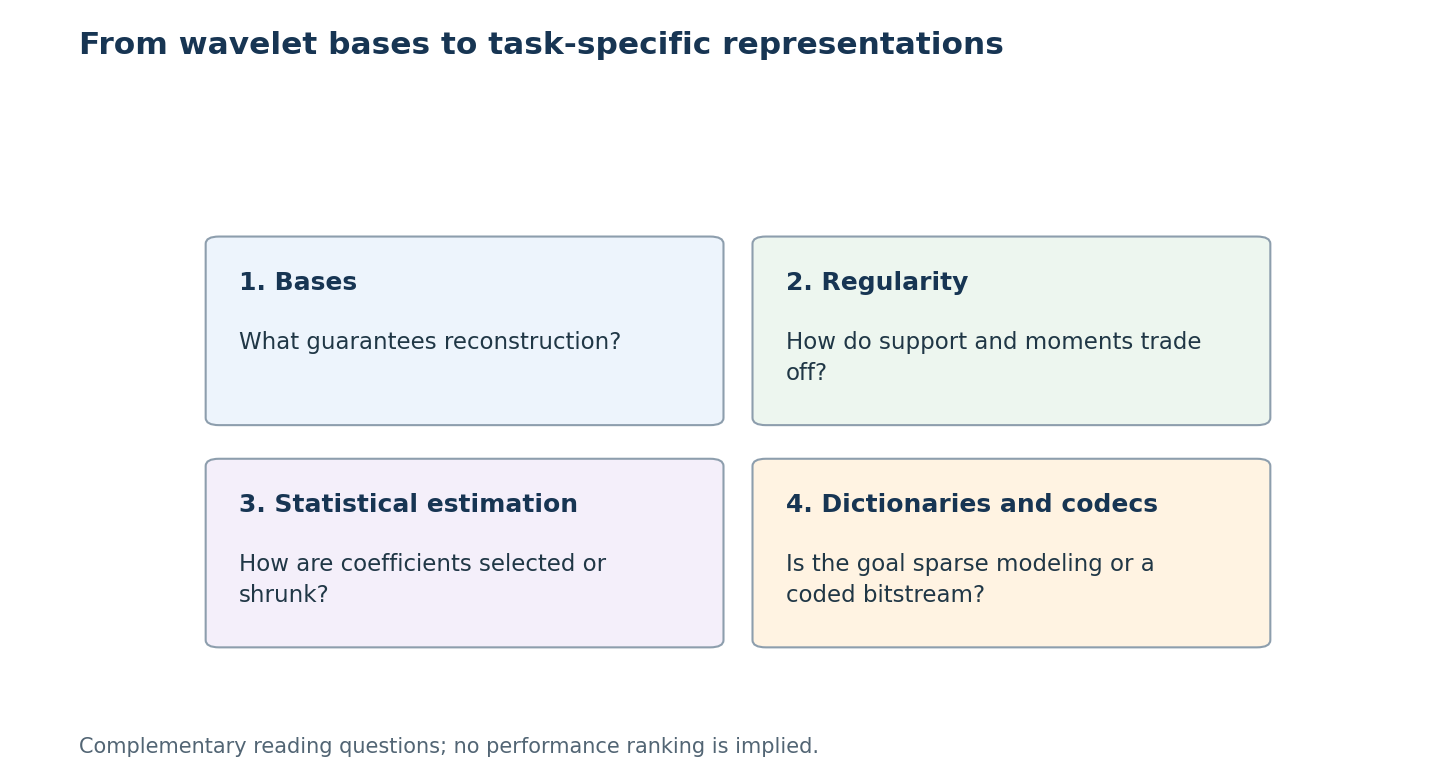
Choose a reading by what you need: wavelet-basis guarantees, denoising estimators, sparse dictionaries, or a complete compression system.
Foundations: Mallat (1989) and Daubechies (1988)
Mallat’s paper [7] introduced multiresolution analysis for images, the link between orthonormal wavelets and two-channel filter banks, and the pyramid algorithm that makes the transform . It also introduced the 2-D separable decomposition into horizontal, vertical and diagonal bands that every library still uses. Daubechies [8] provided the missing piece: orthonormal wavelets with compact support and a chosen amount of smoothness, which made the filters short and practical. Together they explain why pywt.wavedec2(img, "db4") exists at all.
Textbook-length survey: Vetterli and Kovačević (1995)
Wavelets and Subband Coding [2] builds the theory from the signal-processing side: filter banks, perfect reconstruction, time–frequency tilings, and coding. The authors bought back the copyright and distribute the book freely, which makes it the best open reference for the filter-bank view in this chapter.
What makes a wavelet good: Unser and Blu (2003)
“Wavelet theory demystified” [9] rebuilds the classical theory in a self-contained way by writing any scaling function as a B-spline convolved with a residual “irregular” part. Its main takeaway is that the B-spline factor alone is responsible for five properties practitioners care about: order of approximation, reproduction of polynomials, vanishing moments, the multiscale differentiation property, and smoothness. If you want to know why db4 behaves better than Haar on smooth images, this is the paper that explains it.
From bases to dictionaries: Rubinstein, Bruckstein and Elad (2010)
“Dictionaries for sparse representation modeling” [16] surveys the move from analytic transforms (Fourier, DCT, wavelets and their directional successors) to dictionaries learned from data. Its takeaway is the bridge to modern methods: the wavelet idea of “a few coefficients explain the image” survived, but the basis became something you can train. This line of work leads directly into learned priors for restoration.
The standard in practice: Skodras, Christopoulos and Ebrahimi (2001)
Their overview of JPEG 2000 [15] shows how the DWT, biorthogonal filters, subband quantization and embedded coding fit together in a real codec, and what features (resolution scalability, region-of-interest coding, lossless mode) multiresolution makes possible.
Classical denoising theory: Donoho and Johnstone; Chang, Yu and Vetterli
The shrinkage papers [12], [13], [14] showed that a simple nonlinearity in the wavelet domain is close to optimal over broad classes of signals, and that adapting the threshold per subband helps in practice. Every “denoise by thresholding a transform” method, including many hand-crafted priors used before deep learning, descends from these results.
Scattering networks. Bruna and Mallat’s wavelet scattering transform [17] cascades wavelet convolutions with a modulus nonlinearity and averaging. It is a convolutional network whose filters are fixed wavelets rather than learned, and the authors prove that it is stable to small deformations and locally translation invariant. The first layer behaves like SIFT-type descriptors, and higher layers add information that can tell apart textures with the same Fourier power spectrum. It gave state-of-the-art results on handwritten digit and texture classification at the time and became a reference point for explaining why CNNs work: a wavelet frame (redundant, as in the Preliminaries) plus a simple nonlinearity already yields invariance.
Wavelets as pooling and downsampling layers. Strided convolution and max-pooling downsample without proper low-pass filtering, so they alias. Li et al. replaced these operations with DWT layers in standard classifiers (WaveCNet) and kept only the low-frequency band, which improved robustness to noise [19]. In restoration, Liu et al.’s MWCNN replaces the pooling and unpooling of a U-Net with the 2-D DWT and its inverse [18]. Because the DWT is invertible, no information is lost when the network shrinks the feature maps, and the network gets a large receptive field cheaply. The same idea, an invertible and alias-aware down-sampler, appears in many later restoration and generation models.
Large receptive fields. Finder et al.’s WTConv layer (ECCV 2024) applies small convolutions to the subbands of a multilevel DWT, so the effective receptive field grows exponentially with the number of levels while parameters grow only logarithmically with kernel size [20]. It works as a drop-in layer in architectures such as ConvNeXt and MobileNetV2, and the authors report better robustness to image corruptions and a stronger response to shapes over textures.
Reading these papers critically
A basis construction, a denoising risk result and a compression standard are different kinds of evidence. Basis papers establish reconstruction and regularity properties. Statistical denoising analyses specify a signal/noise class and an estimator. Dictionary work changes the representation and often the optimization problem. JPEG 2000 combines transforms with quantization, entropy coding and bitstream organization; a wavelet alone is not a complete codec.
When comparing a wavelet with a learned representation, fix the task and account for every stage needed to use it. Sparsity without a coding model does not determine compressed size, and a thresholding result under white noise does not automatically hold for correlated or signal-dependent corruption. Inspect boundary extension, coefficient normalization and decimation because they affect both reconstruction and artifacts. Use the foundational papers for guarantees, the estimation papers for assumptions about noise and risk, and the codec/dictionary references for the system that turns coefficients into a practical output.
References
- R. C. Gonzalez and R. E. Woods, Digital Image Processing, 4th ed., Pearson, 2018, Ch. 7. publisher page
- M. Vetterli and J. Kovačević, Wavelets and Subband Coding, Prentice Hall, 1995 (free edition from the authors). book site
- N. Ahmed, T. Natarajan and K. R. Rao, “Discrete Cosine Transform,” IEEE Transactions on Computers, 1974. doi
- G. K. Wallace, “The JPEG still picture compression standard,” IEEE Transactions on Consumer Electronics, 1992. doi
- W. K. Pratt, J. Kane and H. C. Andrews, “Hadamard transform image coding,” Proceedings of the IEEE, 1969. doi
- W. K. Pratt, W.-H. Chen and L. R. Welch, “Slant transform image coding,” IEEE Transactions on Communications, 1974. doi
- S. G. Mallat, “A theory for multiresolution signal decomposition: the wavelet representation,” IEEE Transactions on Pattern Analysis and Machine Intelligence, 1989. doi
- I. Daubechies, “Orthonormal bases of compactly supported wavelets,” Communications on Pure and Applied Mathematics, 1988. doi
- M. Unser and T. Blu, “Wavelet theory demystified,” IEEE Transactions on Signal Processing, 2003. doi
- G. R. Lee, R. Gommers, F. Waselewski, K. Wohlfahrt and A. O’Leary, “PyWavelets: A Python package for wavelet analysis,” Journal of Open Source Software, 2019. doi
- R. R. Coifman and M. V. Wickerhauser, “Entropy-based algorithms for best basis selection,” IEEE Transactions on Information Theory, 1992. doi
- D. L. Donoho and I. M. Johnstone, “Ideal spatial adaptation by wavelet shrinkage,” Biometrika, 1994. doi
- D. L. Donoho, “De-noising by soft-thresholding,” IEEE Transactions on Information Theory, 1995. doi
- S. G. Chang, B. Yu and M. Vetterli, “Adaptive wavelet thresholding for image denoising and compression,” IEEE Transactions on Image Processing, 2000. doi
- A. Skodras, C. Christopoulos and T. Ebrahimi, “The JPEG 2000 still image compression standard,” IEEE Signal Processing Magazine, 2001. doi
- R. Rubinstein, A. M. Bruckstein and M. Elad, “Dictionaries for sparse representation modeling,” Proceedings of the IEEE, 2010. doi
- J. Bruna and S. Mallat, “Invariant scattering convolution networks,” arXiv:1203.1513, 2012. arXiv
- P. Liu, H. Zhang, K. Zhang, L. Lin and W. Zuo, “Multi-level wavelet-CNN for image restoration,” CVPR Workshops (NTIRE), 2018. arXiv
- Q. Li, L. Shen, S. Guo and Z. Lai, “Wavelet integrated CNNs for noise-robust image classification,” CVPR, 2020. arXiv
- S. E. Finder, R. Amoyal, E. Treister and O. Freifeld, “Wavelet convolutions for large receptive fields,” ECCV, 2024. arXiv
- PyWavelets developers, “Signal extension modes,” PyWavelets documentation, accessed 5 November 2026. Documentation.